Yuan Haidong, Su Jie, Zhang Siyu, Di Jiayu, Lin Zhenhua, Zhang Jincheng, Zhang Jie, Chang Jingjing, Hao Yue
State Key Discipline Laboratory of Wide Band Gap Semiconductor Technology, Shaanxi Joint Key Laboratory of Graphene, School of Microelectronics, Xidian University, 2 South Taibai Road, Xi'an, 710071 China.
Jiangsu Key Lab of Advanced Food Manufacturing Equipment and Technology, Jiangnan University, Wuxi, 214122 China.
iScience. 2022 Feb 4;25(3):103872. doi: 10.1016/j.isci.2022.103872. eCollection 2022 Mar 18.
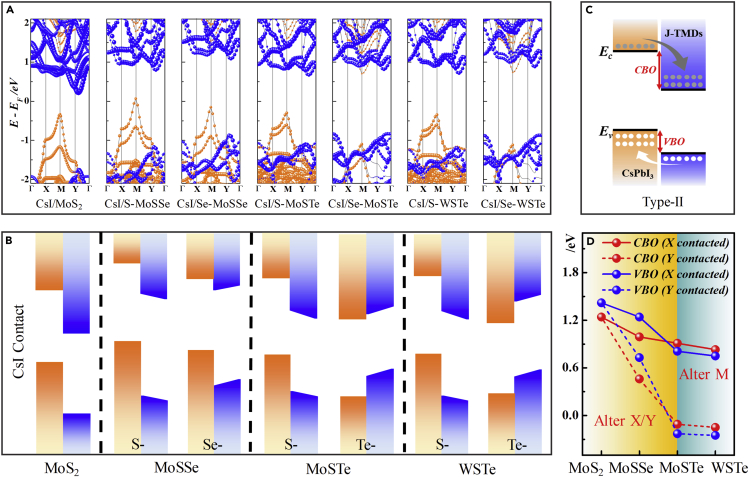
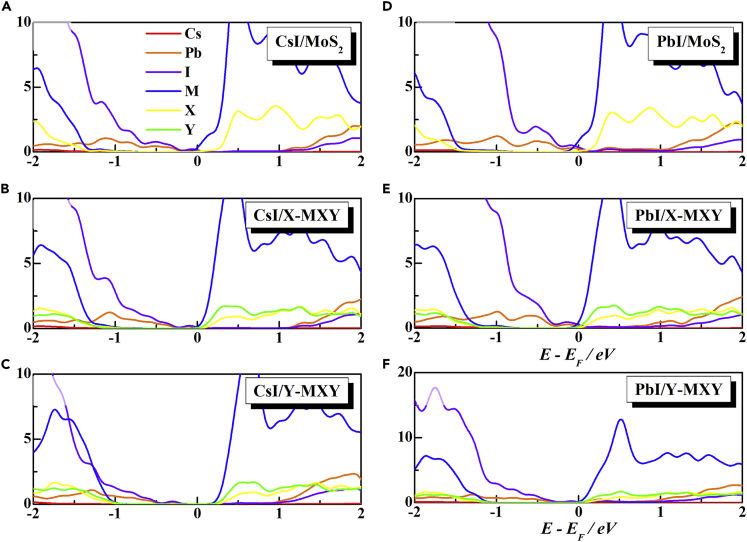
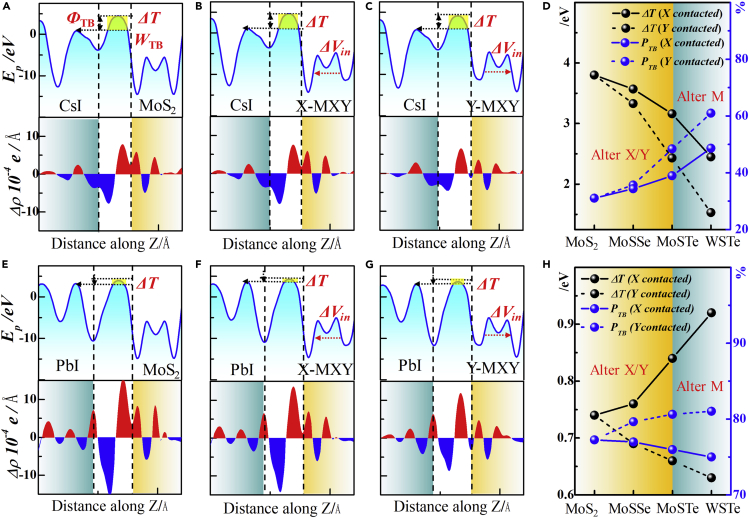
Although perovskite/two-dimensional (2D) materials heterojunctions have been employed to improve the optoelectronic performance of perovskite photodetectors and solar cells, effects of the intrinsic potential difference ( ) of asymmetrical 2D materials, like Janus TMDs (J-TMDs), were not revealed yet. Herein, by investigating the optoelectronic properties of CsPbI/J-TMDs heterojunctions, we find a reversible type-II band alignment related to the intensity and direction of , suggesting that carrier transport paths can be reversed by modulating the contact configuration of J-TMDs in the heterojunctions. Meanwhile, the band offset, carrier transfer efficiency and optical properties of those heterojunctions are directly determined by the intensity and direction of . Overall, CsPbI/MoSSe heterojunction is suggested in this work with a tunneling probability of 79.65%. Our work unveils the role of in asymmetrical 2D materials on the optoelectronic performances of lead halide perovskite devices, and provides a guideline to design high performance perovskite optoelectronic devices.
尽管钙钛矿/二维(2D)材料异质结已被用于改善钙钛矿光电探测器和太阳能电池的光电性能,但不对称二维材料(如Janus过渡金属二卤化物(J-TMDs))的内禀电势差( )的影响尚未揭示。在此,通过研究CsPbI/J-TMDs异质结的光电特性,我们发现了一种与 的强度和方向相关的可逆II型能带排列,这表明通过调制异质结中J-TMDs的接触构型可以反转载流子传输路径。同时,这些异质结的能带偏移、载流子转移效率和光学性质直接由 的强度和方向决定。总体而言,本工作中提出的CsPbI/MoSSe异质结的隧穿概率为79.65%。我们的工作揭示了不对称二维材料中的 对卤化铅钙钛矿器件光电性能的作用,并为设计高性能钙钛矿光电器件提供了指导。