
撒哈拉以南非洲地区的肥胖与慢性肾脏病:一篇综述
Obesity and CKD in Sub-Saharan Africa: A Narrative Review.
作者信息
Oluyombo Rotimi, Banjo Oguntade Hameed, Soje Michael, Obajolowo Omotola, Karim Mahzuz
机构信息
Department of Renal Medicine, Norfolk and Norwich Hospital, Norwich, United Kingdom.
Department of Internal Medicine, Federal Teaching Hospital, Ido-Ekiti, Ekiti State, Nigeria.
出版信息
Kidney Med. 2021 Dec 22;4(2):100403. doi: 10.1016/j.xkme.2021.11.001. eCollection 2022 Feb.
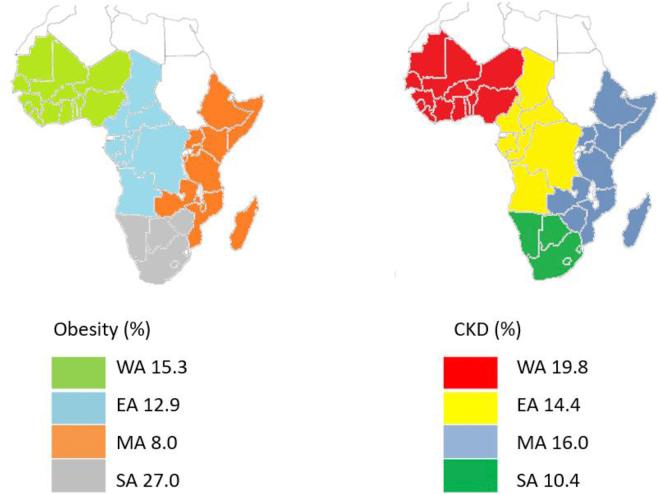
Obesity is a major public health problem in the developed world, where it has reached an epidemic status over the last few decades. In parallel with this, the prevalence of chronic kidney disease (CKD) has increased. Although obesity is a risk factor for hypertension and diabetes, it is also independently associated with the development and progression of CKD. Two-third of patients with CKD worldwide will be residents of developing countries by the year 2030. Risk factors for CKD are prevalent in the sub-Saharan Africa region; this review discusses the available data regarding the relationship between obesity and CKD. The prevalence of CKD appears to correlate with increasing adiposity in sub-Saharan Africa; however, limited data are currently available, and the analysis of this association is further complicated by a variety of parameters used to define obesity. (eg, body mass index vs waist circumference). Longer, large-scale studies are needed to inform the prevalence and kidney implications of obesity in sub-Saharan Africa.
肥胖是发达国家的一个主要公共卫生问题,在过去几十年里已达到流行程度。与此同时,慢性肾脏病(CKD)的患病率有所上升。尽管肥胖是高血压和糖尿病的危险因素,但它也与CKD的发生和进展独立相关。到2030年,全球三分之二的CKD患者将是发展中国家的居民。CKD的危险因素在撒哈拉以南非洲地区普遍存在;本综述讨论了关于肥胖与CKD之间关系的现有数据。在撒哈拉以南非洲,CKD的患病率似乎与肥胖程度的增加相关;然而,目前可用的数据有限,而且用于定义肥胖的各种参数(如体重指数与腰围)使这种关联的分析更加复杂。需要进行更长期的大规模研究,以了解撒哈拉以南非洲肥胖的患病率及其对肾脏的影响。



 Zotero 插件