Department of Chemical Engineering, Imperial College London, London SW7 2AZ, United Kingdom.
Imperial College Centre for Synthetic Biology, Imperial College London, London SW7 2AZ, United Kingdom.
ACS Synth Biol. 2022 Mar 18;11(3):1303-1312. doi: 10.1021/acssynbio.1c00577. Epub 2022 Mar 4.
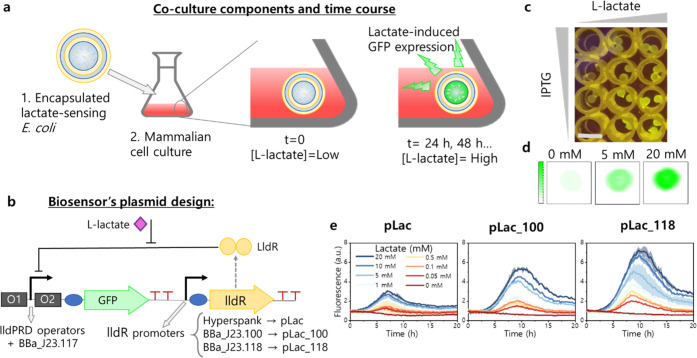
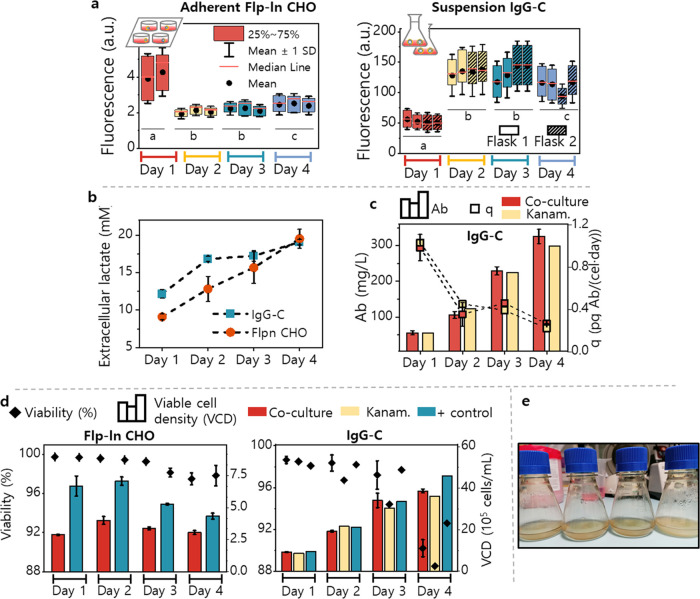
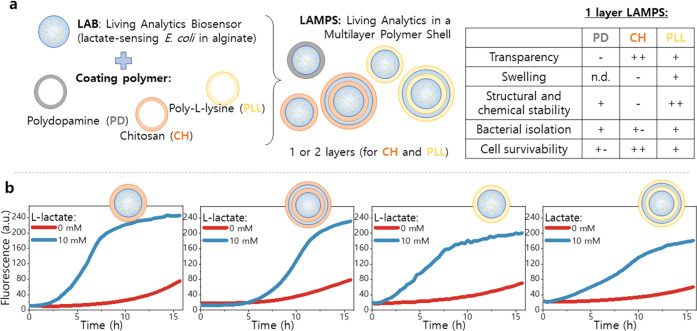
Coexistence of different populations of cells and isolation of tasks can provide enhanced robustness and adaptability or impart new functionalities to a culture. However, generating stable cocultures involving cells with vastly different growth rates can be challenging. To address this, we developed living analytics in a multilayer polymer shell (LAMPS), an encapsulation method that facilitates the coculture of mammalian and bacterial cells. We leverage LAMPS to preprogram a separation of tasks within the coculture: growth and therapeutic protein production by the mammalian cells and l-lactate biosensing by encapsulated within LAMPS. LAMPS enable the formation of a synthetic bacterial-mammalian cell interaction that enables a living biosensor to be integrated into a biomanufacturing process. Our work serves as a proof-of-concept for further applications in bioprocessing since LAMPS combine the simplicity and flexibility of a bacterial biosensor with a viable method to prevent runaway growth that would disturb mammalian cell physiology.
不同细胞群体的共存和任务的隔离可以为培养物提供增强的鲁棒性和适应性,或者赋予其新的功能。然而,产生涉及生长速度差异很大的细胞的稳定共培养物可能具有挑战性。为了解决这个问题,我们开发了多层聚合物壳中的活分析(LAMPS),这是一种封装方法,可促进哺乳动物细胞和细菌细胞的共培养。我们利用 LAMPS 预先在共培养物中分配任务:哺乳动物细胞的生长和治疗性蛋白质生产以及封装在 LAMPS 内的 l-乳酸生物传感。LAMPS 使合成的细菌-哺乳动物细胞相互作用得以形成,从而可以将活体生物传感器集成到生物制造过程中。我们的工作为在生物加工中的进一步应用提供了概念验证,因为 LAMPS 将细菌生物传感器的简单性和灵活性与一种可行的方法结合在一起,可以防止干扰哺乳动物细胞生理学的失控生长。