Department of Cardiovascular Surgery, 30635Lausanne University Hospital (CHUV), Switzerland.
Department of Anaesthesiology, 30635Lausanne University Hospital (CHUV), Switzerland.
Perfusion. 2023 Mar;38(2):425-427. doi: 10.1177/02676591211056564. Epub 2022 Mar 4.
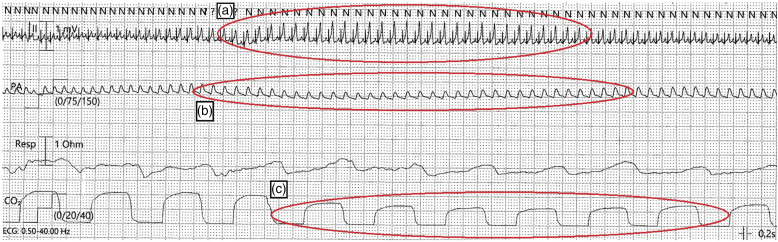
Few patients with coronavirus disease 2019-associated severe acute respiratory distress syndrome (ARDS) require veno-venous extracorporeal membrane oxygenation (VV-ECMO). Prolonged VV-ECMO support necessitates repeated oxygenator replacement, increasing the risk for complications. Transient hypoxemia, induced by VV-ECMO stop needed for this procedure, may induce transient myocardial ischemia and acutely declining cardiac output in critically ill patients without residual pulmonary function. This is amplified by additional activation of the sympathetic nervous system (tachycardia, pulmonary vasoconstriction, and increased systemic vascular resistance). Immediate reinjection of the priming solution of the new circuit and induced acute iatrogenic anemia are other potentially reinforcing factors. The case of a critically ill patient presented here provides an instructive illustration of the hemodynamic relationships occurring during VV-ECMO support membrane oxygenator exchange.
在 COVID-19 相关的严重急性呼吸窘迫综合征(ARDS)患者中,很少需要静脉-静脉体外膜肺氧合(VV-ECMO)治疗。长时间的 VV-ECMO 支持需要反复更换氧合器,增加了并发症的风险。在没有残余肺功能的危重病患者中,VV-ECMO 停止以进行此操作诱导的短暂低氧血症可能会导致短暂的心肌缺血和心输出量急剧下降。这种情况会因交感神经系统的进一步激活(心动过速、肺血管收缩和全身血管阻力增加)而加剧。新回路的预充液的立即再注入和诱导的急性医源性贫血是其他潜在的增强因素。本文介绍的危重病患者的病例提供了一个在 VV-ECMO 支持膜氧合器交换过程中发生的血流动力学关系的教学说明。