Frances Payne Bolton School of Nursing, Case Western Reserve University, Cleveland, OH; Critical Care Transport, Cleveland Clinic, Cleveland, OH.
Critical Care Transport, Cleveland Clinic, Cleveland, OH.
Air Med J. 2022 Jan-Feb;41(1):42-46. doi: 10.1016/j.amj.2021.09.008. Epub 2021 Oct 27.
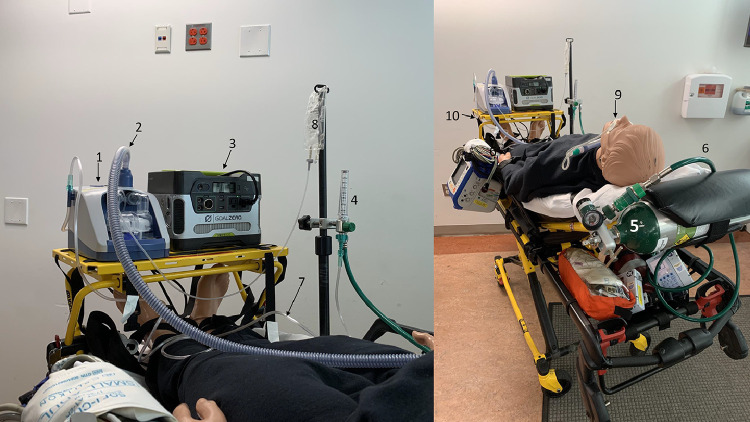
The current coronavirus disease 2019 pandemic has increased interest in the use of high-flow nasal cannula (HFNC) in the transport setting. The purpose of this report was to outline the clinical workflow of using HFNC in transport and the results of a retrospective chart review of patients undergoing interhospital transfer on HFNC.
We conducted a retrospective chart review of all patient transfers using HFNC between January 2018 and June 2019. The primary data abstracted from patient charts included patient demographics, transport distance, HFNC settings including flow rate in liters per minute and fraction of inspired oxygen (Fio), and vital signs.
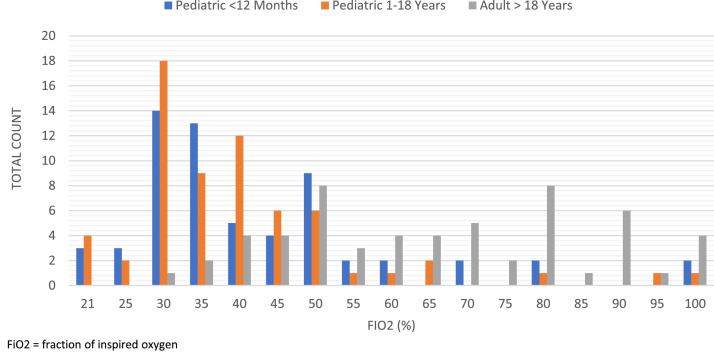
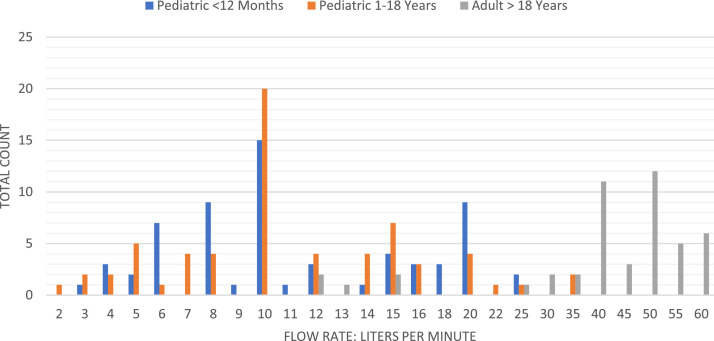
There was a total of 220 patients, 148 pediatric and 72 adult patients. Both pediatric groups experienced statistically significant reductions in heart rate, systolic blood pressure, and diastolic blood pressure. The most common flow rate for both pediatric groups was 10 L/min and 50 L/min for adults. For pediatrics, the most common settings ranged between 30% and 50% Fio, with the most common setting being 30% Fio. The adult Fio settings ranged from 30% to 100% Fio, with the 2 most common settings being 50% Fio and 80% Fio. No patients were intubated during the transport encounter.
Our study provides evidence that HFNC is feasible and tolerated by patients and is an additional option for noninvasive ventilation in transport across the age continuum. Future studies are needed to compare HFNC with other noninvasive modalities that include assessing patient tolerance and comfort as contributing factors and to identify indications and contraindications for use in the transport setting.
当前的 2019 年冠状病毒病疫情增加了人们对高流量鼻导管(HFNC)在转运环境中应用的兴趣。本报告的目的是概述在转运中使用 HFNC 的临床工作流程,以及对接受 HFNC 进行医院间转院的患者进行回顾性图表审查的结果。
我们对 2018 年 1 月至 2019 年 6 月期间使用 HFNC 进行的所有患者转院进行了回顾性图表审查。从患者图表中提取的主要数据包括患者人口统计学信息、转运距离、HFNC 设置,包括流量(升/分钟)和吸入氧分数(Fio)以及生命体征。
共有 220 例患者,148 例儿科患者和 72 例成人患者。两组儿科患者的心率、收缩压和舒张压均有统计学显著降低。两个儿科组最常见的流量均为 10 L/min,成人组最常见的流量为 50 L/min。对于儿科患者,最常见的设置范围为 30%至 50% Fio,最常见的设置为 30% Fio。成人 Fio 设置范围为 30%至 100% Fio,最常见的设置为 50% Fio 和 80% Fio。在转运过程中没有患者需要插管。
我们的研究提供了证据表明,HFNC 是可行的,患者能够耐受,并且是跨年龄范围的转运中无创通气的另一种选择。未来的研究需要比较 HFNC 与其他包括评估患者耐受性和舒适度作为影响因素的无创模式,并确定在转运环境中使用的适应证和禁忌证。