Wang Ke, Zhao Wei, Li Ji, Shu Weiwei, Duan Jun
Department of Respiratory and Critical Care Medicine, The Second Affiliated Hospital of Chongqing Medical University, Chongqing, 400010, People's Republic of China.
Department of Oncology, The Second Affiliated Hospital of Chongqing Medical University, Chongqing, 400010, People's Republic of China.
Ann Intensive Care. 2020 Mar 30;10(1):37. doi: 10.1186/s13613-020-00653-z.
The outbreak of a novel coronavirus (2019-nCoV)-infected pneumonia (NCIP) is currently ongoing in China. Most of the critically ill patients received high-flow nasal cannula (HFNC) oxygen therapy. However, the experience of HFNC in this population is lacking.
We retrospectively screened 318 confirmed patients with NCIP in two hospitals of Chongqing, China, from January 1st to March 4th, 2020. Among them, 27 (8.4%) patients experienced severe acute respiratory failure including 17 patients (63%) treated with HFNC as first-line therapy, 9 patients (33%) treated with noninvasive ventilation (NIV) and one patient (4%) treated with invasive ventilation. HFNC failure was defined by the need of NIV or intubation as rescue therapy.
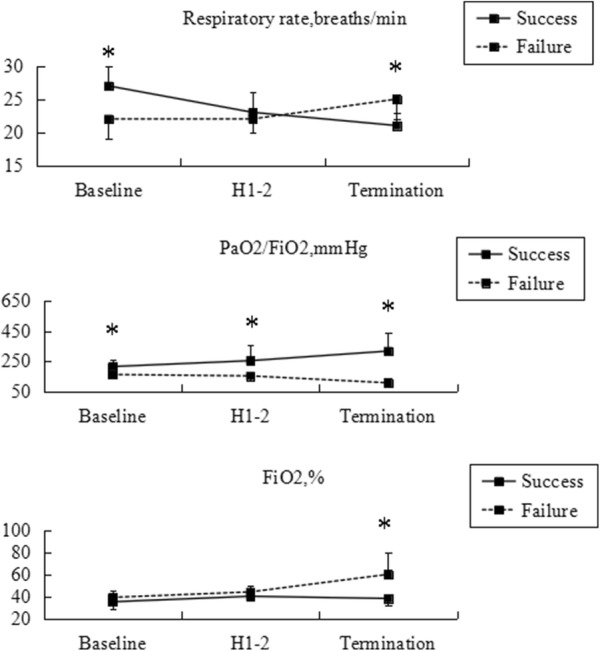
Of the 17 HFNC patients, 7 (41%) experienced HFNC failure. The HFNC failure rate was 0% (0/6) in patients with PaO/FiO > 200 mm Hg vs. 63% (7/11) in those with PaO/FiO ≤ 200 mm Hg (p = 0.04). Compared with baseline data, the respiratory rate significantly decreased after 1-2 h of HFNC in successful group [median 26 (IQR: 25-29) vs. 23 (22-25), p = 0.03]. However, it did not in the unsuccessful group. After initiation of NIV as rescue therapy among the 7 patients with HFNC failure, PaO/FiO significantly improved after 1-2 h of NIV [median 172 (150-208) mmHg vs. 114 (IQR: 79-130) under HFNC, p = 0.04]. However, two out of seven (29%) patients with NIV as rescue therapy ultimately received intubation. Among the 27 patients with severe acute respiratory failure, four patients were eventually intubated (15%).
Our study indicated that HFNC was the most common ventilation support for patients with NCIP. Patients with lower PaO/FiO were more likely to experience HFNC failure.
新型冠状病毒(2019 - nCoV)感染的肺炎(NCIP)疫情目前正在中国蔓延。大多数重症患者接受了高流量鼻导管(HFNC)氧疗。然而,该人群中HFNC的应用经验尚缺。
我们回顾性筛选了2020年1月1日至3月4日在中国重庆两家医院确诊的318例NCIP患者。其中,27例(8.4%)患者发生严重急性呼吸衰竭,包括17例(63%)接受HFNC作为一线治疗的患者、9例(33%)接受无创通气(NIV)治疗的患者和1例(4%)接受有创通气治疗的患者。HFNC失败定义为需要NIV或插管作为挽救治疗。
17例HFNC患者中,7例(41%)发生HFNC失败。PaO/FiO > 200 mmHg的患者HFNC失败率为0%(0/6),而PaO/FiO ≤ 200 mmHg的患者中失败率为63%(7/11)(p = 0.04)。与基线数据相比,成功组HFNC治疗1 - 2小时后呼吸频率显著下降[中位数26(四分位间距:25 - 29)对23(22 - 25),p = 0.03]。然而,失败组未出现这种情况。在7例HFNC失败患者中开始NIV作为挽救治疗后,NIV治疗1 - 2小时后PaO/FiO显著改善[中位数172(150 - 208)mmHg对比HFNC下的114(四分位间距:79 - 130),p = 0.04]。然而,7例接受NIV作为挽救治疗的患者中有2例(29%)最终接受了插管。在27例严重急性呼吸衰竭患者中,4例最终接受了插管(15%)。
我们的研究表明,HFNC是NCIP患者最常用的通气支持方式。PaO/FiO较低的患者更易发生HFNC失败。