Demerath Peter, Kemper Sara, Yousuf Eskender, Banwo Bodunrin
Department of Organizational Leadership, Policy and Development, College of Education and Human Development, University of Minnesota, 206 Burton Hall, 178 Pillsbury Dr, Minneapolis, MN 55455 USA.
Haverford College, Haverford, USA.
Urban Rev. 2022;54(5):703-732. doi: 10.1007/s11256-022-00635-4. Epub 2022 Mar 1.
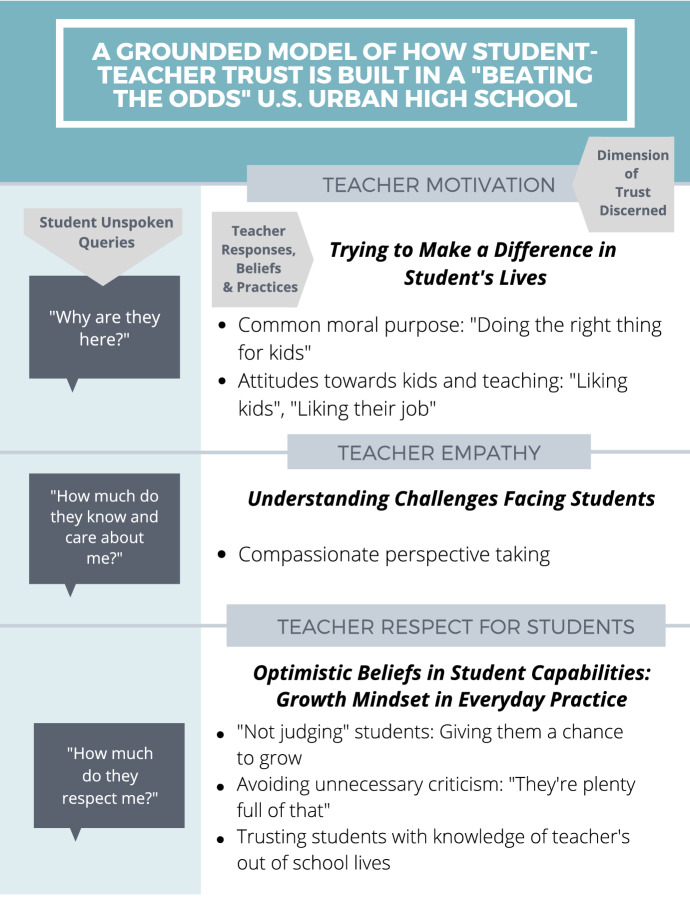
This article presents a grounded model of how educators earn students' trust in a high performing U.S. urban high school. This long-term anthropological project set out to understand the beliefs and practices of experienced teachers and staff members nominated by students as helping them feel like they belonged in school. Analysis of study data revealed a process of whereby adults and young people were reading one another as they explored the possibilities of entering into learning partnerships. For the educators, study data led us to infer that their trust building strategies were largely based on imagining the student discernment process, and responding to a set of unspoken queries about them that, over time, they seem to have learned were often on the minds of students (e.g. "Why are they here?" "How much do they respect me?"). The grounded model and practice-based evidence presented here summarize the strategies and approaches educators used to respond to these unspoken queries and communicate to students various aspects of their selves and their stance, including their motivation, empathy and respect for students, self-awareness and credibility, their professional ability, and finally, their commitment to helping students and investing emotional labor in them. Throughout, data are also presented regarding how students perceived and experienced these strategies, and ultimately how they interpreted and appraised their relationships with educators, as trusting relationships were developed.
本文提出了一个基于实证的模型,阐述了在美国一所表现出色的城市高中里,教育工作者是如何赢得学生信任的。这个长期的人类学项目旨在了解那些被学生提名的、能让他们有归属感的经验丰富的教师和工作人员的信念与做法。对研究数据的分析揭示了一个过程,即成年人和年轻人在探索建立学习伙伴关系的可能性时,相互了解。对于教育工作者而言,研究数据使我们推断,他们建立信任的策略很大程度上基于想象学生的辨别过程,并回应一系列关于他们的未言明的疑问,随着时间的推移,他们似乎了解到这些疑问常常在学生心中(例如“他们为什么来这里?”“他们有多尊重我?”)。这里呈现的基于实证的模型和基于实践的证据总结了教育工作者用来回应这些未言明疑问的策略和方法,并向学生传达他们自身的各个方面以及他们的立场,包括他们对学生的动机、同理心和尊重、自我意识和可信度、专业能力,最后是他们帮助学生并为他们投入情感劳动的承诺。自始至终,还呈现了关于学生如何看待和体验这些策略的数据,以及最终在信任关系建立过程中,他们如何解读和评价与教育工作者的关系的数据。