Takahashi Kanji, Iida Tomohiro, Ishida Susumu, Crawford Bruce, Sakai Yoko, Mochizuki Akikazu, Tsujiuchi Ryuta, Tanaka Satoru, Imai Kota
Department of Ophthalmology, Kansai Medical University, Hirakata, Osaka, Japan.
Department of Ophthalmology, Tokyo Women's Medical University, Shinjuku, Tokyo, Japan.
Clin Ophthalmol. 2022 Feb 25;16:531-540. doi: 10.2147/OPTH.S345403. eCollection 2022.
We conducted a systematic review to investigate the effectiveness of clinical treatments for wet age-related macular degeneration (wAMD) in Japanese patients in the decade since anti-vascular endothelial growth factor (VEGF) therapies were introduced.
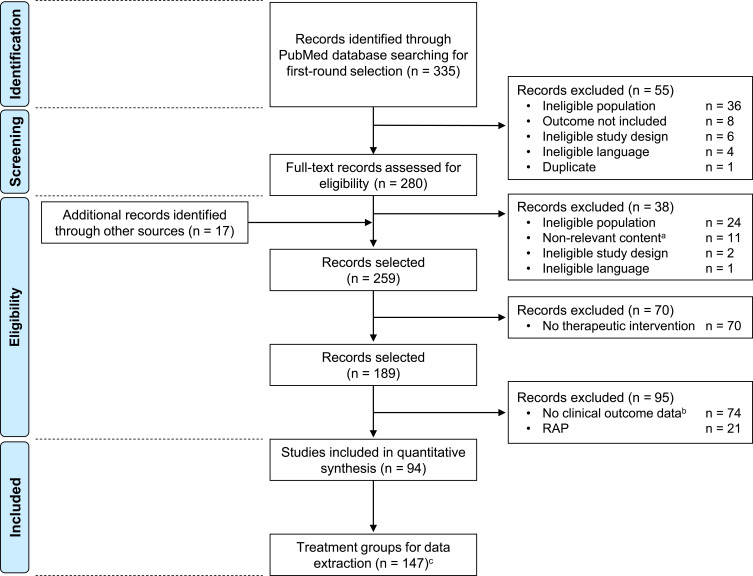
PubMed was searched for articles published in English between 1 January 2008 and 30 September 2018 using a multistring search strategy. Reviews were scanned for additional relevant studies and select gray literature was evaluated. Mean and/or median for the logarithm of the minimum angle of resolution (logMAR) visual acuity (VA), central retinal thickness (CRT), and the number of injections after 12 months of treatment were calculated using extracted data. Data were stratified by disease type and treatment modality.
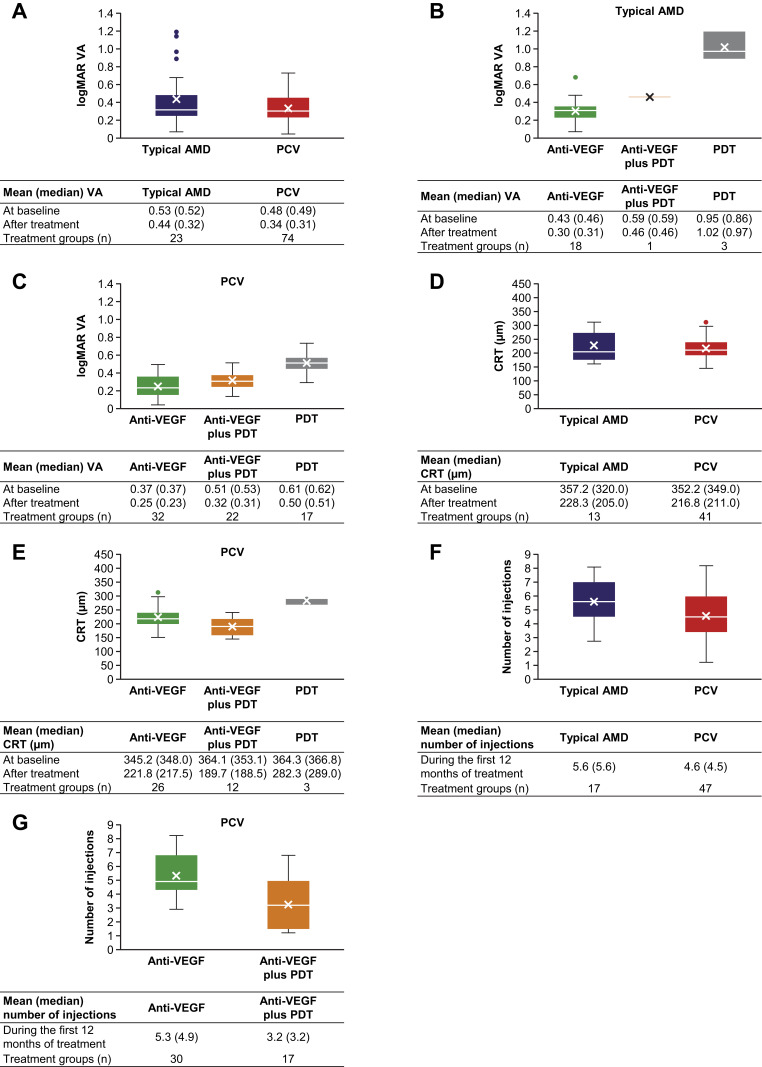
Of 335 studies identified, 94 were selected for data extraction (147 treatment arms; typical AMD, n = 25; polypoidal choroidal vasculopathy [PCV], n = 85). Mean (median) logMAR VA was 0.44 (0.32) for typical AMD and 0.34 (0.31) for PCV; the respective mean number of anti-VEGF injections was 5.6 and 4.6. The mean CRT was approximately 220 μm for both groups. For typical AMD, anti-VEGF monotherapy resulted in better VA outcomes than photodynamic therapy (PDT) alone. For PCV, anti-VEGF monotherapy or anti-VEGF plus PDT combination therapy resulted in better VA and CRT outcomes than PDT monotherapy. Combination therapy required fewer injections than anti-VEGF monotherapy (PCV, 3.2 versus 5.3).
wAMD treatment has advanced dramatically in the years since anti-VEGF drugs were introduced in Japan. Discrete patient populations may benefit from differing management regimens, including the fewer injections required with combination therapy.
我们进行了一项系统评价,以调查自抗血管内皮生长因子(VEGF)疗法引入以来的十年间,日本湿性年龄相关性黄斑变性(wAMD)患者临床治疗的有效性。
使用多字符串搜索策略在PubMed中检索2008年1月1日至2018年9月30日期间发表的英文文章。扫描综述以查找其他相关研究,并评估选定的灰色文献。使用提取的数据计算治疗12个月后的最小分辨角对数(logMAR)视力(VA)、中心视网膜厚度(CRT)以及注射次数的平均值和/或中位数。数据按疾病类型和治疗方式分层。
在识别出的335项研究中,94项被选用于数据提取(147个治疗组;典型AMD,n = 25;息肉样脉络膜血管病变[PCV],n = 85)。典型AMD的平均(中位数)logMAR VA为0.44(0.32),PCV为0.34(0.31);抗VEGF注射的平均次数分别为5.6次和4.6次。两组CRT的平均值约为220μm。对于典型AMD,抗VEGF单药治疗比单纯光动力疗法(PDT)产生更好的视力结果。对于PCV,抗VEGF单药治疗或抗VEGF联合PDT联合治疗比PDT单药治疗产生更好的视力和CRT结果。联合治疗比抗VEGF单药治疗需要的注射次数更少(PCV,3.2次对5.3次)。
自抗VEGF药物在日本引入以来,wAMD治疗在过去几年中有了显著进展。不同的患者群体可能从不同的管理方案中受益,包括联合治疗所需的注射次数更少。