Liang Tao, Zhang Yang, Wu Suyuan, Chen Qingjie, Wang Lin
Department of Clinical Laboratory, Union Hospital, Tongji Medical College, Huazhong University of Science and Technology, Wuhan, China.
Hubei Key Laboratory of Diabetes and Angiopathy, Medicine Research Institute, Xianning Medical College, Hubei University of Science and Technology, Xianning, China.
Front Pharmacol. 2022 Feb 16;13:845185. doi: 10.3389/fphar.2022.845185. eCollection 2022.
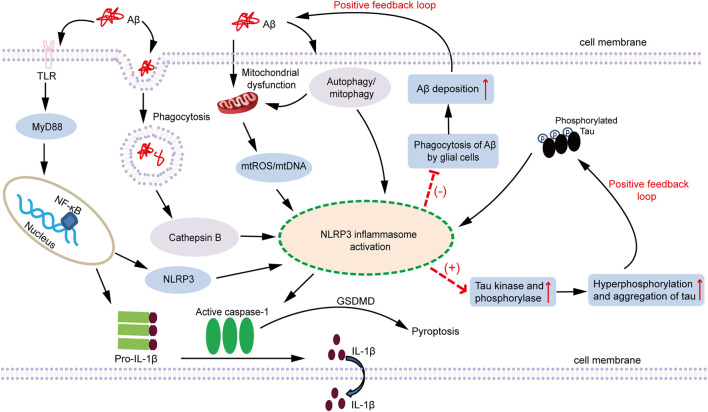
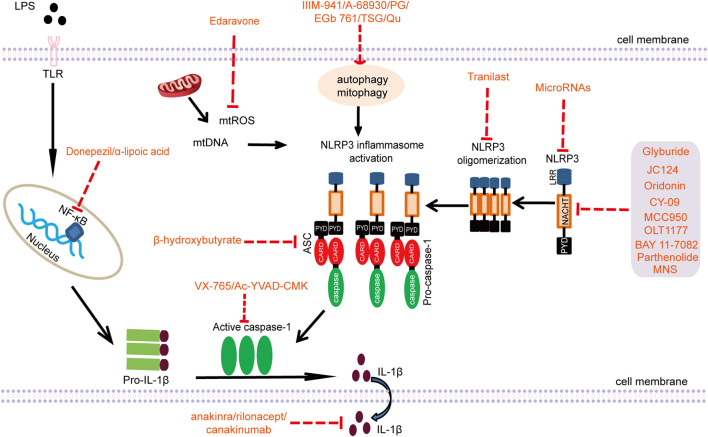
Alzheimer's disease (AD) is a common age-related neurodegenerative disease characterized by progressive cognitive dysfunction and behavioral impairment. The typical pathological characteristics of AD are extracellular senile plaques composed of amyloid (Aβ) protein, intracellular neurofibrillary tangles formed by the hyperphosphorylation of the microtubule-associated protein tau, and neuron loss. In the past hundred years, although human beings have invested a lot of manpower, material and financial resources, there is no widely recognized drug for the effective prevention and clinical cure of AD in the world so far. Therefore, evaluating and exploring new drug targets for AD treatment is an important topic. At present, researchers have not stopped exploring the pathogenesis of AD, and the views on the pathogenic factors of AD are constantly changing. Multiple evidence have confirmed that chronic neuroinflammation plays a crucial role in the pathogenesis of AD. In the field of neuroinflammation, the nucleotide-binding oligomerization domain-like receptor pyrin domain-containing 3 (NLRP3) inflammasome is a key molecular link in the AD neuroinflammatory pathway. Under the stimulation of Aβ oligomers and tau aggregates, it can lead to the assembly and activation of NLRP3 inflammasome in microglia and astrocytes in the brain, thereby causing caspase-1 activation and the secretion of IL-1β and IL-18, which ultimately triggers the pathophysiological changes and cognitive decline of AD. In this review, we summarize current literatures on the activation of NLRP3 inflammasome and activation-related regulation mechanisms, and discuss its possible roles in the pathogenesis of AD. Moreover, focusing on the NLRP3 inflammasome and combining with the upstream and downstream signaling pathway-related molecules of NLRP3 inflammasome as targets, we review the pharmacologically related targets and various methods to alleviate neuroinflammation by regulating the activation of NLRP3 inflammasome, which provides new ideas for the treatment of AD.
阿尔茨海默病(AD)是一种常见的与年龄相关的神经退行性疾病,其特征为进行性认知功能障碍和行为损害。AD的典型病理特征是由淀粉样蛋白(Aβ)构成的细胞外老年斑、微管相关蛋白tau过度磷酸化形成的细胞内神经原纤维缠结以及神经元丢失。在过去的一百年里,尽管人类投入了大量的人力、物力和财力,但迄今为止,世界上仍没有被广泛认可的有效预防和临床治愈AD的药物。因此,评估和探索AD治疗的新药物靶点是一个重要的课题。目前,研究人员对AD发病机制的探索从未停止,对AD致病因素的观点也在不断变化。多项证据证实,慢性神经炎症在AD发病机制中起关键作用。在神经炎症领域,含NOD样受体蛋白3(NLRP3)炎性小体是AD神经炎症途径中的关键分子环节。在Aβ寡聚体和tau聚集体的刺激下,它可导致脑内小胶质细胞和星形胶质细胞中NLRP3炎性小体的组装和激活,从而引起半胱天冬酶-1激活以及IL-1β和IL-18的分泌,最终引发AD的病理生理变化和认知衰退。在本综述中,我们总结了目前关于NLRP3炎性小体激活及其激活相关调控机制的文献,并讨论了其在AD发病机制中的可能作用。此外,聚焦于NLRP3炎性小体,并结合NLRP3炎性小体上下游信号通路相关分子作为靶点,我们综述了通过调节NLRP3炎性小体激活来减轻神经炎症的药理学相关靶点及各种方法,为AD的治疗提供了新思路。