Purcell Rosemary, Pilkington Vita, Carberry Serena, Reid David, Gwyther Kate, Hall Kate, Deacon Adam, Manon Ranjit, Walton Courtney C, Rice Simon
Orygen, Melbourne, VIC, Australia.
Centre for Youth Mental Health, The University of Melbourne, Melbourne, VIC, Australia.
Front Psychol. 2022 Feb 16;13:780359. doi: 10.3389/fpsyg.2022.780359. eCollection 2022.
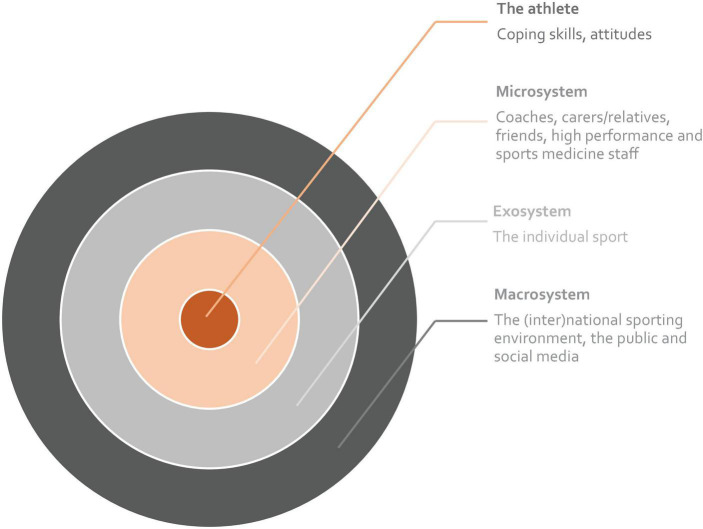
Elite athletes, coaches and high-performance staff are exposed to a range of stressors that have been shown to increase their susceptibility to experiencing mental ill-health. Despite this, athletes may be less inclined than the general population to seek support for their mental health due to stigma, perceptions of limited psychological safety within sport to disclose mental health difficulties (e.g., selection concerns) and/or fears of help-seeking signifying weakness in the context of high performance sport. Guidance on the best ways to promote mental health within sporting environments is increasing, though current frameworks and position statements require greater focus on a approach, in which the needs of athlete, coaches and high-performance staff are considered within the context of the broader ecological system in which they operate and perform. This paper synthesizes existing research, reviewed for translatability by mental health professionals working in elite sport, to provide an evidence-informed framework with real world utility to promote mentally healthy environments for all stakeholders in elite sporting organizations, from athletes through to administrators. Recommendations are provided to positively impact the mental wellbeing of athletes and support staff, which may in turn influence athletic performance. This framework is intended to provide sporting organizations with evidence-informed or best practice principles on which they can develop or progress their policies to support mental health promotion and prevent the onset of mental health difficulties. It is intended that the framework can be adapted or tailored by elite sporting organizations based upon their unique cultural, contextual and resourcing circumstances.
精英运动员、教练和高水平工作人员面临一系列压力源,这些压力源已被证明会增加他们患精神疾病的易感性。尽管如此,由于耻辱感、认为在体育界公开心理健康问题时心理安全感有限(例如,选拔方面的担忧)和/或担心在高水平体育运动中寻求帮助意味着软弱,运动员可能比普通人群更不愿意寻求心理健康方面的支持。关于在体育环境中促进心理健康的最佳方法的指导意见越来越多,不过目前的框架和立场声明需要更加关注一种方法,即在更广泛的生态系统背景下考虑运动员、教练和高水平工作人员的需求,他们在这个生态系统中运作和表现。本文综合了现有研究,由从事精英体育工作的心理健康专业人员对其可翻译性进行了审查,以提供一个具有现实世界实用性的循证框架,为精英体育组织中的所有利益相关者,从运动员到管理人员,促进心理健康的环境。文中提供了一些建议,以积极影响运动员和支持人员的心理健康,这反过来可能会影响运动成绩。该框架旨在为体育组织提供循证或最佳实践原则,它们可以据此制定或推进其政策,以支持心理健康促进并预防心理健康问题的发生。预计精英体育组织可以根据其独特的文化、背景和资源情况对该框架进行调整或定制。