Järvilehto Julius, Harjuhaahto Sandra, Palu Edouard, Auranen Mari, Kvist Jouni, Zetterberg Henrik, Koskivuori Johanna, Lehtonen Marko, Saukkonen Anna Maija, Jokela Manu, Ylikallio Emil, Tyynismaa Henna
Stem Cells and Metabolism Research Program, Faculty of Medicine, University of Helsinki, Helsinki, Finland.
Clinical Neurosciences, Neurology, Helsinki University Hospital, Helsinki, Finland.
Front Neurol. 2022 Feb 17;13:793937. doi: 10.3389/fneur.2022.793937. eCollection 2022.
To characterize serum biomarkers in mitochondrial CHCHD10-linked spinal muscular atrophy Jokela (SMAJ) type for disease monitoring and for the understanding of pathogenic mechanisms.
We collected serum samples from a cohort of 49 patients with SMAJ, all carriers of the heterozygous c.197G>T p.G66V variant in . As controls, we used age- and sex-matched serum samples obtained from Helsinki Biobank. Creatine kinase and creatinine were measured by standard methods. Neurofilament light (NfL) and glial fibrillary acidic protein (GFAP) were measured with single molecule array (Simoa), fibroblast growth factor 21 (FGF-21), and growth differentiation factor 15 (GDF-15) with an enzyme-linked immunosorbent assay. For non-targeted plasma metabolite profiling, samples were analyzed with liquid chromatography high-resolution mass spectrometry. Disease severity was evaluated retrospectively by calculating a symptom-based score.
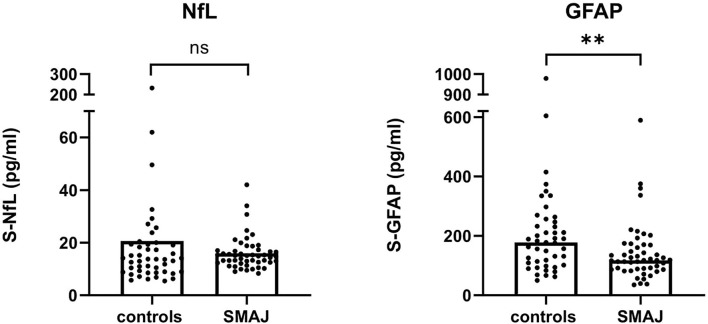
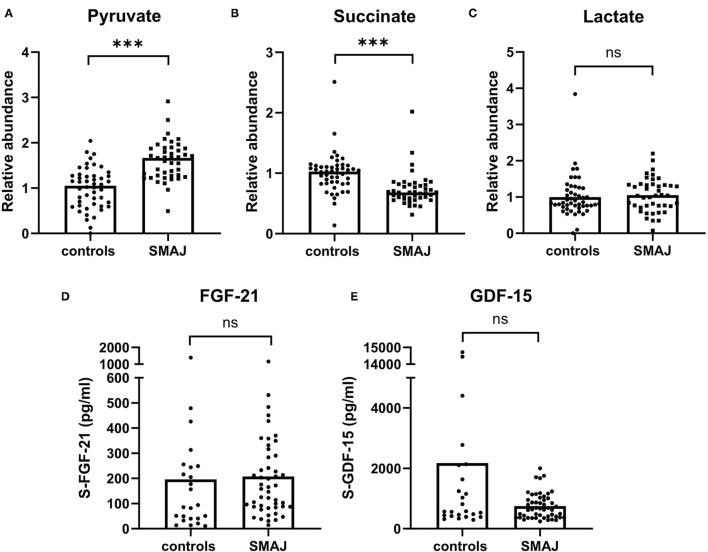
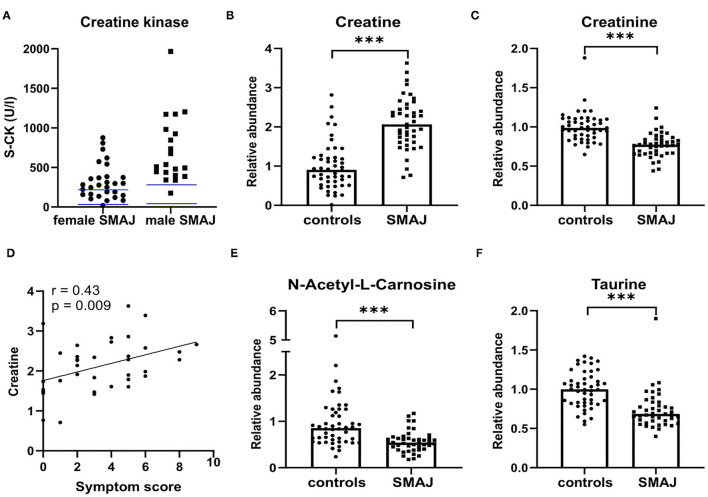
Axon degeneration marker, NfL, was unexpectedly not altered in the serum of patients with SMAJ, whereas astrocytic activation marker, GFAP, was slightly decreased. Creatine kinase was elevated in most patients, particularly men. We identified six metabolites that were significantly altered in serum of patients with SMAJ in comparison to controls: increased creatine and pyruvate, and decreased creatinine, taurine, N-acetyl-carnosine, and succinate. Creatine correlated with disease severity. Altered pyruvate and succinate indicated a metabolic response to mitochondrial dysfunction; however, lactate or mitochondrial myopathy markers FGF-21 or GDF-15 was not changed.
Biomarkers of muscle mass and damage are altered in SMAJ serum, indicating a role for skeletal muscle in disease pathogenesis in addition to neurogenic damage. Despite the minimal mitochondrial pathology in skeletal muscle, signs of a metabolic shift can be detected.
鉴定与线粒体CHCHD10相关的乔凯拉型脊髓性肌萎缩症(SMAJ)患者的血清生物标志物,用于疾病监测及了解致病机制。
我们收集了49例SMAJ患者的血清样本,这些患者均为CHCHD10基因杂合c.197G>T p.G66V变异携带者。作为对照,我们使用了从赫尔辛基生物样本库获取的年龄和性别匹配的血清样本。采用标准方法测定肌酸激酶和肌酐。用单分子阵列(Simoa)法测定神经丝轻链(NfL)和胶质纤维酸性蛋白(GFAP),用酶联免疫吸附测定法测定成纤维细胞生长因子21(FGF-21)和生长分化因子15(GDF-15)。对于非靶向血浆代谢物谱分析,样本采用液相色谱高分辨率质谱法进行分析。通过计算基于症状的评分对疾病严重程度进行回顾性评估。
轴突退化标志物NfL在SMAJ患者血清中出人意料地未发生改变,而星形细胞激活标志物GFAP略有下降。大多数患者,尤其是男性,肌酸激酶升高。我们鉴定出6种代谢物在SMAJ患者血清中与对照组相比有显著改变:肌酸和丙酮酸增加,肌酐、牛磺酸、N-乙酰肌肽和琥珀酸减少。肌酸与疾病严重程度相关。丙酮酸和琥珀酸的改变表明对线粒体功能障碍的代谢反应;然而,乳酸或线粒体肌病标志物FGF-21或GDF-15未发生变化。
SMAJ患者血清中肌肉量和损伤的生物标志物发生改变,表明除神经源性损伤外,骨骼肌在疾病发病机制中也起作用。尽管骨骼肌中线粒体病理改变轻微,但仍可检测到代谢转变的迹象。