Zhou Yuqing, Liu Zhaoxia, Chen Tingtao
Department of Obstetrics and Gynecology, The Second Affiliated Hospital of Nanchang University, Nanchang, China.
Queen Mary School, Nanchang University, Nanchang, China.
Front Oncol. 2022 Feb 16;12:847350. doi: 10.3389/fonc.2022.847350. eCollection 2022.
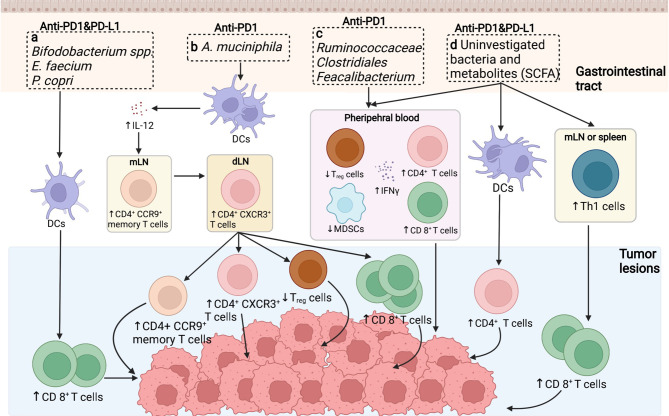
In the past few decades, immunotherapy has emerged as one of the most promising strategies among current treatments of cancer. In particular, the field of PD1/PD-L1 inhibitors has been boosted, widely applied into clinical practice with potent therapeutic efficacy and remarkable survival benefits on various cancers such as melanoma, non-small cell lung cancer (NSCLC), and urothelial carcinoma (UC). However, the application of PD1/PD-L1 blockade therapy is still quite restricted because of unexpected toxicities, limited response rate, as well as associated resistance. In consequence, searching for potential strategies that possibly resolve the existing limitations and enhance the therapeutic responsiveness of PD1/PD-L1 blockade is of great significance. Fortunately, the gut microbiome has been demonstrated to serve as a pivotal regulator in anti-PD1/PD-L1 therapy, providing an applicable tool to improve anti-PD1/PD-L1 clinical efficacy. In this review, we summarized published advancements about how microbiota modulated in anti-PD1/PD-L1 therapy and illustrated its underlying mechanisms, giving insights into putative manipulation of gut microbiota to facilitate PD1/PD-L1 blockade.
在过去几十年中,免疫疗法已成为当前癌症治疗中最具前景的策略之一。特别是,PD1/PD-L1抑制剂领域得到了推动,因其具有强大的治疗效果以及对多种癌症(如黑色素瘤、非小细胞肺癌(NSCLC)和尿路上皮癌(UC))显著的生存获益而被广泛应用于临床实践。然而,由于意想不到的毒性、有限的反应率以及相关的耐药性,PD1/PD-L1阻断疗法的应用仍然相当受限。因此,寻找可能解决现有局限性并提高PD1/PD-L1阻断治疗反应性的潜在策略具有重要意义。幸运的是,肠道微生物群已被证明在抗PD1/PD-L1治疗中起关键调节作用,为提高抗PD1/PD-L1临床疗效提供了一种适用工具。在本综述中,我们总结了已发表的关于微生物群在抗PD1/PD-L1治疗中如何被调节的进展,并阐述了其潜在机制,为通过调节肠道微生物群促进PD1/PD-L1阻断提供了见解。