Tarity T David, Xiang William, Jones Christopher W, Gkiatas Ioannis, Nocon Allina, Selemon Nicolas A, Carli Alberto, Sculco Peter K
Stavros Niarchos Foundation Complex Joint Reconstruction Center, Hospital for Special Surgery, New York, NY, USA.
Adult Reconstruction and Joint Replacement, Hospital for Special Surgery, New York, NY, USA.
Arthroplast Today. 2022 Mar 2;14:90-95. doi: 10.1016/j.artd.2022.01.023. eCollection 2022 Apr.
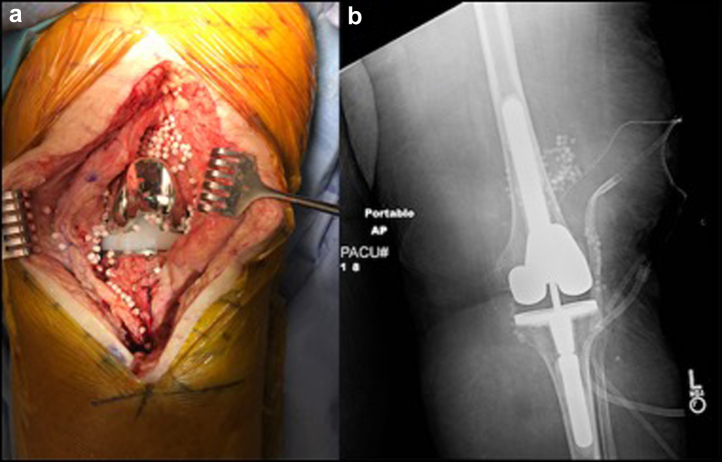
Dissolvable antibiotic-loaded calcium sulfate beads are used as an intraoperative adjunct during debridement with antibiotics and implant retention (DAIR) for periprosthetic joint infections (PJI) to reduce the historically higher failure rates than one- or two-stage exchange. This study evaluated clinical outcomes after DAIRs performed with and without these antibiotic beads. The primary outcome was post-DAIR failure secondary to recurrent PJI at 2 years. The secondary outcome was early failure secondary to recurrent PJI within 90 days.
DAIRs performed for acute or acute hematogenous PJI at a single institution were retrospectively identified between 2013 and 2018. All DAIRs with adjunctive antibiotic beads (cases) were then exactly matched to a cohort of DAIRs without beads (controls) based on Charlson Comorbidity Index. The McNemar's test and Wilcoxon signed-rank test were used to evaluate differences in outcomes and patient characteristics.
Twenty DAIR cases (with antibiotic beads) were matched with 20 DAIR controls. There was no difference in age, sex, body mass index, joint, erythrocyte sedimentation rate, C-reactive protein, microbiology profile, antibiotic-resistance profile, or intraoperative lavage adjuncts between groups. There were no statistically significant differences between cases and controls for either overall infection-related failure at 2 years ( = .21) or early infection-related failure at 90 days ( = 1.00).
Adjunctive dissolvable antibiotic-loaded calcium sulfate beads did not reduce the incidence of recurrent PJIs at 2 years or 90 days postoperatively after DAIR. Given the added cost of these antibiotic dissolvable beads without clinical benefits, we cannot recommend their use as an adjunct treatment during DAIRs.
可溶解的载抗生素硫酸钙珠在假体周围关节感染(PJI)的清创联合抗生素及保留植入物(DAIR)手术中用作术中辅助材料,以降低相较于一期或二期翻修术历来更高的失败率。本研究评估了在有或没有这些抗生素珠的情况下进行DAIR后的临床结果。主要结局是DAIR术后2年因复发性PJI导致的失败。次要结局是90天内因复发性PJI导致的早期失败。
回顾性确定2013年至2018年间在单一机构为急性或急性血源性PJI进行的DAIR手术。然后根据查尔森合并症指数,将所有使用辅助抗生素珠的DAIR(病例)与一组未使用珠的DAIR(对照)进行精确匹配。采用麦克尼马尔检验和威尔科克森符号秩检验来评估结局和患者特征的差异。
20例DAIR病例(使用抗生素珠)与20例DAIR对照相匹配。两组在年龄、性别、体重指数、关节、红细胞沉降率、C反应蛋白、微生物谱、抗生素耐药谱或术中灌洗辅助方面无差异。病例组和对照组在2年时的总体感染相关失败率(P = 0.21)或90天时的早期感染相关失败率(P = 1.00)方面均无统计学显著差异。
辅助性可溶解的载抗生素硫酸钙珠在DAIR术后2年或90天时并未降低复发性PJI的发生率。鉴于这些抗生素可溶解珠增加了成本且无临床益处,我们不建议在DAIR手术中将其用作辅助治疗。