Zheng Siyi, Han Hui, Lin Shuibin
Center for Translational Medicine, Precision Medicine Institute, The First Affiliated Hospital, Sun Yat-sen University, Guangzhou 510080, China.
Department of Otolaryngology, Center for Translational Medicine, Precision Medicine Institute, The First Affiliated Hospital, Sun Yat-sen University, Guangzhou 510080, China.
Cancer Biol Med. 2022 Mar 8;19(4):385-97. doi: 10.20892/j.issn.2095-3941.2021.0534.
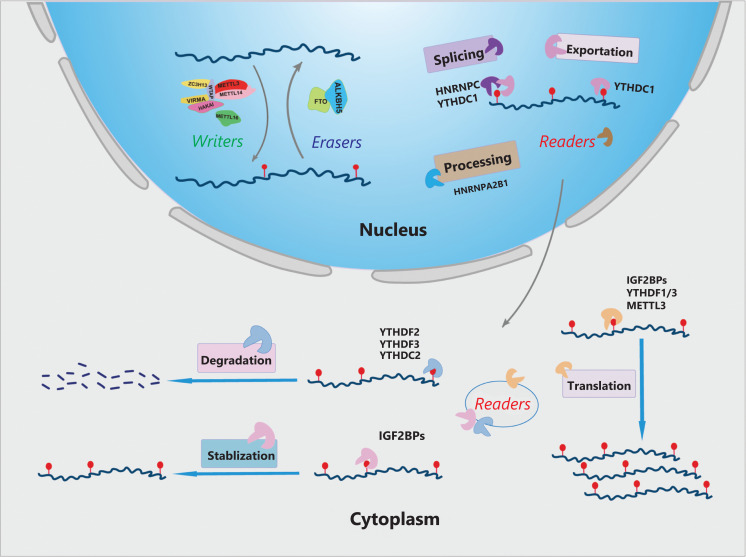
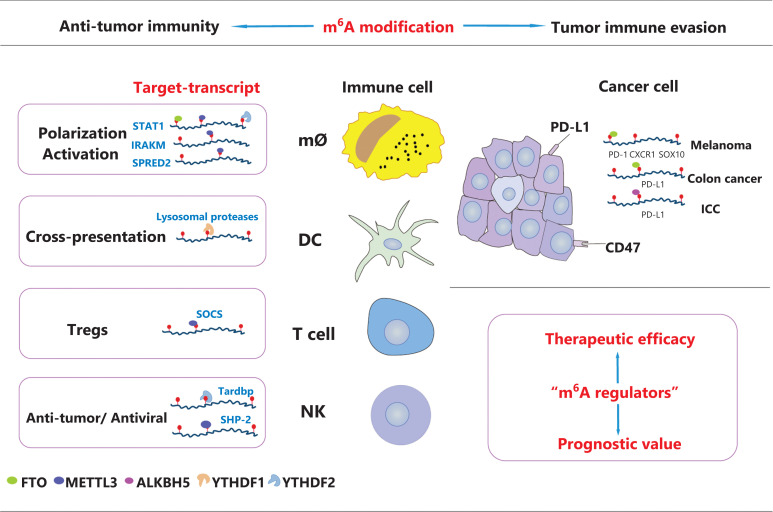
Growing evidence supports that cancer progression is closely associated with the tumor microenvironment and immune evasion. Importantly, recent studies have revealed the crucial roles of epigenetic regulators in shaping the tumor microenvironment and restoring immune recognition. N-methyladenosine (mA) modification, the most prevalent epigenetic modification of mammalian mRNAs, has essential functions in regulating the processing and metabolism of its targeted RNAs, and therefore affects various biological processes including tumorigenesis and progression. Recent studies have demonstrated the critical functions and molecular mechanisms underlying abnormal mA modification in the regulation of tumor immunity. In this review, we summarize recent research progress in the potential roles of mA modification in tumor immunoregulation, with a special focus on the anti-tumor processes of immune cells and involvement in immune-associated molecules and pathways. Furthermore, we review current knowledge regarding the close correlation between mA-related risk signatures and the tumor immune microenvironment landscape, and we discuss the prognostic value and therapeutic efficacy of mA regulators in a variety of cancer types.
越来越多的证据支持癌症进展与肿瘤微环境和免疫逃逸密切相关。重要的是,最近的研究揭示了表观遗传调节因子在塑造肿瘤微环境和恢复免疫识别方面的关键作用。N6-甲基腺苷(m6A)修饰是哺乳动物mRNA中最普遍的表观遗传修饰,在调节其靶向RNA的加工和代谢中具有重要功能,因此影响包括肿瘤发生和进展在内的各种生物学过程。最近的研究已经证明了m6A修饰异常在肿瘤免疫调节中的关键功能和分子机制。在这篇综述中,我们总结了m6A修饰在肿瘤免疫调节中潜在作用的最新研究进展,特别关注免疫细胞的抗肿瘤过程以及在免疫相关分子和途径中的参与情况。此外,我们回顾了关于m6A相关风险特征与肿瘤免疫微环境格局之间密切相关性的现有知识,并讨论了m6A调节因子在多种癌症类型中的预后价值和治疗效果。