Dept. of Anatomy, Anton de Kom University of Suriname, Paramaribo, Suriname.
Dept. of Physiology, Anton de Kom University of Suriname, Paramaribo, Suriname.
PLoS One. 2022 Mar 7;17(3):e0256455. doi: 10.1371/journal.pone.0256455. eCollection 2022.
Home-based physiotherapy interventions to improve post-stroke mobility are successful in high-income countries. These programs require less resources compared to center-based programs. However, feasibility of such an intervention in a low and middle-income setting remains unknown. Therefore, the SunRISe (Stroke Rehabilitation In Suriname) study aimed to assess feasibility and preliminary effectiveness of a home-based semi-supervised physiotherapy intervention to promote post-stroke mobility in a low resource setting.
Prospective randomized controlled trial.
Chronic stroke patients were recruited and randomized into either an intervention group (IG (N = 20)) or a control group (CG (N = 10)). The IG received a 3-days-a-week home-based physiotherapy program that was supervised in the first 4 weeks and tele-supervised during the second 4 weeks. The physiotherapy program consisted of walking as well as functional and mobilization exercises. The CG received usual care. Feasibility outcome measures included adherence, patient satisfaction and safety. Efficacy measures included functional exercise tolerance (six-minute walking test (6MWT), functional balance (Berg Balance Score (BBS), upper extremity (UE) function (Disabilities of the Arm, Shoulder and Hand (DASH) Questionnaire), and UE strength ((non-)paretic handgrip (HG) strength). Two-way analysis of variance was used for data analysis.
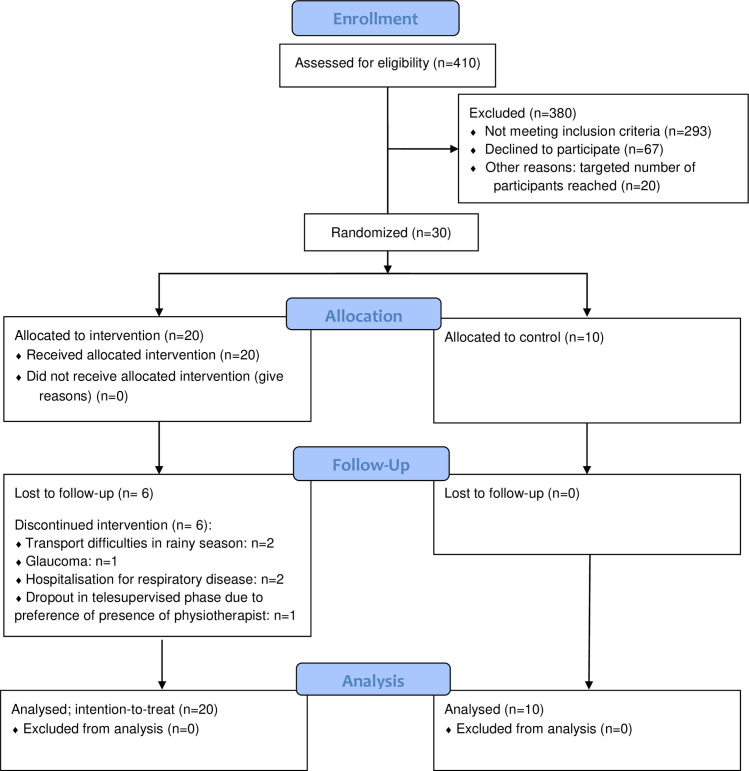
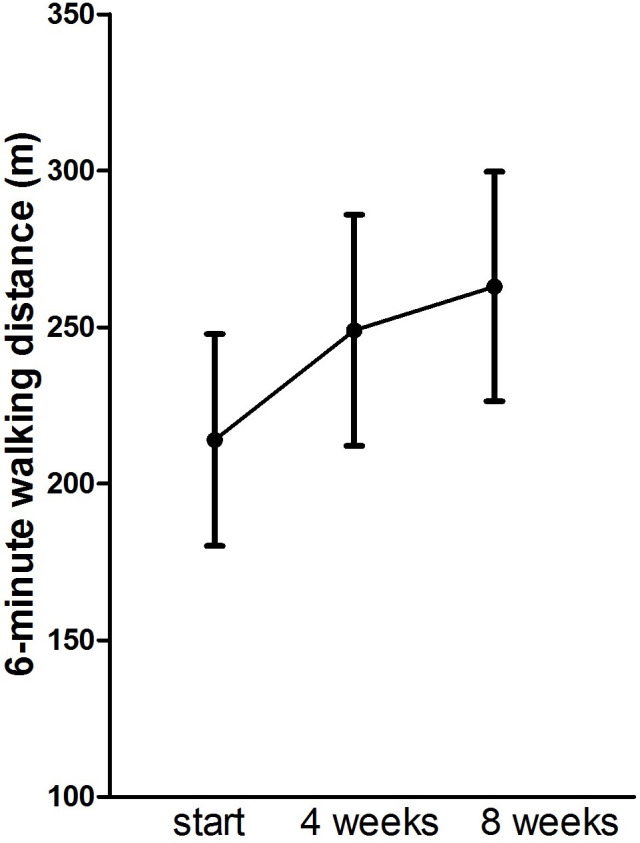
Thirty participants (61.8 ± 9.2 years old, 13 men) were enrolled in the study. The intervention was completed by 14 participants (70%). Adherence was affected by rainy season associated infrastructural problems (n = 2), the medical status of participants (n = 3) and insufficient motivation to continue the program without direct supervision (n = 1). No adverse events were noted and participants were satisfied with the program. Functional exercise tolerance (57.2 ± 67.3m, p = 0.02) and UE function (-9.8 ± 15.2, p = 0.04) improved in the IG compared to no change in the CG. HG strength was unaltered and a ceiling effect occurred for BBS.
Our home-based semi-supervised physiotherapy intervention seems safe, associated with moderate to high levels of engagement and patient satisfaction and results in functional improvements.
家庭为基础的物理治疗干预措施可提高中风后患者的活动能力,在高收入国家取得了成功。与以中心为基础的方案相比,这些方案需要的资源较少。然而,在资源有限的中低收入国家实施这种干预措施的可行性尚不清楚。因此,SunRISe(苏里南中风康复)研究旨在评估在资源有限的环境中,以家庭为基础的半监督物理治疗干预措施促进中风后活动能力的可行性和初步效果。
前瞻性随机对照试验。
招募慢性中风患者并随机分为干预组(IG(N=20))或对照组(CG(N=10))。IG 接受每周 3 天的家庭为基础的物理治疗方案,前 4 周由监督人员监督,后 4 周通过远程监督。物理治疗方案包括行走以及功能和活动能力锻炼。CG 接受常规护理。可行性的衡量指标包括依从性、患者满意度和安全性。疗效衡量指标包括功能性运动耐量(6 分钟步行测试(6MWT))、功能性平衡(伯格平衡评分(BBS))、上肢(UE)功能(手臂、肩部和手的残疾(DASH)问卷)和 UE 力量(非瘫痪手握力(HG)力量)。采用双向方差分析进行数据分析。
研究共纳入 30 名参与者(61.8±9.2 岁,13 名男性)。有 14 名参与者(70%)完成了干预。依从性受到雨季相关基础设施问题(n=2)、参与者的医疗状况(n=3)以及在没有直接监督的情况下继续该方案的动机不足(n=1)的影响。未发生不良事件,参与者对该方案表示满意。与 CG 相比,IG 的功能性运动耐量(57.2±67.3m,p=0.02)和 UE 功能(-9.8±15.2,p=0.04)得到改善,而 HG 力量未改变,BBS 出现上限效应。
我们的家庭为基础的半监督物理治疗干预措施似乎是安全的,与中高度的参与度和患者满意度相关,并能带来功能上的改善。