Radboud University Medical Center, Geert Grooteplein Zuid 10, 6525 GA, Nijmegen, Netherlands.
The Netherlands Cancer Institute, Plesmanlaan 121, 1066 CX, Amsterdam, Netherlands.
Eur Radiol. 2022 Jun;32(6):4036-4045. doi: 10.1007/s00330-022-08617-6. Epub 2022 Mar 8.
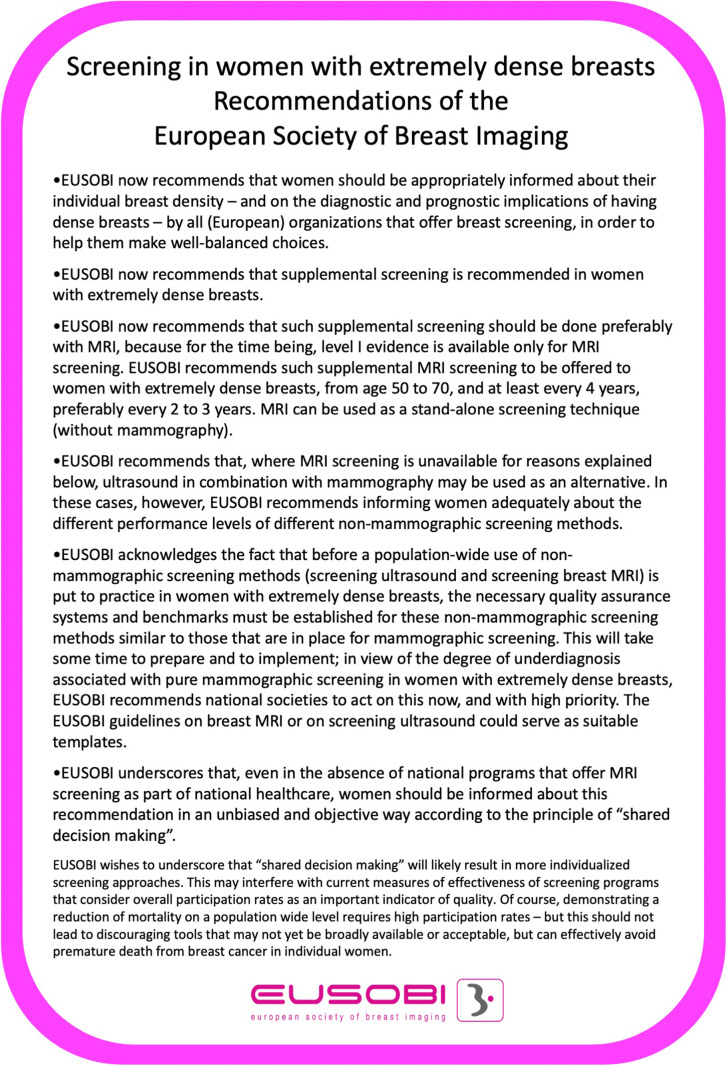
Breast density is an independent risk factor for the development of breast cancer and also decreases the sensitivity of mammography for screening. Consequently, women with extremely dense breasts face an increased risk of late diagnosis of breast cancer. These women are, therefore, underserved with current mammographic screening programs. The results of recent studies reporting on contrast-enhanced breast MRI as a screening method in women with extremely dense breasts provide compelling evidence that this approach can enable an important reduction in breast cancer mortality for these women and is cost-effective. Because there is now a valid option to improve breast cancer screening, the European Society of Breast Imaging (EUSOBI) recommends that women should be informed about their breast density. EUSOBI thus calls on all providers of mammography screening to share density information with the women being screened. In light of the available evidence, in women aged 50 to 70 years with extremely dense breasts, the EUSOBI now recommends offering screening breast MRI every 2 to 4 years. The EUSOBI acknowledges that it may currently not be possible to offer breast MRI immediately and everywhere and underscores that quality assurance procedures need to be established, but urges radiological societies and policymakers to act on this now. Since the wishes and values of individual women differ, in screening the principles of shared decision-making should be embraced. In particular, women should be counselled on the benefits and risks of mammography and MRI-based screening, so that they are capable of making an informed choice about their preferred screening method. KEY POINTS: • The recommendations in Figure 1 summarize the key points of the manuscript.
乳房密度是乳腺癌发展的独立危险因素,也降低了乳房 X 线摄影筛查的敏感性。因此,乳房致密的女性面临着乳腺癌晚期诊断风险增加的问题。这些女性因此在当前的乳房 X 线摄影筛查计划中得不到充分的服务。最近的一些研究报告称,对比增强乳房磁共振成像作为致密乳房女性的筛查方法,提供了令人信服的证据,表明这种方法可以为这些女性显著降低乳腺癌死亡率,并且具有成本效益。由于现在有了一种有效的方法来改善乳腺癌筛查,欧洲乳腺影像学学会(EUSOBI)建议告知女性其乳房密度。因此,EUSOBI 呼吁所有进行乳房 X 线摄影筛查的提供者与接受筛查的女性分享密度信息。鉴于现有证据,在年龄在 50 至 70 岁之间乳房致密的女性中,EUSOBI 现在建议每 2 至 4 年进行一次筛查性乳房磁共振成像。EUSOBI 承认,目前可能无法立即在任何地方提供乳房 MRI,并强调需要建立质量保证程序,但敦促放射学会和政策制定者现在就采取行动。由于个体女性的意愿和价值观存在差异,在筛查中应采用共同决策原则。特别是,应向女性提供关于乳房 X 线摄影和基于磁共振成像的筛查的益处和风险的咨询,以便她们能够对其首选的筛查方法做出明智的选择。要点:• 图 1 中的建议总结了本文的要点。