Department of Hematology/Medical Oncology, Emory University, Atlanta, GA.
Winship Cancer Institute, Atlanta, GA.
J Clin Oncol. 2022 Sep 10;40(26):3057-3064. doi: 10.1200/JCO.21.02257. Epub 2022 Mar 8.
Vaccine-induced neutralizing antibodies (nAbs) play a critical role in protection from SARS CoV-2. Patients with B-cell malignancies including myeloma are at increased risk of COVID-19-related mortality and exhibit variable serologic response to the vaccine. The capacity of vaccine-induced antibodies in these patients to neutralize SARS CoV-2 or its variants is not known.
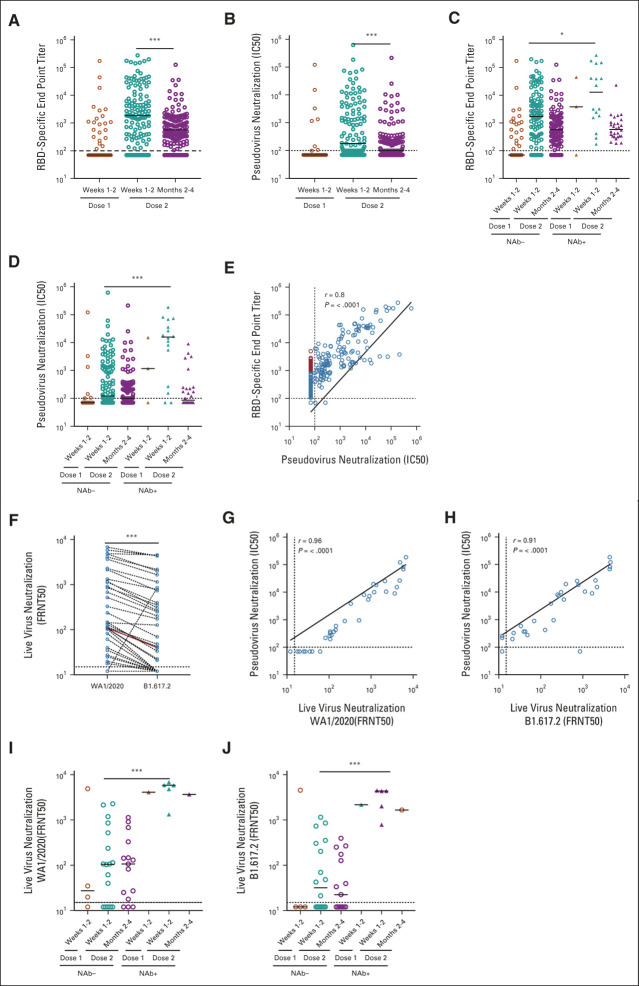
Sera from 238 patients with multiple myeloma (MM) undergoing SARS CoV-2 vaccination were analyzed. Antibodies against the SARS CoV-2 spike receptor-binding domain (RBD) and viral nucleocapsid were measured to detect serologic response to vaccine and environmental exposure to the virus. The capacity of antibodies to neutralize virus was quantified using pseudovirus neutralization assay and live virus neutralization against the initial SARS CoV-2 strain and the B1.617.2 (Delta) variant.
Vaccine-induced nAbs are detectable at much lower rates (54%) than estimated in previous seroconversion studies in MM, which did not monitor viral neutralization. In 33% of patients, vaccine-induced antispike RBD antibodies lack detectable neutralizing capacity, including against the B1.617.2 variant. Induction of nAbs is affected by race, disease, and treatment-related factors. Patients receiving mRNA1273 vaccine (Moderna) achieved significantly greater induction of nAbs compared with those receiving BNT162b2 (Pfizer; 67% 48%, = .006).
These data show that vaccine-induced antibodies in several patients with MM lack detectable virus-neutralizing activity. Vaccine-mediated induction of nAbs is affected by race, disease, vaccine, and treatment characteristics. These data have several implications for the emerging application of booster vaccines in immunocompromised hosts.
疫苗诱导的中和抗体(nAbs)在预防 SARS-CoV-2 方面发挥着关键作用。患有包括骨髓瘤在内的 B 细胞恶性肿瘤的患者患 COVID-19 相关死亡的风险增加,并且对疫苗的血清学反应存在差异。这些患者疫苗诱导的抗体中和 SARS-CoV-2 或其变体的能力尚不清楚。
分析了 238 名接受 SARS-CoV-2 疫苗接种的多发性骨髓瘤(MM)患者的血清。测量针对 SARS-CoV-2 刺突受体结合域(RBD)和病毒核衣壳的抗体,以检测疫苗接种后的血清学反应和对病毒的环境暴露。使用假病毒中和测定法和针对初始 SARS-CoV-2 株和 B1.617.2(Delta)变体的活病毒中和来定量抗体中和病毒的能力。
与以前在未监测病毒中和的 MM 中进行的血清转化率研究中估计的水平相比,疫苗诱导的 nAbs 的检测率要低得多(54%)。在 33%的患者中,疫苗诱导的抗刺突 RBD 抗体缺乏可检测的中和能力,包括针对 B1.617.2 变体的中和能力。nAbs 的诱导受种族、疾病和治疗相关因素的影响。接受 mRNA1273 疫苗(Moderna)的患者与接受 BNT162b2(辉瑞;67% 48%, =.006)的患者相比,nAbs 的诱导明显更大。
这些数据表明,MM 中的几种患者的疫苗诱导抗体缺乏可检测的病毒中和活性。疫苗介导的 nAbs 诱导受种族、疾病、疫苗和治疗特征的影响。这些数据对免疫功能低下宿主中新兴应用加强疫苗具有重要意义。