Center for Neuroscience Imaging Research, Institute for Basic Science (IBS), Suwon, 16419, Republic of Korea.
Department of Biomedical Engineering, Sungkyunkwan University, 2066 Seobu-ro, Jangan-gu, Suwon-si, Gyeonggi-do, 16419, Republic of Korea.
Sci Rep. 2022 Mar 8;12(1):3710. doi: 10.1038/s41598-022-07788-y.
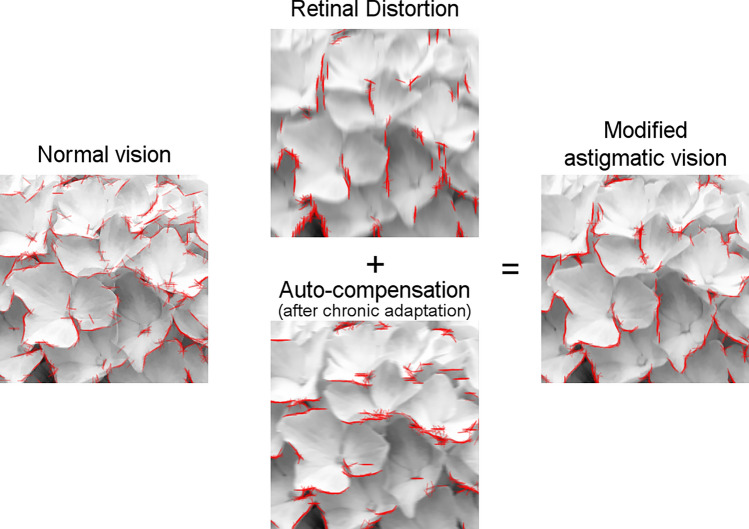
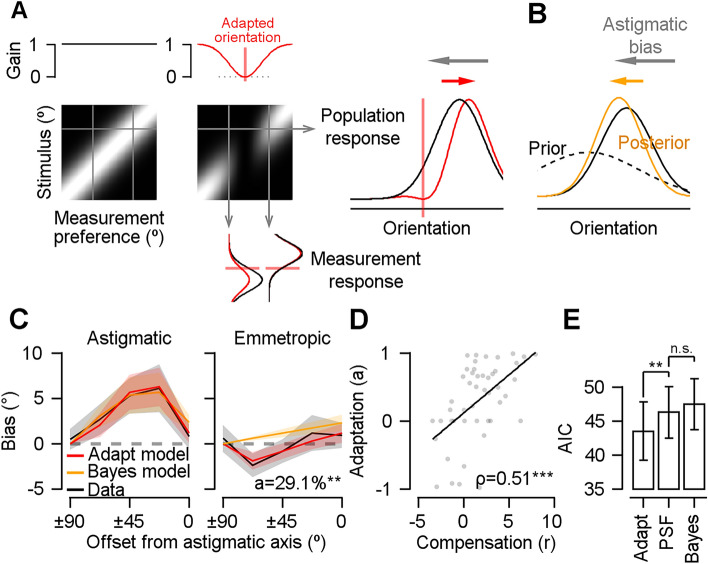
Astigmatism is a prevalent optical problem in which two or more focal points blur the retinal image at a particular meridian. Although many features of astigmatic vision, including orientation perception, are impaired at the retinal image level, the visual system appears to partly restore perceptual impairment after an extended period of astigmatism. However, the mechanism of orientation perception restoration in chronic astigmatism has not yet been clarified. We investigated the notable reduction of perceptual error in chronic astigmatism by comparing the orientation perception of a chronic astigmatism group with the perception of a normal-vision group, in which astigmatism was transiently induced. We found that orientation perception in the chronic group was more accurate than in the normal vision group. Interestingly, the reduction of perceptual errors was automatic; it remained even after the optical refractive errors were fully corrected, and the orientation perception was much more stable across different orientations, despite the uneven noise levels of the retinal images across meridians. We provide here a mechanistic explanation for how the compensation of astigmatic orientation perception occurred, using neural adaptation to the biased distribution of orientations.
散光(astigmatism)是一种常见的光学问题,在该问题中,两个或更多的焦点会使特定子午线上的视网膜图像模糊。尽管散光视觉的许多特征,包括方向感知,在视网膜图像水平上受到损害,但在散光持续一段时间后,视觉系统似乎会部分恢复感知损伤。然而,慢性散光中方向感知恢复的机制尚未阐明。我们通过比较慢性散光组和正常视力组的方向感知,研究了慢性散光中显著减少的感知误差,其中,散光被暂时诱发。我们发现,慢性组的方向感知比正常视力组更准确。有趣的是,感知误差的减少是自动的;即使在完全矫正光学屈光不正后,它仍然存在,而且尽管在不同子午线上视网膜图像的不均匀噪声水平,方向感知在不同方向上仍然更加稳定。我们使用神经适应于方向的有偏差分布的方法,为散光方向感知的补偿是如何发生的提供了一种机制解释。