Han Daewon, Kim Haeil, Kim Soojin, Le Qui Anh, Han Seung Yun, Bae Jeongyun, Shin Hye Won, Kang Hyun-Goo, Han Kyung Ho, Shin Jongdae, Park Hwan-Woo
Department of Cell Biology, Konyang University College of Medicine, Daejeon, 35365, Republic of Korea.
Department of Anatomy, Catholic Neuroscience Institute, College of Medicine, The Catholic University of Korea, Seoul, 06591, Republic of Korea.
Exp Mol Med. 2022 Mar;54(3):239-251. doi: 10.1038/s12276-022-00737-9. Epub 2022 Mar 8.
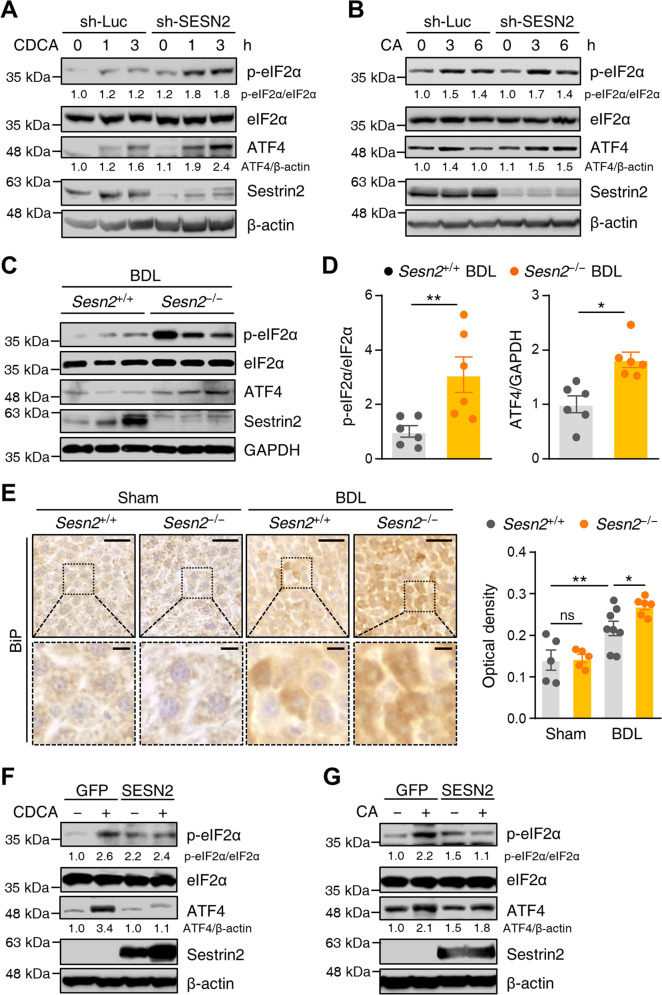
Chronic exposure to bile acid in the liver due to impaired bile flow induces cholestatic liver disease, resulting in hepatotoxicity and liver fibrosis. Sestrin2, a highly conserved, stress-inducible protein, has been implicated in cellular responses to multiple stress conditions and the maintenance of cellular homeostasis. However, its role in cholestatic liver injury is not fully understood. In this study, we investigated the role of hepatic Sestrin2 in cholestatic liver injury and its underlying mechanisms using in vivo and in vitro approaches. Hepatic Sestrin2 expression was upregulated by activating transcription factor 4 (ATF4) and CCAAT/enhancer-binding protein-β (C/EBP-β) after treatment with bile acids and correlated with endoplasmic reticulum (ER) stress responses. Bile-duct ligation (BDL)-induced hepatocellular apoptosis and liver fibrosis were exacerbated in Sestrin2-knockout (Sesn2) mice. Moreover, Sestrin2 deficiency enhanced cholestasis-induced hepatic ER stress, whereas Sestrin2 overexpression ameliorated bile acid-induced ER stress. Notably, the mammalian target of rapamycin (mTOR) inhibitor rapamycin and the AMP-activated protein kinase (AMPK) activator AICAR reversed bile acid-induced ER stress in Sestrin2-deficient cells. Furthermore, Sestrin2 deficiency promoted cholestasis-induced hepatic pyroptosis by activating NLRP3 inflammasomes. Thus, our study provides evidence for the biological significance of Sestrin2 and its relationship with cholestatic liver injury, suggesting the potential role of Sestrin2 in regulating ER stress and inflammasome activation during cholestatic liver injury.
胆汁流动受损导致肝脏长期暴露于胆汁酸中会诱发胆汁淤积性肝病,进而导致肝毒性和肝纤维化。Sestrin2是一种高度保守的应激诱导蛋白,与细胞对多种应激条件的反应以及细胞内稳态的维持有关。然而,其在胆汁淤积性肝损伤中的作用尚未完全明确。在本研究中,我们采用体内和体外方法研究了肝脏Sestrin2在胆汁淤积性肝损伤中的作用及其潜在机制。用胆汁酸处理后,肝脏Sestrin2的表达通过激活转录因子4(ATF4)和CCAAT/增强子结合蛋白-β(C/EBP-β)而上调,并与内质网(ER)应激反应相关。在Sestrin2基因敲除(Sesn2)小鼠中,胆管结扎(BDL)诱导的肝细胞凋亡和肝纤维化加剧。此外,Sestrin2缺乏增强了胆汁淤积诱导的肝脏ER应激,而Sestrin2过表达则改善了胆汁酸诱导的ER应激。值得注意的是,雷帕霉素靶蛋白(mTOR)抑制剂雷帕霉素和AMP激活蛋白激酶(AMPK)激活剂AICAR可逆转Sestrin2缺陷细胞中胆汁酸诱导的ER应激。此外,Sestrin2缺乏通过激活NLRP3炎性小体促进胆汁淤积诱导的肝脏焦亡。因此,我们的研究为Sestrin2的生物学意义及其与胆汁淤积性肝损伤的关系提供了证据,表明Sestrin2在胆汁淤积性肝损伤期间调节ER应激和炎性小体激活方面的潜在作用。