L'Oréal Research and Innovation, Centre Charles Zviak, Saint-Ouen, France.
L'Oréal Paris, Centre Eugene Schueller, Clichy, France.
Skin Res Technol. 2022 May;28(3):455-464. doi: 10.1111/srt.13146. Epub 2022 Mar 8.
To determine the aesthetical accordance between a given skin tone and the 11 possible colours of head hairs, covered by a marketed hair colouration product.
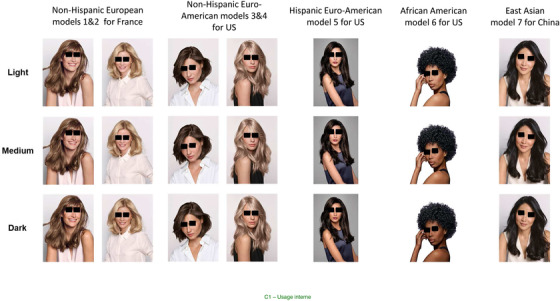
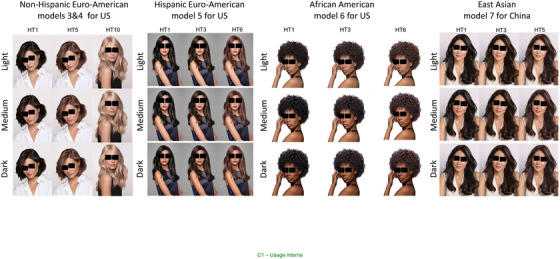
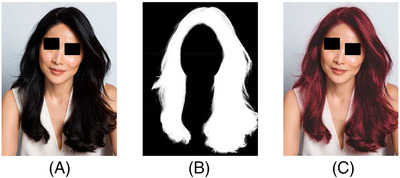
The photographs of professional top models, representing several ancestries (non-Hispanic European and Euro-American, East Asian, Hispanic Euro-American, and African-American ancestries), were used to virtually modify skin tones (from light, medium to dark) and hair colour by an artificial intelligence (AI)-based algorithm. Hence, 117 modified photographs were then assessed by five local panels of about 60 women each (one in China, one in France and three in US). The same questionnaire was given to the panels, written in their own language, asking which and how both skin tones and hair colours fit preferentially (or not appreciated), asking in addition the reasons of their choices, using fixed wordings.
Answers from the five panels differed according to origin or cultural aspects, although some agreements were found among both non-Hispanic European and Euro-American groups. The Hispanic American panel in US globally much appreciated darker hair tones (HTs). Two panels (East Asian in China and African American in US) and part of non-Hispanic European panel in France declared appreciating all HTs, almost irrespective with the skin tone (light, medium and dark). This surprising result is very likely caused by gradings (in %) that differ by too low values, making the establishment of a decisive or significant assessment. By nature highly subjective (culturally and/or fashion driven), the assessments should be more viewed as trends, an unavoidable limit of the present virtual approach. The latter offers nevertheless a full respect of ethical rules as such objective could hardly be conducted in vivo: applying 10 or 11 hair colourations on the same individual is an unthinkable option.
The virtual approach developed in the present study that mixes two major facial coloured phenotypes seems at the crossroad of both genetic backgrounds and the secular desire of a modified appearance. Nonetheless, this methodology could afford, at the individual level in total confidentiality, a great help to subjects exposed to some facial skin disorders or afflictions.
确定给定肤色与市售染发剂 11 种可能颜色之间的美学协调性。
使用具有人工智能(AI)算法的技术,对代表多种种族(非西班牙裔欧洲裔和欧裔美国人、东亚裔、西班牙裔欧裔和非裔美国人)的专业顶级模特的照片进行虚拟肤色(从浅、中到深)和头发颜色的调整。然后,由五个面板(每个面板约 60 名女性)评估了 117 张经过修改的照片,每个面板都来自一个不同的国家或地区(中国、法国和美国各一个)。用面板所在国的语言向面板提供了相同的问卷,询问他们更喜欢哪种和哪种肤色和头发颜色搭配(或不喜欢),并要求他们用固定的措辞说明选择的原因。
五个面板的回答因起源或文化方面而异,尽管非西班牙裔欧洲裔和欧裔美国人两个群体之间存在一些共识。来自美国的西班牙裔美国面板普遍非常喜欢较深的头发色调(HTs)。两个面板(中国的东亚裔和美国的非裔美国人)和法国非西班牙裔欧洲裔面板的一部分宣称喜欢所有的 HTs,几乎与肤色(浅、中、深)无关。这一令人惊讶的结果很可能是由于分级(以%表示)差异太小,使得做出决定性或重要的评估变得困难。由于评估本质上是主观的(受文化和/或时尚驱动),因此这些评估应该更多地被视为趋势,这是目前虚拟方法不可避免的局限性。然而,这种方法提供了对伦理规则的充分尊重,因为在体内进行这样的评估几乎是不可能的:在同一个人身上应用 10 或 11 种染发剂颜色是不可想象的。
本研究中开发的混合两种主要面部肤色表型的虚拟方法似乎处于遗传背景和对修饰外观的长期渴望的交叉点。尽管如此,这种方法可以在完全保密的情况下,为那些患有某些面部皮肤疾病或不适的个体提供帮助。