Department of Nutrition, Exercise and Sports, University of Copenhagen, Frederiksberg, Denmark.
Paediatric Department, Holbæk Sygehus, Holbæk, Denmark.
PLoS Med. 2022 Mar 9;19(3):e1003943. doi: 10.1371/journal.pmed.1003943. eCollection 2022 Mar.
Among children with moderate acute malnutrition (MAM) the level of serum cobalamin (SC) and effect of food supplements are unknown. We aimed to assess prevalence and correlates of low SC in children with MAM, associations with hemoglobin and development, and effects of food supplements on SC.
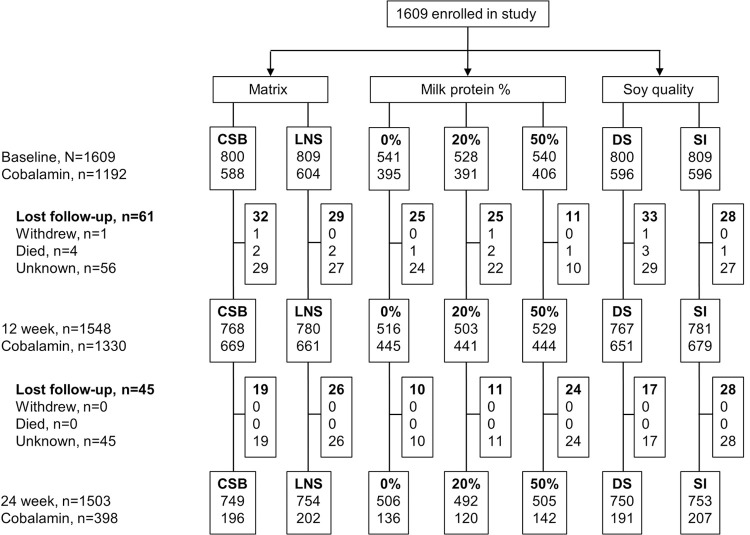
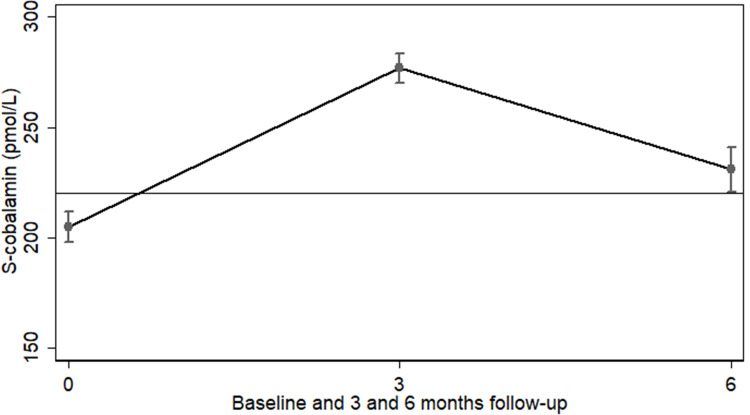
A randomized 2 × 2 × 3 factorial trial was conducted in Burkina Faso. Children aged 6 to 23 months with MAM received 500 kcal/d as lipid-based nutrient supplement (LNS) or corn-soy blend (CSB), containing dehulled soy (DS) or soy isolate (SI) and 0%, 20%, or 50% of total protein from milk for 3 months. Randomization resulted in baseline equivalence between intervention groups. Data on hemoglobin and development were available at baseline. SC was available at baseline and after 3 and 6 months. SC was available from 1,192 (74.1%) of 1,609 children at baseline. The mean (±SD) age was 12.6 (±5.0) months, and 54% were females. Low mid-upper arm circumference (MUAC; <125 mm) was found in 80.4% (958) of the children and low weight-for-length z-score (WLZ; <-2) in 70.6% (841). Stunting was seen in 38.2% (456). Only 5.9% were not breastfed. Median (IQR) SC was 188 (137; 259) pmol/L. Two-thirds had SC ≤222 pmol/L, which was associated with lower hemoglobin. After age and sex adjustments, very low SC (<112 pmol/L) was associated with 0.21 (95% CI: 0.01; 0.41, p = 0.04) and 0.24 (95% CI: 0.06; 0.42, p = 0.01) z-score lower fine and gross motor development, respectively. SC data were available from 1,330 (85.9%) of 1,548 children followed up after 3 months and 398 (26.5%) of the 1,503 children after 6 months. Based on tobit regression, accounting for left censored data, and adjustments for correlates of missing data, the mean (95% CI) increments in SC from baseline to the 3- and 6-month follow-up were 72 (65; 79, p < 0.001) and 26 (16; 37, p < 0.001) pmol/L, respectively. The changes were similar among the 310 children with SC data at all 3 time points. Yet, the increase was 39 (20; 57, p < 0.001) pmol/L larger in children given LNS compared to CSB if based on SI (interaction, p < 0.001). No effect of milk was found. Four children died, and no child developed an allergic reaction to supplements. The main limitation of this study was that only SC was available as a marker of status and was missing from a quarter of the children.
Low SC is prevalent among children with MAM and may contribute to impaired erythropoiesis and child development. The SC increase during supplementation was inadequate. The bioavailability and adequacy of cobalamin in food supplements should be reconsidered.
ISRCTN Registry ISRCTN42569496.
中度急性营养不良(MAM)儿童的血清钴胺素(SC)水平和营养补充剂的效果尚不清楚。我们旨在评估 MAM 儿童中低 SC 的患病率及其相关因素,以及其与血红蛋白和发育的关系,以及营养补充剂对 SC 的影响。
在布基纳法索进行了一项随机 2×2×3 析因试验。6 至 23 个月大的 MAM 儿童每天接受 500 千卡的脂质基营养素补充剂(LNS)或玉米-大豆混合物(CSB),含有去壳大豆(DS)或大豆分离物(SI)和 0%、20%或 50%的总蛋白来自牛奶,持续 3 个月。随机分组导致干预组之间的基线等效性。基线时可获得血红蛋白和发育数据。基线和 3 个月和 6 个月后可获得 SC 数据。基线时可获得 1192(74.1%)名 1609 名儿童的 SC 数据。平均(±SD)年龄为 12.6(±5.0)个月,54%为女性。80.4%(958)的儿童上臂中部周长(MUAC;<125 毫米)较低,70.6%(841)的儿童体重长度 z 分数(WLZ;<-2)较低。38.2%(456)的儿童出现发育迟缓。只有 5.9%的儿童没有母乳喂养。中位数(IQR)SC 为 188(137;259)pmol/L。三分之二的儿童 SC ≤222 pmol/L,这与较低的血红蛋白有关。在年龄和性别调整后,极低的 SC(<112 pmol/L)与精细运动和粗大运动发育的 z 评分分别低 0.21(95%CI:0.01;0.41,p = 0.04)和 0.24(95%CI:0.06;0.42,p = 0.01)相关。3 个月和 6 个月随访时,1330(85.9%)名 1548 名儿童和 398(26.5%)名 1503 名儿童分别有 SC 数据。基于 Tobit 回归,考虑到左截断数据,并对缺失数据的相关性进行调整,从基线到 3 个月和 6 个月随访时 SC 的平均(95%CI)增量分别为 72(65;79,p<0.001)和 26(16;37,p<0.001)pmol/L。在所有 3 个时间点都有 SC 数据的 310 名儿童中,变化情况相似。然而,如果基于 SI(交互作用,p<0.001),与 CSB 相比,给予 LNS 的儿童 SC 增加了 39(20;57,p<0.001)pmol/L。未发现牛奶的影响。4 名儿童死亡,没有儿童对补充剂产生过敏反应。本研究的主要局限性是仅 SC 可用作状态标志物,四分之一的儿童的数据缺失。
MAM 儿童中低 SC 较为常见,可能导致红细胞生成受损和儿童发育不良。补充期间 SC 的增加是不足够的。应重新考虑营养补充剂中钴胺素的生物利用度和充足性。
ISRCTN 注册表 ISRCTN42569496。