Department of Nephrology, Tokyo Metropolitan Health and Hospitals Corporation Okubo Hospital, Tokyo, Japan.
Disease Control and Prevention Center, National Center for Global Health and Medicine, Tokyo, Japan.
CEN Case Rep. 2022 Nov;11(4):422-427. doi: 10.1007/s13730-022-00697-z. Epub 2022 Mar 9.
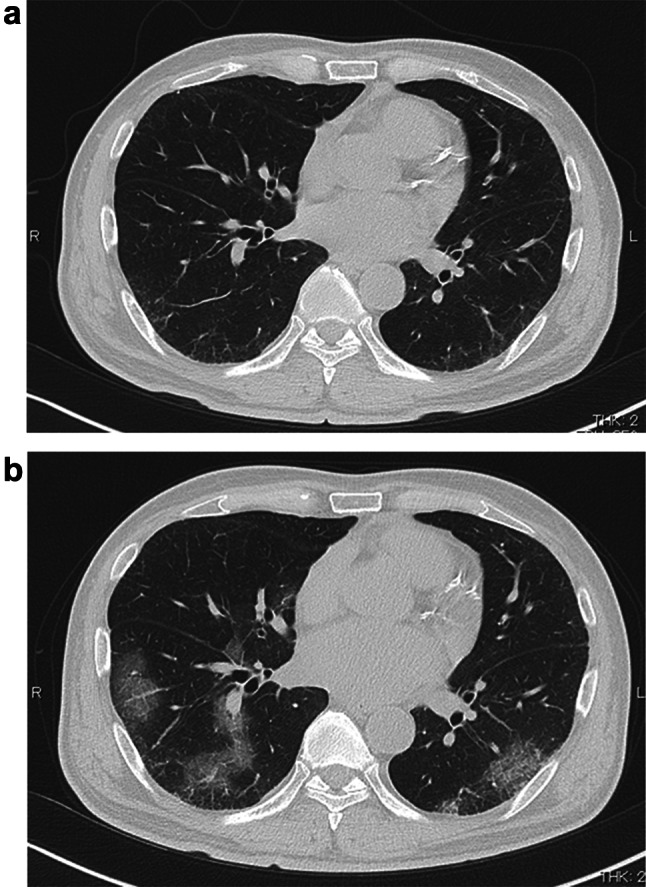
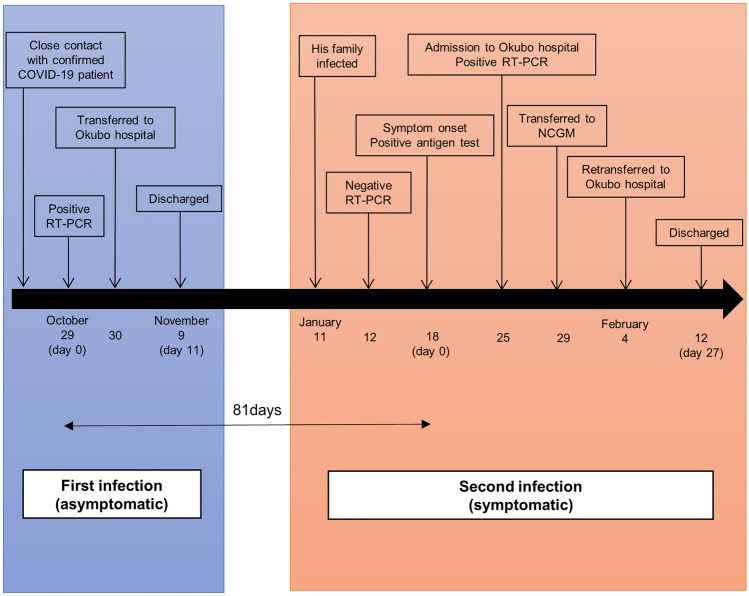
Hemodialysis patients are vulnerable to severe and lethal COVID-19, and their protective immunity against COVID-19 is not yet fully understood. Therefore, we report a case of COVID-19 reinfection in a hemodialysis patient 81 days after the first episode and discuss the role of antibodies in SARS-CoV-2 infection. A hemodialysis patient developed asymptomatic COVID-19 due to an outbreak in a hospital on October 29th, 2020. As he was hospitalized and did not develop any symptoms, he was discharged on November 9th. On January 18th, he presented with symptomatic COVID-19 due to close household contact. Then, he developed respiratory failure and was transferred to National Center for Global Health and Medicine if he would need intensive care. He recovered with oxygen inhalation, favipiravir, and steroid treatment, and was discharged on February 12th. To evaluate anti-SARS-CoV-2 antibodies during two hospital stays, we measured immunoglobulin (Ig) G specific for S1 subunit of Spike (S) protein of SARS-CoV-2 (IgG-S1) , IgG specific for the full-length S protein (anti-Spike IgG) and neutralizing antibodies. No seroconversion occurred 5 days after initial infection, the seroconversion of IgG-S1 was observed 10 days after the second infection. Similar to IgG-S1 antibody titer results, anti-Spike IgG and neutralizing antibodies increased from 12 days after the second infection. In conclusion, we experienced a case of COVID-19 reinfection in a hemodialysis patient 81 days after the first episode and showed the kinetics and role of antibodies in SARS-CoV-2 infection. Further studies are needed to understand SARS-CoV-2 reinfection risk in hemodialysis patients and its clinical significance.
血液透析患者易感染严重且致命的 COVID-19,其针对 COVID-19 的保护性免疫尚未完全了解。因此,我们报告了一例血液透析患者在首次发作后 81 天再次感染 COVID-19 的病例,并讨论了抗体在 SARS-CoV-2 感染中的作用。2020 年 10 月 29 日,一名血液透析患者因医院内爆发疫情而出现无症状 COVID-19。由于他住院且未出现任何症状,于 11 月 9 日出院。1 月 18 日,因与家庭密切接触而出现有症状的 COVID-19。随后,他因呼吸衰竭而被转至国立国际医疗研究中心,如果需要重症监护。他通过吸氧、法匹拉韦和类固醇治疗康复,并于 2 月 12 日出院。为了评估两次住院期间抗 SARS-CoV-2 抗体,我们检测了针对 SARS-CoV-2 刺突(S)蛋白 S1 亚单位的 IgG(IgG-S1)、针对全长 S 蛋白的 IgG(抗-Spike IgG)和中和抗体。初次感染后 5 天未发生血清转换,第二次感染后 10 天观察到 IgG-S1 血清转换。与 IgG-S1 抗体滴度结果相似,抗-Spike IgG 和中和抗体从第二次感染后 12 天开始增加。总之,我们在首次发作后 81 天经历了一例血液透析患者的 COVID-19 再次感染,并显示了 SARS-CoV-2 感染中抗体的动力学和作用。需要进一步研究来了解血液透析患者 SARS-CoV-2 再感染的风险及其临床意义。