Gedik Özköse Zeynep, Oğlak Süleyman Cemil, Bestel Ayşegül, Behram Mustafa, Süzen Çaypınar Sema, Ölmez Fatma, Özdemir İsmail
Clinic of Perinatology, University of Health Sciences Turkey, Kanuni Sultan Süleyman Training and Research Hospital, İstanbul, Turkey
Clinic of Obstetrics and Gynecology, University of Health Sciences Turkey, Gazi Yaşargil Training and Research Hospital, Diyarbakır, Turkey
J Turk Ger Gynecol Assoc. 2022 Dec 8;23(4):268-274. doi: 10.4274/jtgga.galenos.2021.2021-0042. Epub 2022 Mar 10.
The aim of this study was to improve knowledge of prenatally diagnosed fetal intracranial hemorrhage (ICH), defining the ultrasound (US) examination results, the contribution of fetal magnetic resonance imagination (MRI) to the diagnosis, and the pregnancy outcomes, from a series of fetal ICH cases.
This retrospective, observational study included eleven fetuses diagnosed with ICH from April 2016 to August 2020. The data regarding the medical records, prenatal US and MRI findings, treatment, and prognosis of fetal ICH cases were collected from the hospital database and analyzed.
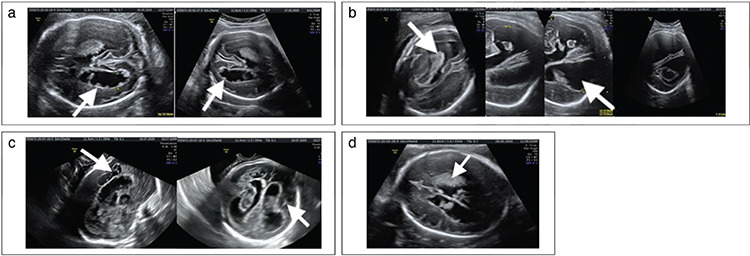
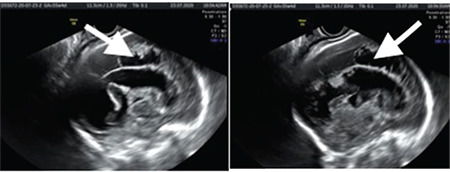
Fetal ICHs were grade 3 in six cases, and grade 4 in the remaining five cases. The mean gestational age at diagnosis was 30.2 weeks. Nine (81.8%) of the cases were diagnosed in the third trimester and two (18.2%) in the second trimester. Fetal cranial MRI was performed in 7/11 (63.6%) following ultrasonographic diagnosis. MRI confirmed fetal ICH diagnosis and previous US findings regarding location and grade in all cases. Five patients (45.5%) diagnosed with grade 3 (n=1) and grade 4 (n=4) ICH underwent pregnancy termination. Of the remaining six cases, one (9.1%) diagnosed with grade 3 fetal ICH resulted in an intrauterine fetal demise. Four cases classified as grade 3 fetal ICH and one case with grade 4 fetal ICH were born alive at term.
The clinical manifestations of fetal ICH are diverse and have a wide spectrum of severity and prognostic implications. Fetal ICH cases were mainly detected in the third trimester, with a minority detected in the second trimester. These cases can be safely diagnosed and graded by US examination, but the underlying etiology frequently cannot be determined. Fetal cranial MRI may aid in diagnosis confirmation if this is unclear from US in order to provide appropriate counseling to the parents.
本研究旨在通过一系列胎儿颅内出血(ICH)病例,提高对产前诊断的胎儿ICH的认识,明确超声(US)检查结果、胎儿磁共振成像(MRI)对诊断的贡献以及妊娠结局。
这项回顾性观察性研究纳入了2016年4月至2020年8月期间诊断为ICH的11例胎儿。从医院数据库收集胎儿ICH病例的病历、产前US和MRI检查结果、治疗及预后等数据并进行分析。
胎儿ICH病例中6例为3级,其余5例为4级。诊断时的平均孕周为30.2周。9例(81.8%)在孕晚期诊断,2例(18.2%)在孕中期诊断。超声诊断后,11例中有7例(63.6%)进行了胎儿颅脑MRI检查。MRI在所有病例中均证实了胎儿ICH的诊断以及之前US检查发现的部位和分级。5例(45.5%)诊断为3级(1例)和4级(4例)ICH的患者终止了妊娠。其余6例中,1例(9.1%)诊断为3级胎儿ICH导致宫内胎儿死亡。4例3级胎儿ICH和1例4级胎儿ICH足月存活出生。
胎儿ICH的临床表现多样,严重程度和预后影响范围广泛。胎儿ICH病例主要在孕晚期被检测到,少数在孕中期被检测到。这些病例可通过US检查安全地进行诊断和分级,但通常无法确定潜在病因。如果US检查结果不明确,胎儿颅脑MRI可能有助于确诊,以便为父母提供适当的咨询。