Université de Paris, Institut Cochin, INSERM U-1016, CNRS UMR-8104, Paris, France.
Endocrinology, AP-HP Hôpital Cochin, Paris, France.
Eur J Endocrinol. 2022 Apr 21;186(6):607-617. doi: 10.1530/EJE-21-1228.
Molecular classification is important for the diagnosis and prognosis of adrenocortical tumors (ACT). Transcriptome profiles separate adrenocortical adenomas 'C2' from carcinomas, and identify two groups of carcinomas 'C1A' and 'C1B', of poor and better prognosis respectively. However, many ACT cannot be profiled because of improper or absent freezing procedures, a mandatory requirement so far. The main aim was to determine transcriptome profiles on formalin-fixed paraffin-embedded (FFPE) samples, using the new 3'-end RNA-sequencing technology. A secondary aim was to demonstrate the ability of this technique to explore large FFPE archives, by focusing on the rare oncocytic ACT variants.
We included 131 ACT: a training cohort from Cochin hospital and an independent validation cohort from Wuerzburg hospital. The 3' transcriptome was generated from FFPE samples using QuantSeq (Lexogen, Vienna, Austria) and NextSeq500 (Illumina, San Diego, CA, USA).
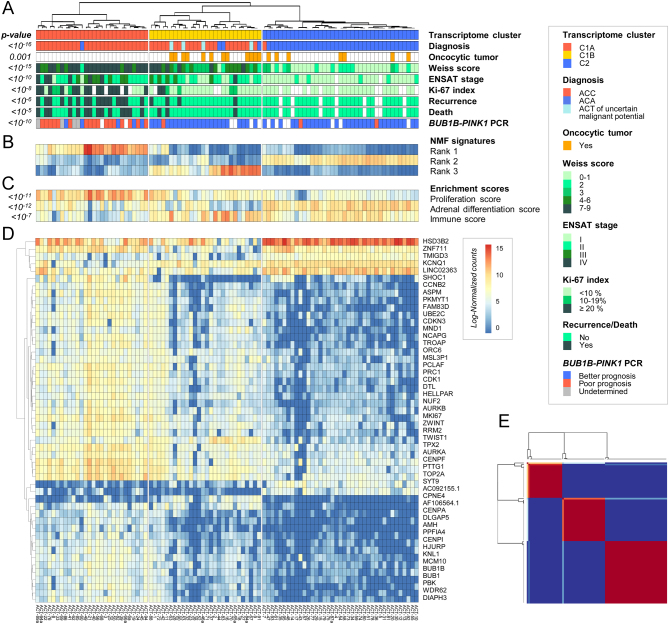
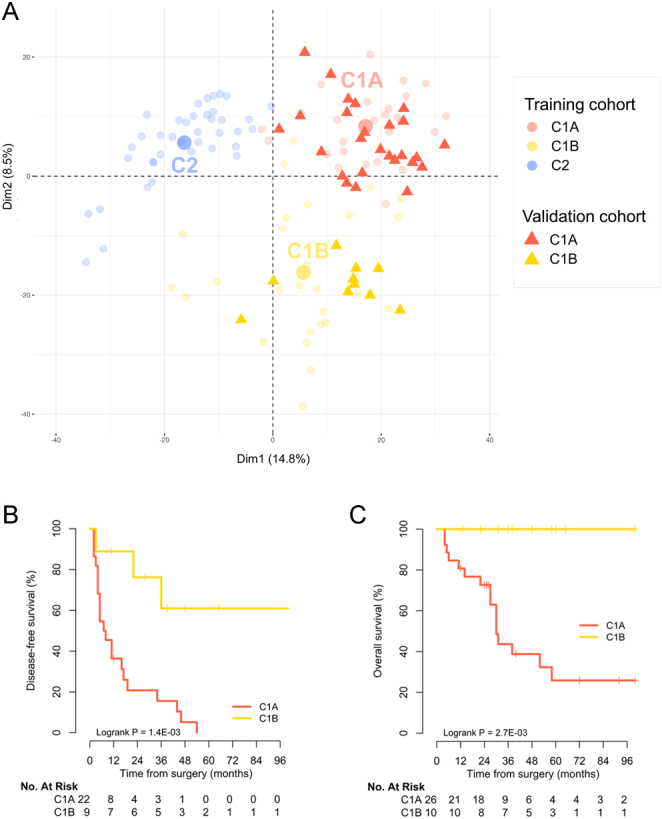
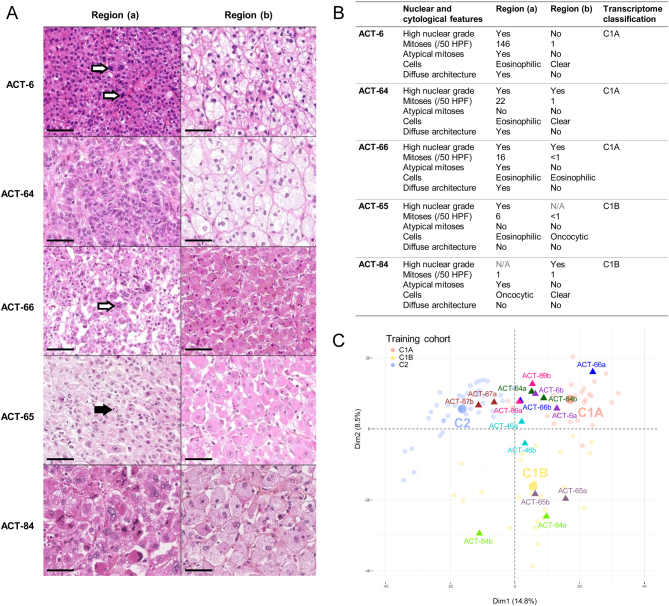
In the training cohort, unsupervised clustering identified three groups: 'C1A' aggressive carcinomas (n = 28, 29%), 'C1B' more indolent carcinomas (n = 28, 29%), and 'C2' adenomas (n = 39, 41%). The prognostic value of FFPE transcriptome was confirmed in the validation cohort (5-year OS: 26% in 'C1A' (n = 26) and 100% in 'C1B' (n = 10), P = 0.003). FFPE transcriptome was an independent prognostic factor in a multivariable model including tumor stage and Ki-67 (OS HR: 7.5, P = 0.01). Oncocytic ACT (n = 19) did not form any specific cluster. Oncocytic carcinomas (n = 6) and oncocytic ACT of uncertain malignant potential (n = 4) were all in 'C1B'.
The 3' RNA-sequencing represents a convenient solution for determining ACT molecular class from FFPE samples. This technique should facilitate routine use and large retrospective studies.
分子分类对于肾上腺皮质肿瘤(ACT)的诊断和预后很重要。转录组谱将肾上腺皮质腺瘤“C2”与癌区分开来,并分别确定预后较差和较好的两组癌“C1A”和“C1B”。然而,由于不适当或不存在冷冻程序,许多 ACT 无法进行分析,这是迄今为止的强制性要求。主要目的是使用新的 3'-端 RNA 测序技术确定福尔马林固定石蜡包埋(FFPE)样本的转录组谱。次要目的是证明该技术通过专注于罕见的嗜酸细胞 ACT 变体来探索大型 FFPE 档案的能力。
我们纳入了 131 例 ACT:来自 Cochin 医院的训练队列和来自 Würzburg 医院的独立验证队列。使用 QuantSeq(Lexogen,维也纳,奥地利)和 NextSeq500(Illumina,圣地亚哥,CA,美国)从 FFPE 样本中生成 3'转录组。
在训练队列中,无监督聚类鉴定出三个组:侵袭性“C1A”癌(n = 28,29%)、惰性“C1B”癌(n = 28,29%)和“C2”腺瘤(n = 39,41%)。FFPE 转录组在验证队列中的预后价值得到证实(5 年 OS:“C1A”(n = 26)为 26%,“C1B”(n = 10)为 100%,P = 0.003)。FFPE 转录组是包括肿瘤分期和 Ki-67 在内的多变量模型中的独立预后因素(OS HR:7.5,P = 0.01)。嗜酸细胞 ACT(n = 19)没有形成任何特定的聚类。嗜酸细胞癌(n = 6)和不确定恶性潜能的嗜酸细胞 ACT(n = 4)均为“C1B”。
3'RNA 测序是从 FFPE 样本中确定 ACT 分子分类的便捷解决方案。该技术应促进常规使用和大型回顾性研究。