Kim Gi-Tae, Go Hye-Bin, Yu Jae-Hun, Yang Song-Yi, Kim Kwang-Mahn, Choi Sung-Hwan, Kwon Jae-Sung
Department and Research Institute of Dental Biomaterials and Bioengineering, Yonsei University College of Dentistry, Seoul 03722, Korea.
BK21 FOUR Program, Yonsei University College of Dentistry, Seoul 03722, Korea.
Polymers (Basel). 2022 Feb 28;14(5):979. doi: 10.3390/polym14050979.
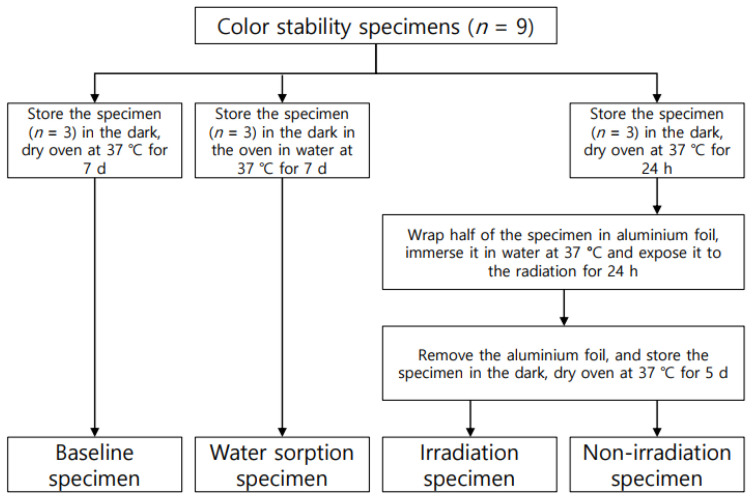
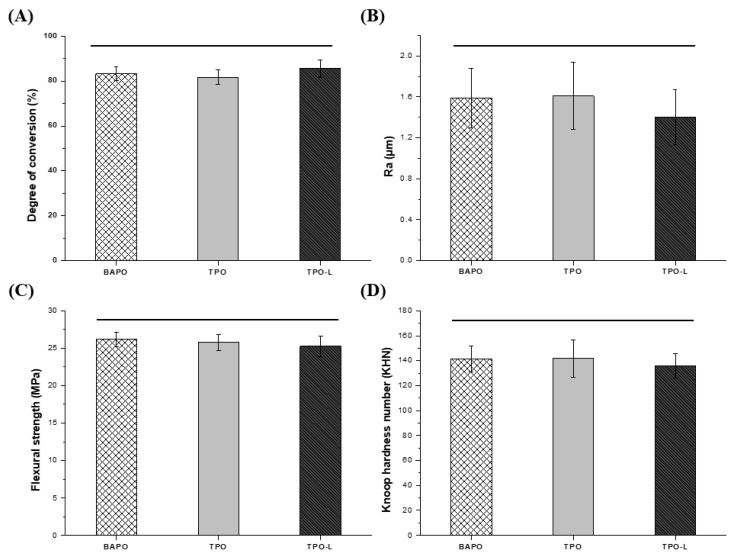
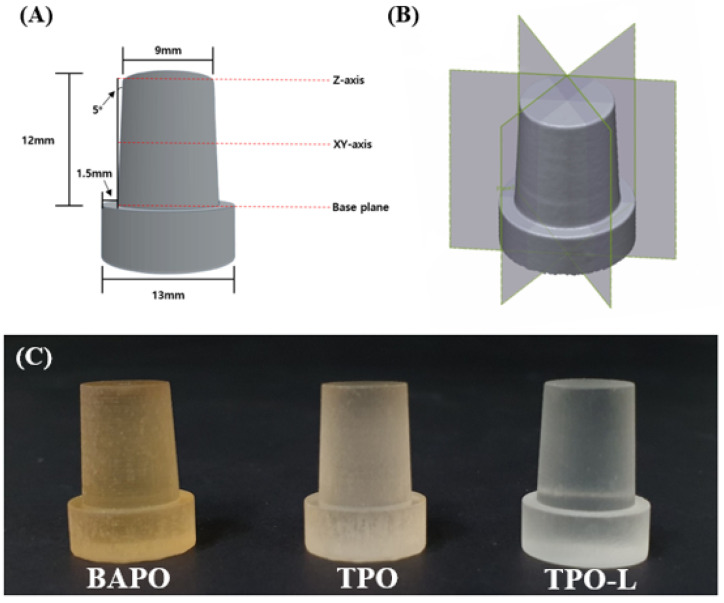
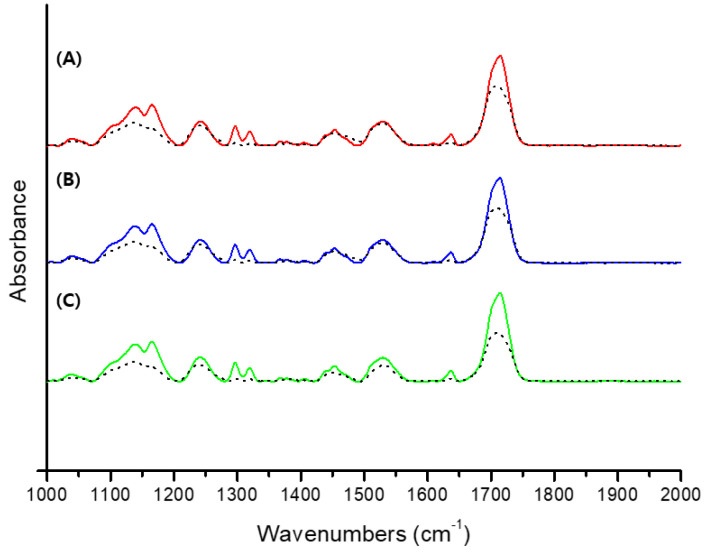
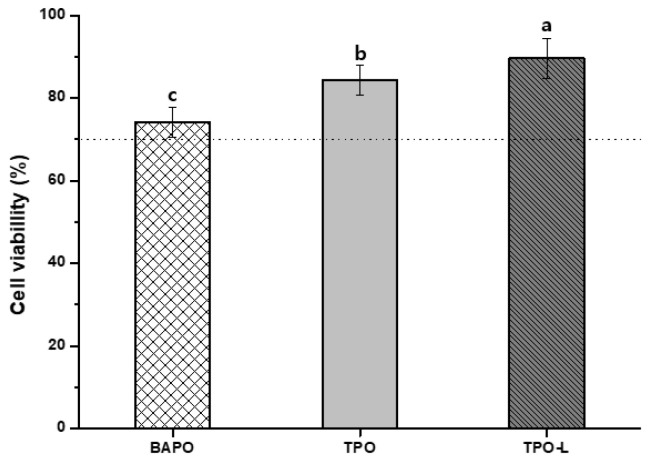
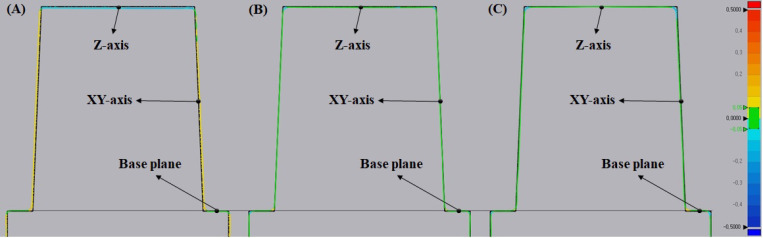
Biocompatibility is important for the 3D printing of resins used in medical devices and can be affected by photoinitiators, one of the key additives used in the 3D printing process. The choice of ingredients must be considered, as the toxicity varies depending on the photoinitiator, and unreacted photoinitiator may leach out of the polymerized resin. In this study, the use of ethyl (2,4,6-trimethylbenzoyl) phenylphosphinate (TPO-L) as a photoinitiator for the 3D printing of resin was considered for application in medical device production, where the cytotoxicity, colour stability, dimensional accuracy, degree of conversion, and mechanical/physical properties were evaluated. Along with TPO-L, two conventional photoinitiators, phenylbis (2,4,6-trimethylbenzoyl) phosphine oxide (BAPO) and diphenyl (2,4,6-trimethylbenzoyl) phosphine oxide (TPO), were considered. A total of 0.1 mol% of each photoinitiator was mixed with the resin matrix to prepare a resin mixture for 3D printing. The specimens were printed using a direct light processing (DLP) type 3D printer. The 3D-printed specimens were postprocessed and evaluated for cytotoxicity, colour stability, dimensional accuracy, degree of conversion, and mechanical properties in accordance with international standards and the methods described in previous studies. The TPO-L photoinitiator showed excellent biocompatibility and colour stability and possessed with an acceptable dimensional accuracy for use in the 3D printing of resins. Therefore, the TPO-L photoinitiator can be sufficiently used as a photoinitiator for dental 3D-printed resin.
生物相容性对于用于医疗设备的树脂3D打印很重要,并且可能会受到光引发剂的影响,光引发剂是3D打印过程中使用的关键添加剂之一。必须考虑成分的选择,因为毒性会因光引发剂而异,并且未反应的光引发剂可能会从聚合树脂中渗出。在本研究中,考虑使用乙基(2,4,6-三甲基苯甲酰基)苯基次膦酸酯(TPO-L)作为树脂3D打印的光引发剂,用于医疗设备生产,对其细胞毒性、颜色稳定性、尺寸精度、转化率以及机械/物理性能进行了评估。除了TPO-L,还考虑了两种传统的光引发剂,苯基双(2,4,6-三甲基苯甲酰基)氧化膦(BAPO)和二苯基(2,4,6-三甲基苯甲酰基)氧化膦(TPO)。将每种光引发剂的总量0.1 mol%与树脂基体混合,以制备用于3D打印的树脂混合物。使用直接光处理(DLP)型3D打印机打印试样。根据国际标准和先前研究中描述的方法,对3D打印的试样进行后处理,并评估其细胞毒性、颜色稳定性、尺寸精度、转化率和机械性能。TPO-L光引发剂表现出优异的生物相容性和颜色稳定性,并且在树脂3D打印中具有可接受的尺寸精度。因此,TPO-L光引发剂可以充分用作牙科3D打印树脂的光引发剂。