Moon Wonjoon, Kim Seihwan, Lim Bum-Soon, Park Young-Seok, Kim Ryan Jin-Young, Chung Shin Hye
Department of Dental Biomaterials Science, Dental Research Institute, School of Dentistry, Seoul National University, 101 Daehak-ro, Jongno-gu, Seoul 03080, Korea.
Department of Aeronautical & Mechanical Engineering, Inha Technical College, 100 Inha-ro, Michuhol-gu, Incheon 22212, Korea.
Materials (Basel). 2021 Mar 18;14(6):1487. doi: 10.3390/ma14061487.
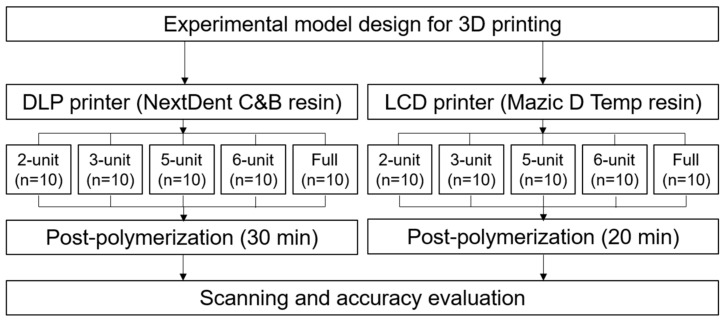
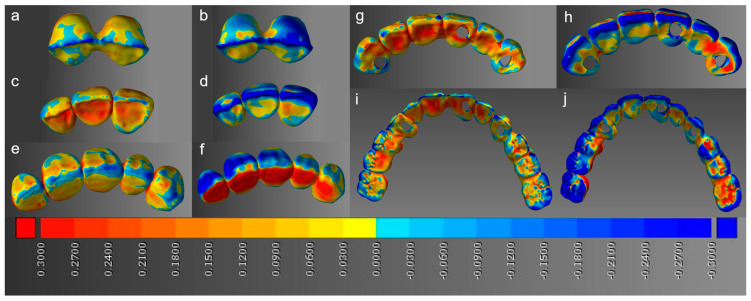
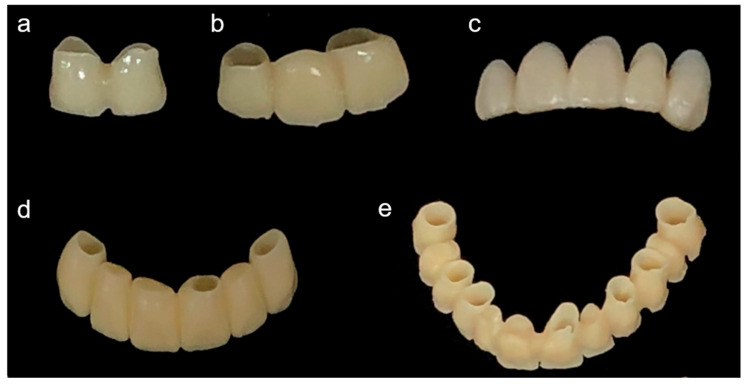
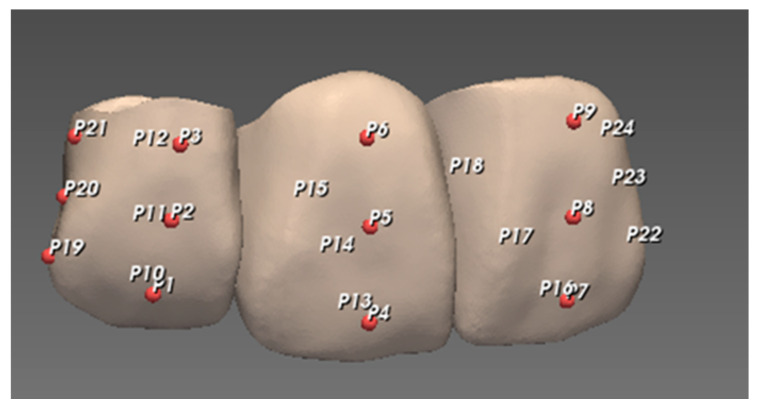
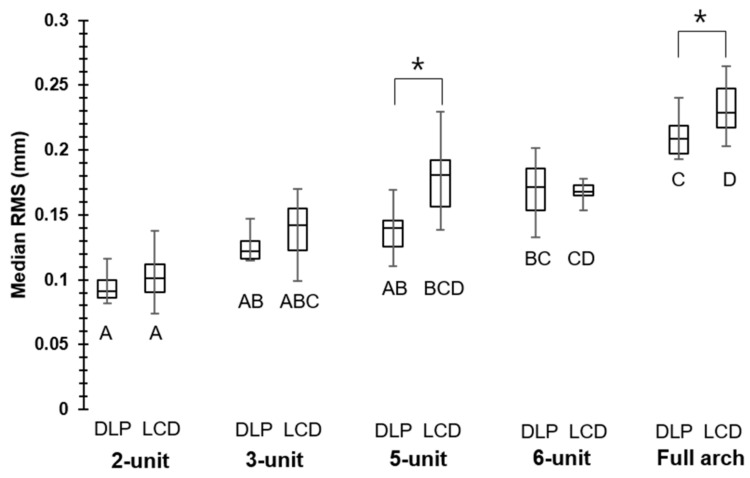
With the advent of 3D printing technologies in dentistry, the optimization of printing conditions has been of great interest, so this study analyzed the accuracy of 3D-printed temporary restorations of different sizes produced by digital light processing (DLP) and liquid crystal display (LCD) printers. Temporary restorations of 2-unit, 3-unit, 5-unit, 6-unit, and full-arch cases were designed and printed from a DLP printer using NextDent C&B or an LCD printer using Mazic D Temp ( = 10 each). The restorations were scanned, and each restoration standard tessellation language (STL) file was superimposed on the reference STL file, by the alignment functions, to evaluate the trueness through whole/point deviation. In the whole-deviation analysis, the root-mean-square (RMS) values were significantly higher in the 6-unit and full-arch cases for the DLP printer and in the 5-unit, 6-unit, and full-arch cases for the LCD printer. The significant difference between DLP and LCD printers was found in the 5-unit and full-arch cases, where the DLP printer exhibited lower RMS values. Color mapping demonstrated less shrinkage in the DLP printer. In the point deviation analysis, a significant difference in direction was exhibited in all the restorations from the DLP printer but only in some cases from the LCD printer. Within the limitations of this study, 3D printing was most accurate with less deviation and shrinkage when a DLP printer was used for short-unit restorations.
随着牙科3D打印技术的出现,打印条件的优化备受关注,因此本研究分析了数字光处理(DLP)打印机和液晶显示器(LCD)打印机制作的不同尺寸3D打印临时修复体的精度。设计了2单位、3单位、5单位、6单位和全牙弓病例的临时修复体,并使用NextDent C&B DLP打印机或Mazic D Temp LCD打印机各打印10个。对修复体进行扫描,并通过对齐功能将每个修复体的标准镶嵌语言(STL)文件叠加在参考STL文件上,以通过整体/点偏差评估准确性。在整体偏差分析中,DLP打印机打印的6单位和全牙弓病例以及LCD打印机打印的5单位、6单位和全牙弓病例的均方根(RMS)值显著更高。在5单位和全牙弓病例中发现DLP打印机和LCD打印机之间存在显著差异,其中DLP打印机的RMS值较低。颜色映射显示DLP打印机的收缩较小。在点偏差分析中,DLP打印机打印的所有修复体在方向上均表现出显著差异,而LCD打印机打印的修复体仅在某些情况下表现出显著差异。在本研究的局限性内,当使用DLP打印机进行短单位修复体打印时,3D打印最为精确,偏差和收缩较小。