Department of Epidemiology and Biostatistics, School of Public Health, Peking University, Beijing 100191, China.
Key Laboratory of Molecular Cardiovascular Sciences, Ministry of Education, Peking University, Beijing 100191, China.
Nutrients. 2022 Feb 25;14(5):980. doi: 10.3390/nu14050980.
This study aimed to identify lipid metabolism-related dietary patterns with reduced rank regression (RRR) among Chinese adults and examine their associations with incident diabetes.
We derived lipid metabolism-related dietary patterns using an RRR with 21 food groups as predictors as well as total cholesterol, low-density lipoprotein (LDL) cholesterol, high-density lipoprotein (HDL) cholesterol, triglycerides, body mass index (BMI), and waist circumference from the responses of 17,318 participants from the second resurvey of the China Kadoorie Biobank (CKB). The dietary scores were calculated for the entire cohort. We followed up 479,207 participants for diabetes incidence from the baseline and used multivariable Cox regression models to estimate the hazard ratios (HRs) and 95% confidence intervals (CIs).
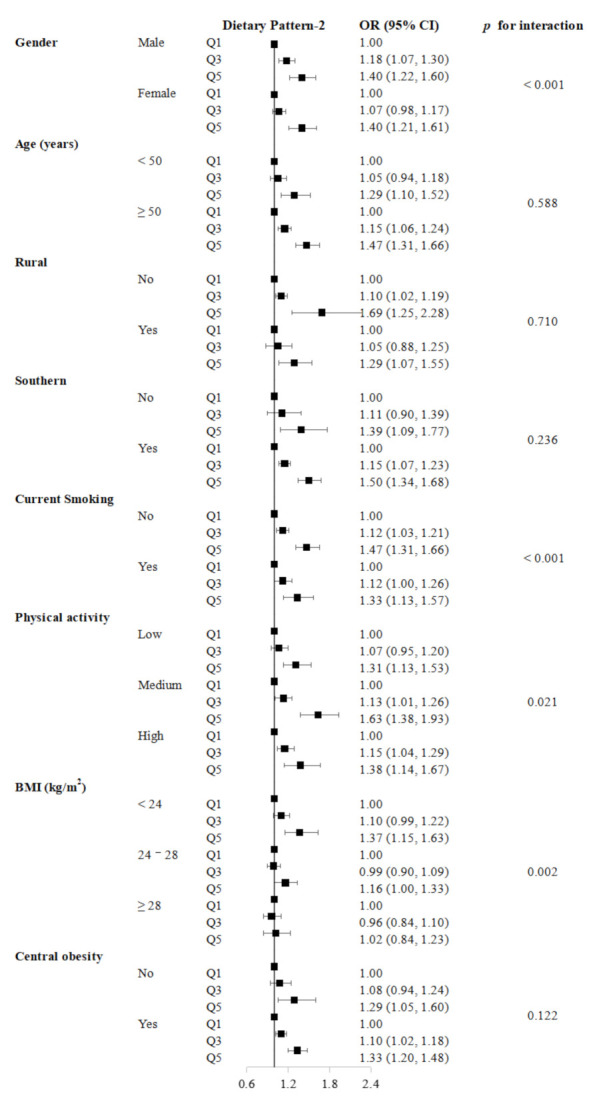
Two lipid metabolism-related dietary patterns were extracted. The dietary pattern-characterized by high intakes of fish, poultry, and other staples as well as fresh fruit and vegetables-was correlated with a higher BMI, waist circumference, and LDL cholesterol. Participants in the highest quintile (Q5) had a 44% increased risk of diabetes incidence when compared with those in the lowest quintile (Q1) (HR = 1.44; 95% CI: 1.31-1.59).
A dietary pattern characterized by high intakes of both animal and plant foods was related to obesity and dyslipidemia and could increase the risk of diabetes incidence.
本研究旨在采用基于降秩回归(RRR)的方法,在中国成年人中识别与脂质代谢相关的饮食模式,并探讨其与糖尿病发病风险的关系。
我们采用 RRR 方法,以 21 种食物组作为预测因子,同时考虑总胆固醇、低密度脂蛋白胆固醇、高密度脂蛋白胆固醇、甘油三酯、体重指数和腰围,从中国慢性病前瞻性研究(CKB)第二次随访的 17318 名参与者的应答中提取与脂质代谢相关的饮食模式。计算整个队列的饮食评分。我们对 479207 名参与者进行了糖尿病发病的随访,使用多变量 Cox 回归模型估计风险比(HR)和 95%置信区间(CI)。
提取出两种与脂质代谢相关的饮食模式。一种饮食模式的特点是摄入大量的鱼、禽肉和其他主食以及新鲜水果和蔬菜,与较高的 BMI、腰围和 LDL 胆固醇相关。与最低五分位组(Q1)相比,处于最高五分位组(Q5)的参与者发生糖尿病的风险增加了 44%(HR=1.44;95%CI:1.31-1.59)。
一种以大量动植物食物摄入为特征的饮食模式与肥胖和血脂异常有关,并可能增加糖尿病发病的风险。