Department of Epidemiology, Colorado School of Public Health, CU Anschutz, Anschutz Medical Campus, Aurora, CO 80045, USA.
Department of Kinesiology, Nutrition, and Dietetics, University of Northern Colorado, Greeley, CO 80639, USA.
Nutrients. 2023 Feb 14;15(4):945. doi: 10.3390/nu15040945.
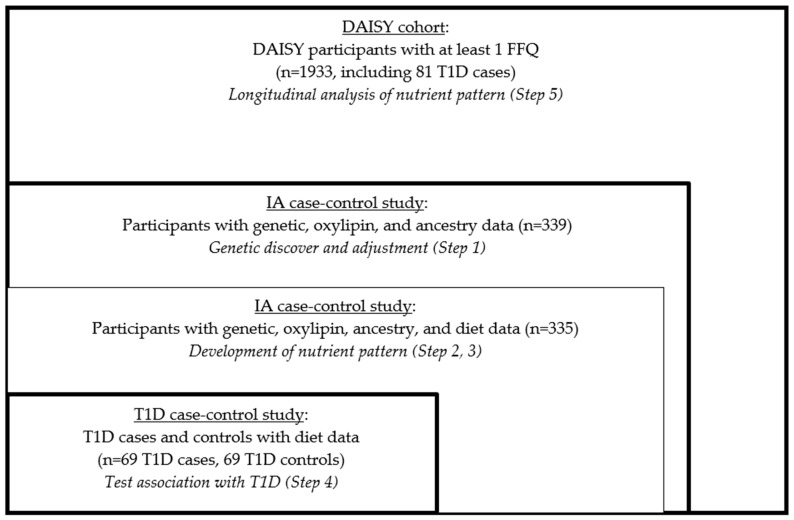
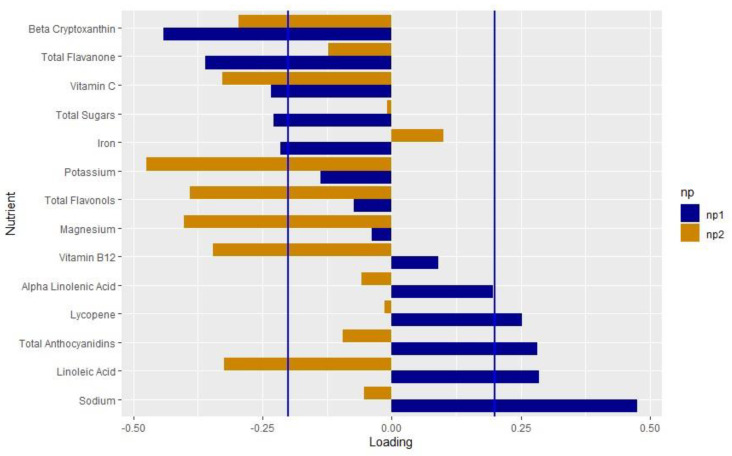
Oxylipins, pro-inflammatory and pro-resolving lipid mediators, are associated with the risk of type 1 diabetes (T1D) and may be influenced by diet. This study aimed to develop a nutrient pattern related to oxylipin profiles and test their associations with the risk of T1D among youth. The nutrient patterns were developed with a reduced rank regression in a nested case-control study ( = 335) within the Diabetes Autoimmunity Study in the Young (DAISY), a longitudinal cohort of children at risk of T1D. The oxylipin profiles (adjusted for genetic predictors) were the response variables. The nutrient patterns were tested in the case-control study ( = 69 T1D cases, 69 controls), then validated in the DAISY cohort using a joint Cox proportional hazards model ( = 1933, including 81 T1D cases). The first nutrient pattern (NP1) was characterized by low beta cryptoxanthin, flavanone, vitamin C, total sugars and iron, and high lycopene, anthocyanidins, linoleic acid and sodium. After adjusting for T1D family history, the HLA genotype, sex and race/ethnicity, NP1 was associated with a lower risk of T1D in the nested case-control study (OR: 0.44, = 0.0126). NP1 was not associated with the risk of T1D (HR: 0.54, -value = 0.1829) in the full DAISY cohort. Future studies are needed to confirm the nested case-control findings and investigate the modifiable factors for oxylipins.
氧化脂类,促炎和促分解脂质介质,与 1 型糖尿病(T1D)的风险相关,并且可能受饮食影响。本研究旨在开发一种与氧化脂类谱相关的营养模式,并测试其与年轻人中 T1D 风险的关联。在糖尿病自身免疫研究中的嵌套病例对照研究(= 335)中,使用简化秩回归方法开发了营养模式,该研究是 T1D 风险儿童的纵向队列。氧化脂类谱(经遗传预测因素调整)是响应变量。营养模式在病例对照研究(= 69 例 T1D 病例,69 例对照)中进行了测试,然后在 DAISY 队列中使用联合 Cox 比例风险模型进行了验证(= 1933,包括 81 例 T1D 病例)。第一个营养模式(NP1)的特征是低β隐黄质、黄烷酮、维生素 C、总糖和铁,而高番茄红素、花青素、亚油酸和钠。在调整 T1D 家族史、HLA 基因型、性别和种族/民族后,NP1 与嵌套病例对照研究中 T1D 风险降低相关(OR:0.44,= 0.0126)。在完整的 DAISY 队列中,NP1 与 T1D 风险无关(HR:0.54,-值= 0.1829)。需要进一步的研究来证实嵌套病例对照研究的结果,并研究可改变的氧化脂类因素。