Lawton Kaila O Y, Arthur Rick M, Moeller Benjamin C, Barnum Samantha, Pusterla Nicola
Department of Medicine and Epidemiology, School of Veterinary Medicine, University of California, Davis, CA 95616, USA.
School of Veterinary Medicine, University of California, Davis, CA 95616, USA.
Animals (Basel). 2022 Feb 28;12(5):614. doi: 10.3390/ani12050614.
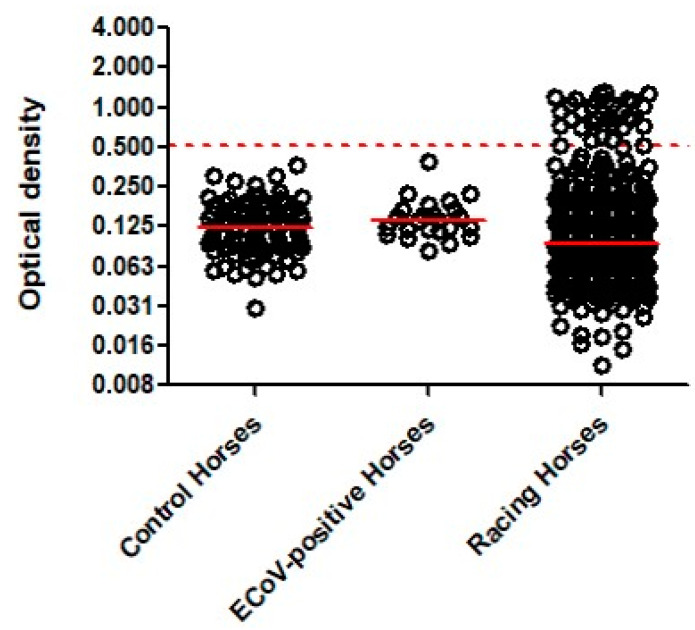
More and more studies are reporting on the natural transmission of SARS-CoV-2 between humans with COVID-19 and their companion animals (dogs and cats). While horses are apparently susceptible to SARS-CoV-2 infection based on the homology between the human and the equine ACE-2 receptor, no clinical or subclinical infection has yet been reported in the equine species. To investigate the possible clinical role of SARS-CoV-2 in equids, nasal secretions from 667 horses with acute onset of fever and respiratory signs were tested for the presence of SARS-CoV-2 by qPCR. The samples were collected from January to December of 2020 and submitted to a commercial molecular diagnostic laboratory for the detection of common respiratory pathogens (equine influenza virus, equine herpesvirus-1/-4, equine rhinitis A and B virus, subspecies ). An additional 633 serum samples were tested for antibodies to SARS-CoV-2 using an ELISA targeting the receptor-binding domain of the spike protein. The serum samples were collected from a cohort of 587 healthy racing Thoroughbreds in California after track personnel tested qPCR-positive for SARS-CoV-2. While 241/667 (36%) equids with fever and respiratory signs tested qPCR-positive for at least one of the common respiratory pathogens, not a single horse tested qPCR-positive for SARS-CoV-2. Amongst the racing Thoroughbreds, 35/587 (5.9%) horses had detectable antibodies to SARS-CoV-2. Similar to dogs and cats, horses do not seem to develop clinical SARS-CoV-2 infection. However, horses can act as incidental hosts and experience silent infection following spillover from humans with COVID-19. SARS-CoV-2-infected humans should avoid close contact with equids during the time of their illness.
越来越多的研究报告了新冠病毒(SARS-CoV-2)在新冠肺炎患者与其伴侣动物(狗和猫)之间的自然传播情况。虽然基于人和马的血管紧张素转换酶2(ACE-2)受体的同源性,马显然易受SARS-CoV-2感染,但尚未有马出现临床或亚临床感染的报告。为了研究SARS-CoV-2在马科动物中可能的临床作用,对667匹出现发热和呼吸道症状急性发作的马的鼻分泌物进行了实时荧光定量聚合酶链反应(qPCR)检测,以确定是否存在SARS-CoV-2。样本采集于2020年1月至12月,并提交给一家商业分子诊断实验室,用于检测常见呼吸道病原体(马流感病毒、马疱疹病毒1型/4型、马鼻炎A和B病毒亚种)。另外,使用一种针对刺突蛋白受体结合域的酶联免疫吸附测定(ELISA)法,对633份血清样本进行了SARS-CoV-2抗体检测。这些血清样本采自加利福尼亚州587匹健康的赛马纯血马,此前赛道工作人员的SARS-CoV-2 qPCR检测呈阳性。虽然667匹出现发热和呼吸道症状的马科动物中有241匹(36%)至少对一种常见呼吸道病原体的qPCR检测呈阳性,但没有一匹马的SARS-CoV-2 qPCR检测呈阳性。在赛马纯血马中,35/587(5.9%)匹马的SARS-CoV-2抗体检测呈阳性。与狗和猫一样,马似乎不会发生SARS-CoV-2临床感染。然而,马可以作为偶然宿主,在接触新冠肺炎患者后发生无症状感染。感染SARS-CoV-2的人在患病期间应避免与马科动物密切接触。