Frustaci Andrea, Najafian Behzad, Donato Giuseppe, Verardo Romina, Chimenti Cristina, Sansone Luigi, Belli Manuel, Vernucci Enza, Russo Matteo Antonio
Department of Clinical, Internal, Anesthesiologist and Cardiovascular Sciences, La Sapienza University, 00100 Rome, Italy.
Cellular and Molecular Cardiology Laboratory, IRCCS L. Spallanzani, 00149 Rome, Italy.
J Clin Med. 2022 Feb 28;11(5):1344. doi: 10.3390/jcm11051344.
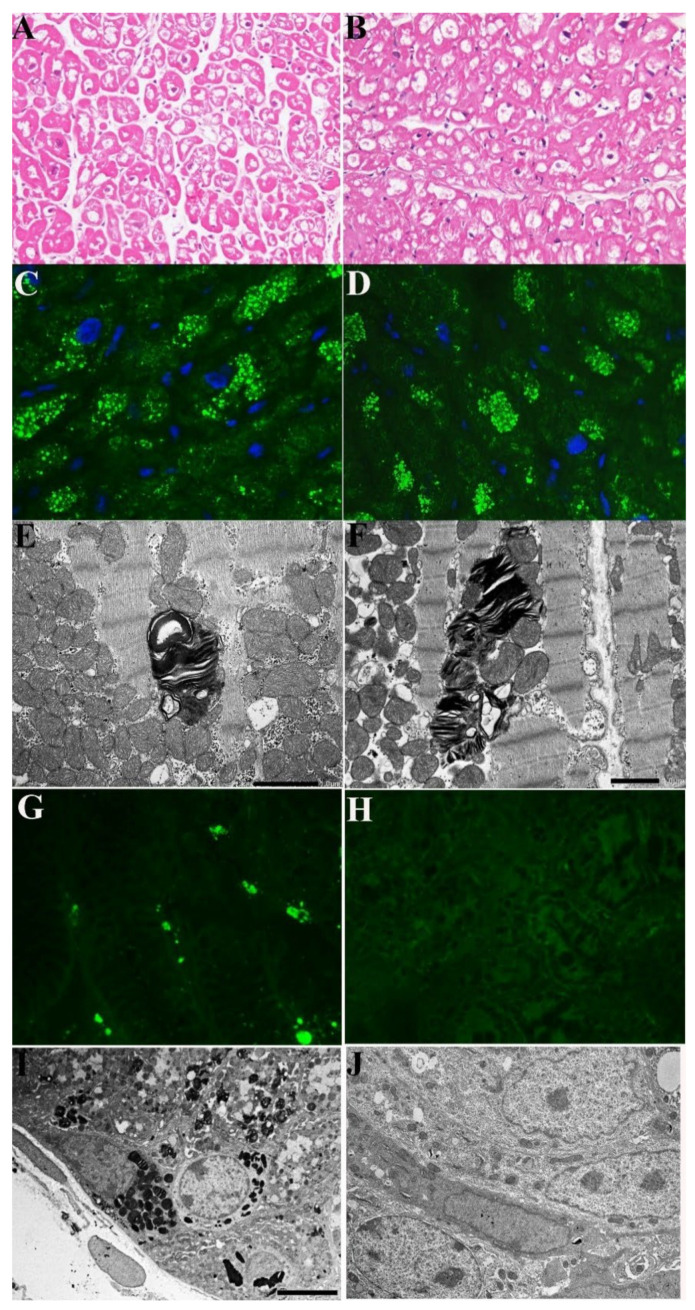
Background: The impact of enzyme replacement therapy (ERT) on cardiomyocytes and intestinal cells, affected by Fabry disease (FD), is still unclear. Methods: Six patients with FD, including five family members with GLA mutation c.666delC and one with GLA mutation c.658C > T, manifesting cardiomyopathy and intestinal symptoms (abdominal pain, diarrhea and malabsorption) were included in the study. Clinical outcome, cardiac magnetic resonance (CMR), endomyocardial and gastro-intestinal biopsies were evaluated before and after 2 years of treatment with agalsidase-α (0.2 mg/kg every other week). Immunohistochemistry and Western blot assessments of mannose-6-phosphate receptors (IGF-II-R) on intestinal and myocardial frozen tissue were obtained at diagnosis and after 2 years of ERT. Results: After ERT left ventricular maximal wall thickness, ranging from pre (<10.5 mm) to mild (<15 mm) and moderate hypertrophy (16 mm), was not associated with significant changes at CMR. Degree of dyspnea, mean cardiomyocyte diameter and % vacuolated areas of cardiomyocytes, representing intracellular GL3, remained unmodified. In contrast, intestinal symptoms improved with disappearance of diarrhea, recovery of anemia and weight gain, correlating with near complete clearance of the enterocytes from GL3 inclusions. IGF-II-R expression was remarkably higher even at histochemistry in intestinal tissue compared with myocardium (p < 0.001) either at baseline and after ERT, thus justifying intestinal recovery. Conclusions: Human cells affected by FD may respond differently to ERT: while cardiomyocytes retain their GL3 content after 2 years of treatment, gastro-intestinal cells show GL3 removal with recovery of function. This divergent response may be related to differences in cellular turnover, as well as tissue IGF-II-R expression.
酶替代疗法(ERT)对受法布里病(FD)影响的心肌细胞和肠道细胞的影响仍不清楚。方法:本研究纳入了6例FD患者,其中包括5名携带GLA突变c.666delC的家庭成员和1名携带GLA突变c.658C>T的患者,这些患者均表现出心肌病和肠道症状(腹痛、腹泻和吸收不良)。在使用α-半乳糖苷酶(每隔一周0.2mg/kg)治疗2年前后,对临床结局、心脏磁共振成像(CMR)、心内膜和胃肠道活检进行了评估。在诊断时和ERT治疗2年后,对肠道和心肌冷冻组织进行了甘露糖-6-磷酸受体(IGF-II-R)的免疫组织化学和蛋白质印迹评估。结果:ERT治疗后,左心室最大壁厚从治疗前的<10.5mm变为轻度的<15mm和中度肥厚(16mm),CMR检查未发现显著变化。呼吸困难程度、平均心肌细胞直径和代表细胞内GL3的心肌细胞空泡化面积百分比均未改变。相比之下,肠道症状有所改善,腹泻消失、贫血恢复且体重增加,这与肠细胞中GL3包涵体几乎完全清除相关。在基线和ERT治疗后,肠道组织中IGF-II-R的表达在组织化学上均显著高于心肌(p<0.001),这也解释了肠道功能的恢复。结论:受FD影响的人体细胞对ERT的反应可能不同:治疗2年后心肌细胞仍保留其GL3含量,而胃肠道细胞则显示GL3清除且功能恢复。这种不同的反应可能与细胞更新差异以及组织中IGF-II-R的表达有关。