Denegri Andrea, Sola Matteo, Morelli Marianna, Farioli Francesco, Alberto Tosetti, D'Arienzo Matteo, Savorani Fulvio, Pezzuto Giuseppe Stefano, Boriani Giuseppe, Szarpak Lukasz, Magnani Giulia
Cardiology Division, Parma University Hospital, 43125 Parma, Italy.
Faculty of Medicine & Surgery, University of Modena and Reggio Emilia, Via Università 4, 41121 Modena, Italy.
J Clin Med. 2022 Mar 7;11(5):1463. doi: 10.3390/jcm11051463.
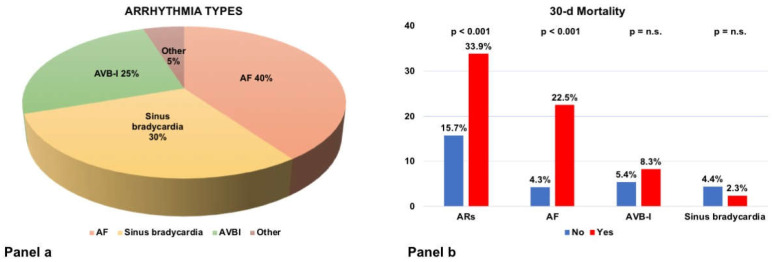
Arrhythmias (ARs) are potential cardiovascular complication of COVID-19 but may also have a prognostic role. The aim of this study was to explore the prevalence and impact of cardiac ARs in hospitalized COVID-19 patients. All-comer patients admitted to the emergency department of Modena University Hospital from 16 March to 31 December 2020 and diagnosed with COVID-19 pneumonia infection were included in the study. The primary endpoint was 30-day mortality. Out of 902 patients, 637 (70.6%) presented a baseline 12-lead ECG registration; of these, 122 (19.2%) were diagnosed with ARs. Atrial fibrillation (AF, 40.2%) was the most frequent AR detected. The primary endpoint (30-day mortality) occurred in 33.6% (p < 0.001). AR-patients presented an almost 3-fold risk of mortality compared to non-AR-patients at 30d (Adj. OR = 2.8, 95%CI: 1.8−4.3, p < 0.001). After adjustment for significant baseline characteristics selected by a stepwise backward selection, AR-patients remained at increased risk of mortality (Adj. HR = 2.0, 95%CI: 1.9−2.3, p < 0.001). Sub-group analysis revealed that among ARs patients, those with AF at admission presented the highest risk of 30-day mortality (Adj. HR = 3.1, 95%CI: 2.0−4.9, p < 0.001). In conclusion, ARs are a quite common manifestation in COVID-19 patients, who are burdened by even worse prognosis. AR patients with AF presented the highest risk of mortality; thus, these patients may benefit from a more aggressive secondary preventive therapy and a closer follow up.
心律失常(ARs)是新冠病毒肺炎(COVID-19)潜在的心血管并发症,但也可能具有预后作用。本研究旨在探讨住院COVID-19患者中心脏ARs的患病率及影响。纳入2020年3月16日至12月31日入住摩德纳大学医院急诊科且诊断为COVID-19肺炎感染的所有患者。主要终点为30天死亡率。902例患者中,637例(70.6%)有基线12导联心电图记录;其中122例(19.2%)诊断为ARs。检测到的最常见ARs是心房颤动(AF,40.2%)。主要终点(30天死亡率)发生率为33.6%(p<0.001)。与非ARs患者相比,ARs患者在30天时的死亡风险几乎高出3倍(调整后比值比=2.8,95%置信区间:1.8−4.3,p<0.001)。在通过逐步向后选择确定的显著基线特征进行调整后,ARs患者的死亡风险仍然增加(调整后风险比=2.0,95%置信区间:1.9−2.3,p<0.001)。亚组分析显示,在ARs患者中,入院时患有AF的患者30天死亡风险最高(调整后风险比=3.1,95%置信区间:2.0−4.9,p<0.001)。总之,ARs是COVID-19患者中相当常见的表现,这些患者预后更差。患有AF的ARs患者死亡风险最高;因此,这些患者可能从更积极的二级预防治疗和更密切的随访中获益。