Zhu Xiaohong, Hu Ziwei, Yu Tian, Hu Hao, Zhao Yunshi, Li Chenyang, Zhu Qinchang, Wang Mingzhong, Zhai Peng, He Longxia, Riaz Rajoka Muhammad Shahid, Song Xun, He Zhendan
Affiliated Longhua People's Hospital, Southern Medical University, Shenzhen 518172, China.
School of Pharmaceutical Sciences, School of Basic Medicine, Health Science Center, Shenzhen University, Shenzhen 518000, China.
Molecules. 2022 Feb 28;27(5):1598. doi: 10.3390/molecules27051598.
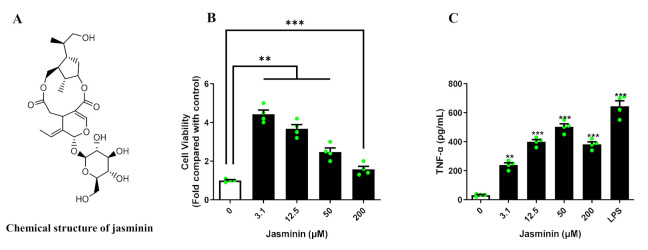
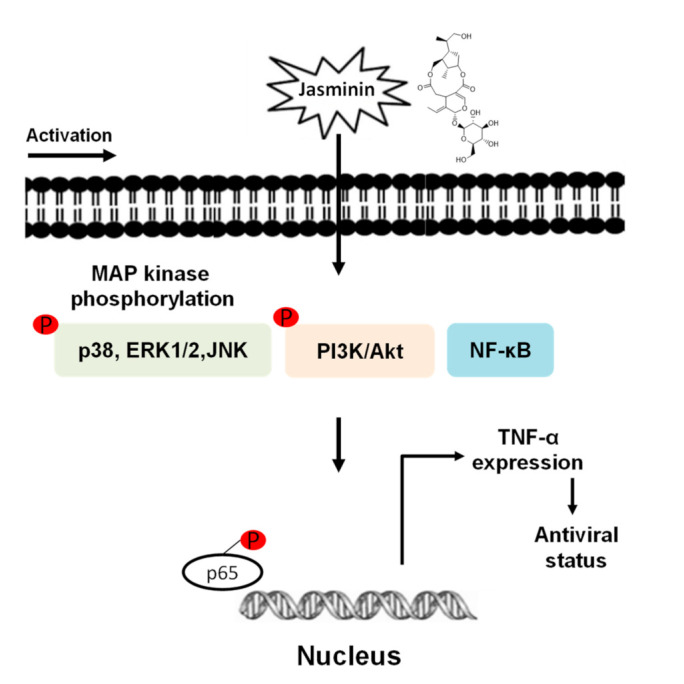
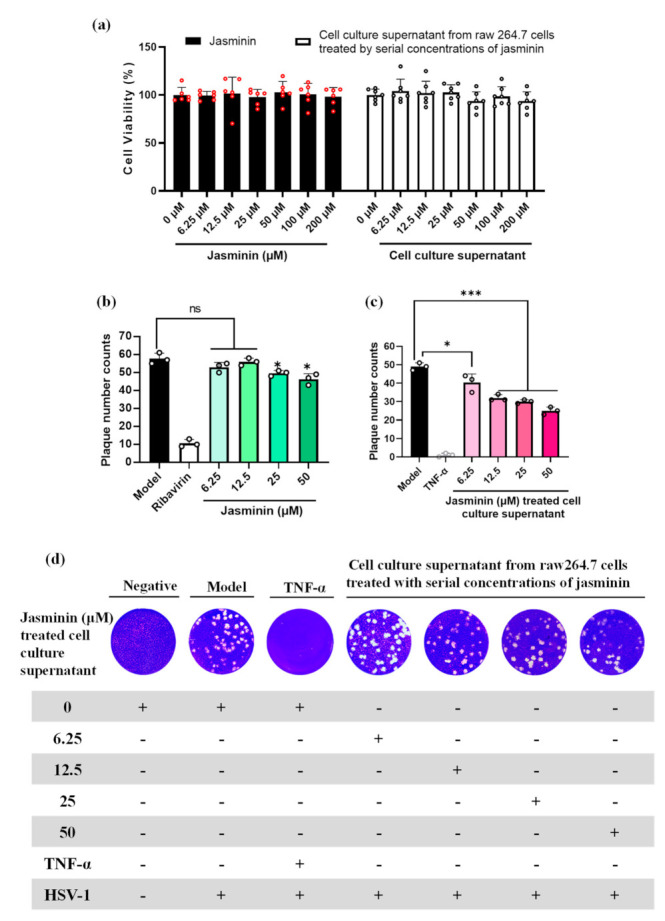
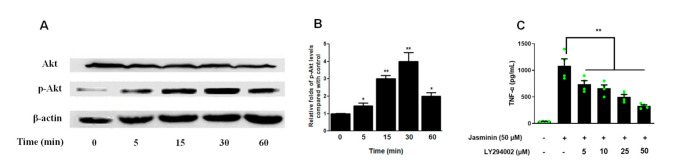
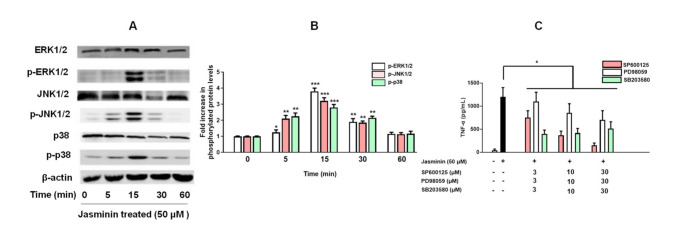
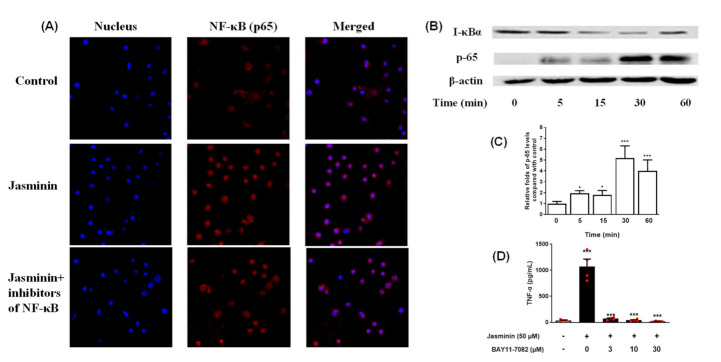
Previous studies have reported that recombinant tumor necrosis factor (TNF)-α has powerful antiviral activity but severe systematic side effects. Jasminin is a common bioactive component found in Chinese herbal medicine beverage "Jasmine Tea". Here, we report that jasminin-induced endogenous TNF-α showed antiviral activity in vitro. The underlying TNF-α-inducing action of jasminin was also investigated in RAW264.7 cells. The level of endogenous TNF-α stimulated by jasminin was first analyzed by an enzyme-linked immunosorbent assay (ELISA) from the cell culture supernatant of RAW264.7 cells. The supernatants were then collected to investigate the potential antiviral effect against herpes simplex virus 1 (HSV-1). The antiviral effects of jasminin alone or its supernatants were evaluated by a plaque reduction assay. The potential activation of the PI3K-Akt pathway, three main mitogen-activated protein kinases (MAPKs), and nuclear factor (NF)-κB signaling pathways that induce TNF-α production were also investigated. Jasminin induces TNF-α protein expression in RAW264.7 cells without additional stimuli 10-fold more than the control. No significant up-expression of type I, II, and III interferons; interleukins 2 and 10; nor TNF-β were observed by the jasminin stimuli. The supernatants, containing jasminin-induced-TNF-α, showed antiviral activity against HSV-1. The jasminin-stimulated cells caused the simultaneous activation of the Akt, MAPKs, and NF-κB signal pathways. Furthermore, the pretreatment of the cells with the Akt, MAPKs, and NF-κB inhibitors effectively suppressed jasminin-induced TNF-α production. Our research provides evidence that endogenous TNF-α can be used as a strategy to encounter viral infections. Additionally, the Akt, MAPKs, and NF-κB signaling pathways are involved in the TNF-α synthesis that induced by jasminin.
先前的研究报道,重组肿瘤坏死因子(TNF)-α具有强大的抗病毒活性,但会产生严重的全身副作用。茉莉宁是在中草药饮品“茉莉花茶”中发现的一种常见生物活性成分。在此,我们报道茉莉宁诱导的内源性TNF-α在体外具有抗病毒活性。我们还在RAW264.7细胞中研究了茉莉宁诱导TNF-α的潜在作用机制。首先通过酶联免疫吸附测定(ELISA)分析RAW264.7细胞培养上清液中茉莉宁刺激的内源性TNF-α水平。然后收集上清液以研究其对单纯疱疹病毒1(HSV-1)的潜在抗病毒作用。通过蚀斑减少试验评估茉莉宁单独作用或其上清液的抗病毒效果。我们还研究了诱导TNF-α产生的PI3K-Akt信号通路、三种主要的丝裂原活化蛋白激酶(MAPK)和核因子(NF)-κB信号通路的潜在激活情况。茉莉宁在无额外刺激的情况下可诱导RAW264.7细胞中TNF-α蛋白表达,其表达量比对照高10倍。茉莉宁刺激未观察到I型、II型和III型干扰素、白细胞介素2和10以及TNF-β的显著上调表达。含有茉莉宁诱导的TNF-α的上清液对HSV-1具有抗病毒活性。茉莉宁刺激的细胞导致Akt、MAPK和NF-κB信号通路同时激活。此外,用Akt、MAPK和NF-κB抑制剂预处理细胞可有效抑制茉莉宁诱导的TNF-α产生。我们的研究提供了证据表明内源性TNF-α可作为对抗病毒感染的一种策略。此外,Akt、MAPK和NF-κB信号通路参与了茉莉宁诱导的TNF-α合成。