Linkou Medical Center, Department of Neurology, Chang Gung Memorial Hospital, College of Medicine, Chang Gung University, Taoyuan 333, Taiwan.
Department of Life Science, School of Life Science, National Taiwan Normal University, Taipei 106, Taiwan.
Int J Mol Sci. 2022 Feb 28;23(5):2685. doi: 10.3390/ijms23052685.
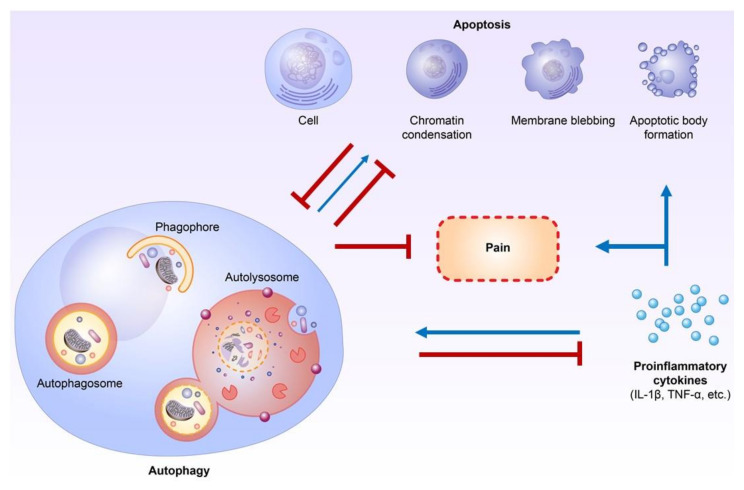
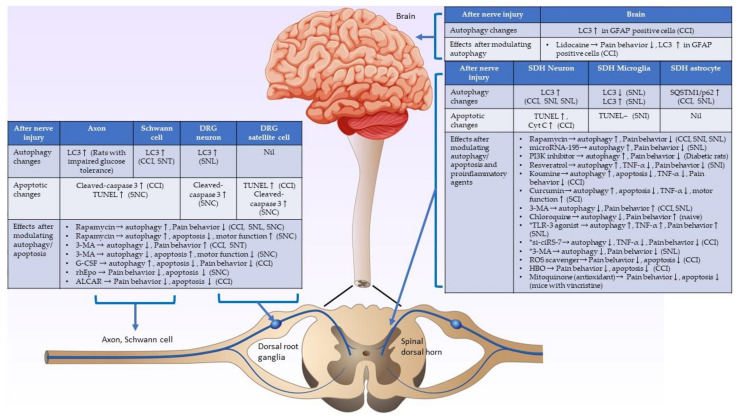
Neuropathic pain indicates pain caused by damage to the somatosensory system and is difficult to manage and treat. A new treatment strategy urgently needs to be developed. Both autophagy and apoptosis are critical adaptive mechanisms when neurons encounter stress or damage. Recent studies have shown that, after nerve damage, both autophagic and apoptotic activities in the injured nerve, dorsal root ganglia, and spinal dorsal horn change over time. Many studies have shown that upregulated autophagic activities may help myelin clearance, promote nerve regeneration, and attenuate pain behavior. On the other hand, there is no direct evidence that the inhibition of apoptotic activities in the injured neurons can attenuate pain behavior. Most studies have only shown that agents can simultaneously attenuate pain behavior and inhibit apoptotic activities in the injured dorsal root ganglia. Autophagy and apoptosis can crosstalk with each other through various proteins and proinflammatory cytokine expressions. Proinflammatory cytokines can promote both autophagic/apoptotic activities and neuropathic pain formation, whereas autophagy can inhibit proinflammatory cytokine activities and further attenuate pain behaviors. Thus, agents that can enhance autophagic activities but suppress apoptotic activities on the injured nerve and dorsal root ganglia can treat neuropathic pain. Here, we summarized the evolving changes in apoptotic and autophagic activities in the injured nerve, dorsal root ganglia, spinal cord, and brain after nerve damage. This review may help in further understanding the treatment strategy for neuropathic pain during nerve injury by modulating apoptotic/autophagic activities and proinflammatory cytokines in the nervous system.
神经病理性疼痛表示由躯体感觉系统损伤引起的疼痛,且难以管理和治疗。因此急需开发新的治疗策略。自噬和细胞凋亡都是神经元遇到应激或损伤时的关键适应机制。最近的研究表明,在神经损伤后,损伤神经、背根神经节和脊髓背角中的自噬和凋亡活性随时间发生变化。许多研究表明,上调的自噬活性可能有助于髓鞘清除、促进神经再生和减轻疼痛行为。另一方面,没有直接证据表明抑制损伤神经元中的凋亡活性可以减轻疼痛行为。大多数研究仅表明药物可以同时减轻疼痛行为并抑制损伤背根神经节中的凋亡活性。自噬和凋亡可以通过各种蛋白质和促炎细胞因子的表达相互作用。促炎细胞因子可以促进自噬/凋亡活性和神经病理性疼痛的形成,而自噬可以抑制促炎细胞因子的活性,进一步减轻疼痛行为。因此,能够增强损伤神经和背根神经节上自噬活性但抑制凋亡活性的药物可以治疗神经病理性疼痛。在这里,我们总结了神经损伤后损伤神经、背根神经节、脊髓和大脑中凋亡和自噬活性的演变变化。这篇综述可能有助于通过调节神经系统中的凋亡/自噬活性和促炎细胞因子来进一步了解神经损伤期间神经病理性疼痛的治疗策略。