Dar Basharat A, Assaeed Abdulaziz M, Al-Rowaily Saud L, Al-Doss Abdullah A, Abd-ElGawad Ahmed M
Plant Production Department, College of Food & Agriculture Sciences, King Saud University, P.O. Box 2460, Riyadh 11451, Saudi Arabia.
Department of Botany, Faculty of Science, Mansoura University, Mansoura 35516, Egypt.
Plants (Basel). 2022 Feb 28;11(5):666. doi: 10.3390/plants11050666.
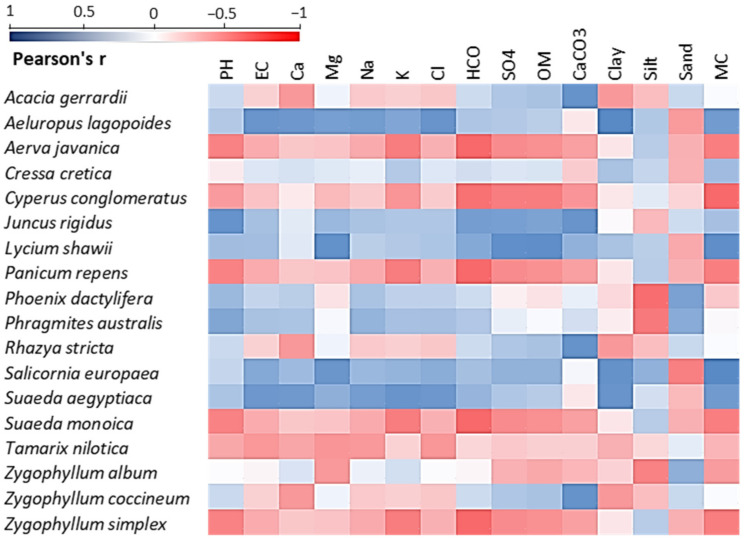
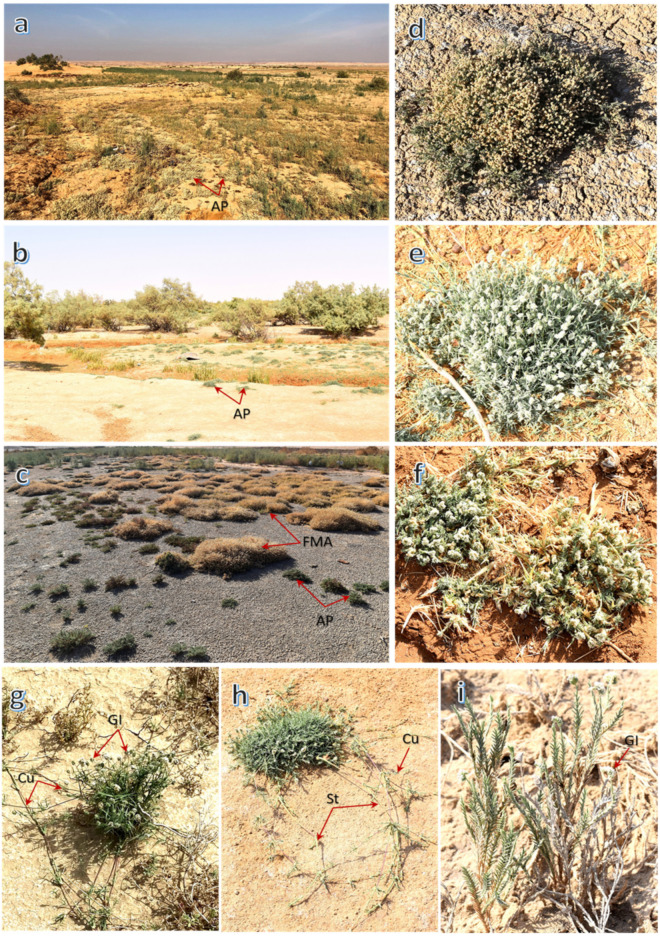
Sabkhas are unique, highly saline ecosystems, where specially adapted plants can grow. (L.) Thwaites is a halophytic forage plant growing in salt marsh habitats of inland and coastal sabkhas of Saudi Arabia. The present study provides an analysis of vegetation composition and distribution of the community in five different regions within Saudi Arabia, emphasizing the environmental factors that affect species distribution. The floristic survey revealed the presence of 48 species, belonging to 26 families. Poaceae, Chenopodiaceae, Mimosaceae, Zygophyllaceae, and Asteraceae are the largest families (50% of total species). Phanerophyte, followed by chamaephytes, are the most frequent forms, indicating a typical saline desert life-form spectrum. The vegetation analysis revealed the dominance of in all locations, where it was the most dominant species in Qareenah, Qaseem, and Salwa locations, and the second most dominant species in Jouf and Jizan locations. The flourishment of this halophytic grass within a wide soil range in sabkhas revealed its adaptability to the harsh environment, which could be ascribed to its structural adaptations and modifications, as well as the phenotypic plasticity. The Qareenah and Qaseem locations attained the highest species richness and evenness, while the Jizan location was the least diverse. Within the studied locations, other highly salt-tolerant species were determined with high abundances, such as (Hasselq.) Zohary, L.f., (Ehrenb.) Bunge, L., and L. The soil analysis showed a significant variation for all parameters among the studied locations, except for pH, chloride, and clay content. The Qaseem location revealed the highest values of most soil parameters, while the Jizan location showed the lowest. The canonical correspondence analysis (CCA) showed that the community structure and diversity are mainly affected by the soil salinity and moisture. Due to the economic potentialities of as a forage plant and sand stabilizer, the conservation of its habitats is of vital importance. In addition, this grass could be integrated as a promising forage candidate that can be planted in saline-affected areas, even in the summer dry season.
盐沼是独特的、高盐度的生态系统,在那里有特别适应的植物能够生长。(L.) Thwaites是一种盐生饲用植物,生长在沙特阿拉伯内陆和沿海盐沼的盐沼生境中。本研究对沙特阿拉伯五个不同地区群落的植被组成和分布进行了分析,强调了影响物种分布的环境因素。植物区系调查发现了48个物种,隶属于26个科。禾本科、藜科、含羞草科、蒺藜科和菊科是最大的科(占总物种数的50%)。高位芽植物,其次是地面芽植物,是最常见的生活型,表明是典型的盐漠生活型谱。植被分析表明,在所有地点均占优势,在卡瑞纳、卡西姆和萨尔瓦地点它是最优势的物种,在焦夫和吉赞地点是第二优势物种。这种盐生草在盐沼广泛的土壤范围内繁茂生长,揭示了它对恶劣环境的适应性,这可归因于其结构适应和修饰以及表型可塑性。卡瑞纳和卡西姆地点的物种丰富度和均匀度最高,而吉赞地点的多样性最低。在研究地点内,还确定了其他高耐盐物种,且丰度较高,如(Hasselq.) Zohary、L.f.、(Ehrenb.) Bunge、L.和L.。土壤分析表明,除pH值、氯化物和粘土含量外,所有参数在研究地点之间存在显著差异。卡西姆地点的大多数土壤参数值最高,而吉赞地点的值最低。典范对应分析(CCA)表明,群落结构和多样性主要受土壤盐度和湿度的影响。由于作为饲用植物和固沙植物具有经济潜力,保护其栖息地至关重要。此外,这种草可以作为一种有前景的饲用候选植物引入,甚至可以在夏季干旱季节种植在受盐影响的地区。