Saw Swee Hock School of Public Health, National University of Singapore, Singapore.
Singapore Institute for Clinical Sciences, Agency for Science, Technology and Research, Singapore.
Am J Mens Health. 2022 Mar-Apr;16(2):15579883221074788. doi: 10.1177/15579883221074788.
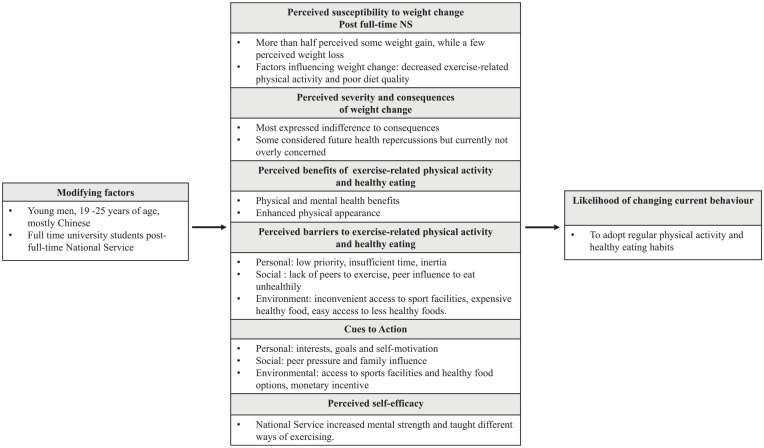
Higher prevalence of obesity in men compared with women, particularly among those 18 to 40 years of age, has been observed in Singapore. We explored young men's perceptions of weight change after transiting out of National Service (NS) over a 12-month period and sought to understand the underlying drivers. In-depth interviews, guided by the Health Belief Model (HBM), were conducted with young men 12 months after they had completed full-time NS. Six constructs from the HBM, namely, perceived susceptibility, perceived severity, perceived benefits, perceived barriers, cues to action, and perceived self-efficacy, were utilized to guide the analysis. Thematic analysis revealed that participants generally perceived a gain in body weight after the transition and attributed this to decreased exercise-related physical activity (PA) levels and increased consumption of unhealthy food. However, many did not display immediate concerns nor view leading a healthy lifestyle as priority, citing time constraints, inertia to comply, or lack of access to sports facilities and healthy food options as barriers. Healthy lifestyle behaviors, mainly PA, were mostly pursued for physical health and appearance. Motivators toward a healthy lifestyle tended to be internal factors such as self-motivation, personal preference, and habit, whereas external motivators included peer or familial influence and environmental factors. Our findings align with key concepts of the HBM and suggest a need to educate young men transiting out of NS on lifestyle, weight, and health, in particular addressing their misconceptions.
在新加坡,男性的肥胖患病率高于女性,尤其是在 18 至 40 岁的人群中。我们探讨了年轻男性在服完兵役(NS)后一年内对体重变化的看法,并试图了解其潜在驱动因素。在完成全职兵役 12 个月后,对年轻男性进行了深入访谈,访谈以健康信念模型(HBM)为指导。HBM 的六个构建体,即感知易感性、感知严重性、感知益处、感知障碍、行动线索和感知自我效能,被用来指导分析。主题分析显示,参与者普遍认为在过渡后体重增加,并将其归因于运动相关体力活动(PA)水平下降和不健康食物消费增加。然而,许多人并没有立即表现出担忧,也没有将健康生活方式视为优先事项,他们提到时间限制、惯性遵守、或缺乏体育设施和健康食品选择等障碍。健康的生活方式行为,主要是 PA,主要是为了身体健康和外表。健康生活方式的动机往往是内在因素,如自我激励、个人偏好和习惯,而外在动机包括同伴或家庭的影响和环境因素。我们的研究结果与 HBM 的关键概念一致,表明需要对刚服完兵役的年轻男性进行有关生活方式、体重和健康的教育,特别是要纠正他们的误解。