Department of Biomedical Engineering, University of Michigan, Ann Arbor, MI, United States.
Department of Microbiology and Immunology, The University of Melbourne, at the Peter Doherty Institute for Infection and Immunity, Melbourne, VIC, Australia.
Front Immunol. 2022 Feb 22;13:820148. doi: 10.3389/fimmu.2022.820148. eCollection 2022.
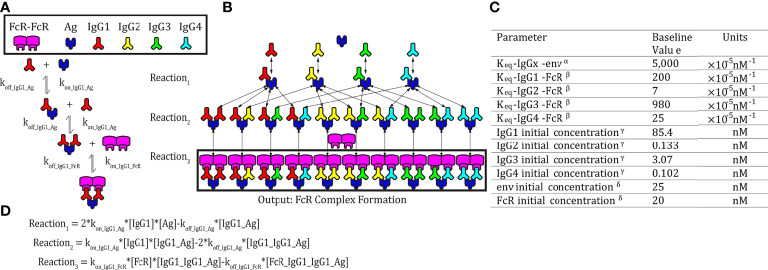
Fc-mediated immune functions have been correlated with protection in the RV144 HIV vaccine trial and are important for immunity to a range of pathogens. IgG antibodies (Abs) that form complexes with Fc receptors (FcRs) on innate immune cells can activate Fc-mediated immune functions. Genetic variation in both IgGs and FcRs have the capacity to alter IgG-FcR complex formation changes in binding affinity and concentration. A growing challenge lies in unraveling the importance of multiple variations, especially in the context of vaccine trials that are conducted in homogenous genetic populations. Here we use an ordinary differential equation model to quantitatively assess how IgG1 allotypes and FcγR polymorphisms influence IgG-FcγRIIIa complex formation in vaccine-relevant settings. Using data from the RV144 HIV vaccine trial, we map the landscape of IgG-FcγRIIIa complex formation predicted post-vaccination for three different IgG1 allotypes and two different FcγRIIIa polymorphisms. Overall, the model illustrates how specific vaccine interventions could be applied to maximize IgG-FcγRIIIa complex formation in different genetic backgrounds. Individuals with the G1m1,17 and G1m1,3 allotypes were predicted to be more responsive to vaccine adjuvant strategies that increase antibody FcγRIIIa affinity (e.g. glycosylation modifications), compared to the G1m-1,3 allotype which was predicted to be more responsive to vaccine boosting regimens that increase IgG1 antibody titers (concentration). Finally, simulations in mixed-allotype populations suggest that the benefit of boosting IgG1 concentration versus IgG1 affinity may be dependent upon the presence of the G1m-1,3 allotype. Overall this work provides a quantitative tool for rationally improving Fc-mediated functions after vaccination that may be important for assessing vaccine trial results in the context of under-represented genetic populations.
Fc 介导的免疫功能与 RV144 HIV 疫苗试验中的保护作用相关,对于针对多种病原体的免疫至关重要。与 Fc 受体 (FcR) 形成复合物的 IgG 抗体 (Abs) 可以激活 Fc 介导的免疫功能。IgG 和 FcR 的遗传变异都有能力改变 IgG-FcR 复合物的形成——改变结合亲和力和浓度。一个日益严峻的挑战在于揭示多种变异的重要性,尤其是在同质遗传人群中进行的疫苗试验背景下。在这里,我们使用常微分方程模型来定量评估 IgG1 同种型和 FcγR 多态性如何影响疫苗相关环境中的 IgG-FcγRIIIa 复合物形成。利用来自 RV144 HIV 疫苗试验的数据,我们为三种不同的 IgG1 同种型和两种不同的 FcγRIIIa 多态性描绘了疫苗接种后预测的 IgG-FcγRIIIa 复合物形成的景观。总体而言,该模型说明了如何应用特定的疫苗干预措施来最大限度地提高不同遗传背景下的 IgG-FcγRIIIa 复合物形成。与 G1m-1,3 同种型相比,预测具有 G1m1,17 和 G1m1,3 同种型的个体对增加抗体 FcγRIIIa 亲和力的疫苗佐剂策略(例如糖基化修饰)更敏感,而 G1m-1,3 同种型则预测对增加 IgG1 抗体滴度(浓度)的疫苗增强方案更敏感。最后,在混合同种型人群中的模拟表明,与 IgG1 亲和力相比,增强 IgG1 浓度的益处可能取决于 G1m-1,3 同种型的存在。总的来说,这项工作为理性地改善接种疫苗后的 Fc 介导功能提供了一种定量工具,这对于在代表性不足的遗传人群背景下评估疫苗试验结果可能很重要。