Department of Healthcare Management, School of Public Health, Wuhan University, Wuhan 430071, China.
Department of Implementation Science, Division of Public Health Sciences, Wake Forest School of Medicine, Winston-Salem, NC 27101, USA.
Nutrients. 2022 Jan 25;14(3):510. doi: 10.3390/nu14030510.
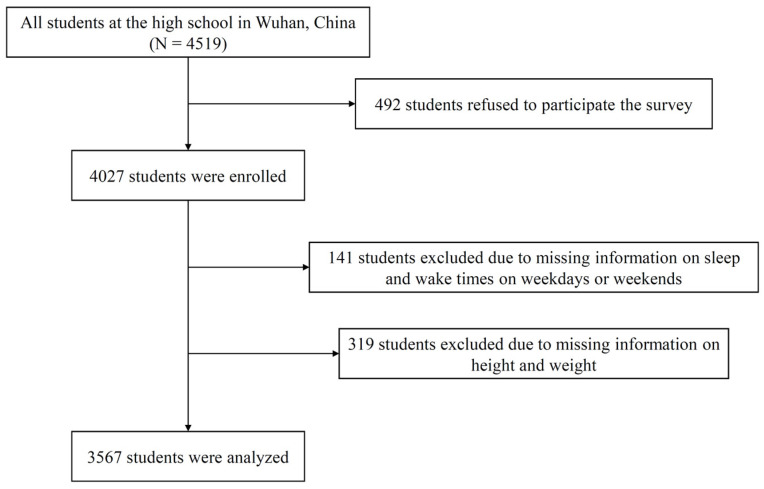
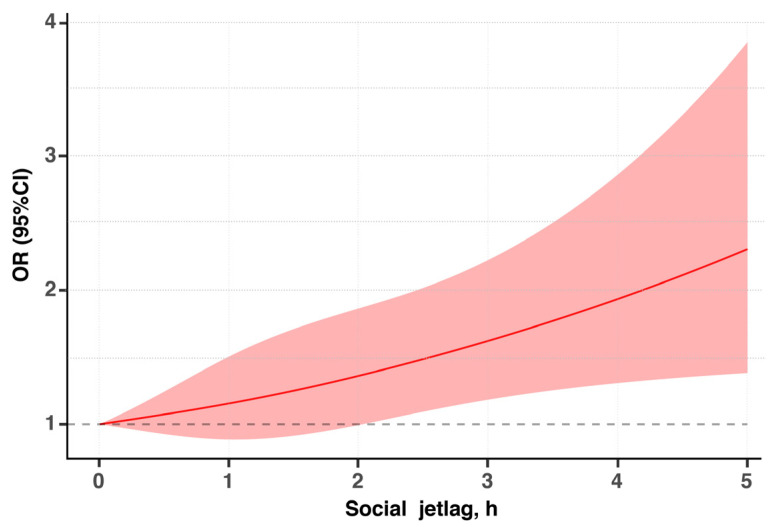
This study aimed to investigate the associations between social jetlag (SJL), dietary behavior, physical activity, and weight status in Chinese youth. Data were derived from a cross-sectional survey in Wuhan, China in 2019. Information on SJL, the frequency of food and beverage consumption, physical activity, and BMI category were collected via a self-reported questionnaire. The Kruskal-Wallis test and ANOVA were conducted to determine differences in daily consumption frequency of food and beverage groups, BMI category, and physical activity among SJL groups. Logistic regressions and restricted cubic splines were performed to test the association between SJL and the incidence of overweight or obesity. A final sample of 3567 Chinese adolescents [mean (SD) age, 14.67 (1.72) years; 47.41% (1691) female] were included. Our findings demonstrated that adolescents with SJL may consume more unhealthy foods and fewer beneficial foods, while engaging in less moderate to vigorous physical activity (MVPA) and reporting higher BMIs. In addition, adolescents who experience more than 2 h of SJL had significant greater risk of overweight or obesity. Our findings on SJL of Chinese adolescents confirm the harmful effects of SJL and also provide insights into the etiology of obesity in Chinese adolescents.
本研究旨在探讨中国青少年社会时差(SJL)、饮食行为、体力活动与体重状况之间的关系。数据来源于 2019 年在中国武汉进行的一项横断面调查。通过自报问卷收集 SJL、食物和饮料消费频率、体力活动和 BMI 类别信息。采用 Kruskal-Wallis 检验和 ANOVA 检验比较不同 SJL 组的食物和饮料组每日消费频率、BMI 类别和体力活动差异。采用 logistic 回归和限制三次样条检验 SJL 与超重或肥胖发生率之间的关系。最终纳入 3567 名中国青少年(平均[标准差]年龄 14.67[1.72]岁;47.41%[1691 人]为女性)。研究结果表明,有 SJL 的青少年可能会更多地食用不健康的食物和较少食用有益健康的食物,同时进行的中等至剧烈体力活动(MVPA)较少,报告的 BMI 较高。此外,经历超过 2 小时 SJL 的青少年超重或肥胖的风险显著增加。本研究证实了 SJL 对中国青少年的不良影响,并为中国青少年肥胖的病因学提供了新的见解。