Wellcome Centre for Cell-Matrix Research, Division of Cell-Matrix Biology and Regenerative Medicine, School of Biological Sciences, Faculty of Biology Medicine and Health, The University of Manchester, Manchester Academic Health Science Centre, Manchester, M13 9PT, UK.
South West Genomic Laboratory Hub, Bristol Genetics Laboratory, Pathology Sciences, Southmead Hospital, Bristol, UK.
Pediatr Nephrol. 2022 Dec;37(12):3105-3115. doi: 10.1007/s00467-022-05447-y. Epub 2022 Mar 12.
CD151 is a cell-surface molecule of the tetraspanin family. Its lateral interaction with laminin-binding integrin ɑ3β1 is important for podocyte adhesion to the glomerular basement membrane (GBM). Deletion of Cd151 in mice induces glomerular dysfunction, with proteinuria and associated focal glomerulosclerosis, disorganisation of GBM and tubular cystic dilation. Despite this, CD151 is not routinely screened for in patients with nephrotic-range proteinuria. We aimed to better understand the relevance of CD151 in human kidney disease.
Next-generation sequencing (NGS) was used to detect the variant in CD151. Electron and light microscopy were used to visualise the filtration barrier in the patient kidney biopsy, and immunoreactivity of patient red blood cells to anti-CD151/MER2 antibodies was performed. Further validation of the CD151 variant as disease-causing was performed in zebrafish using CRISPR-Cas9.
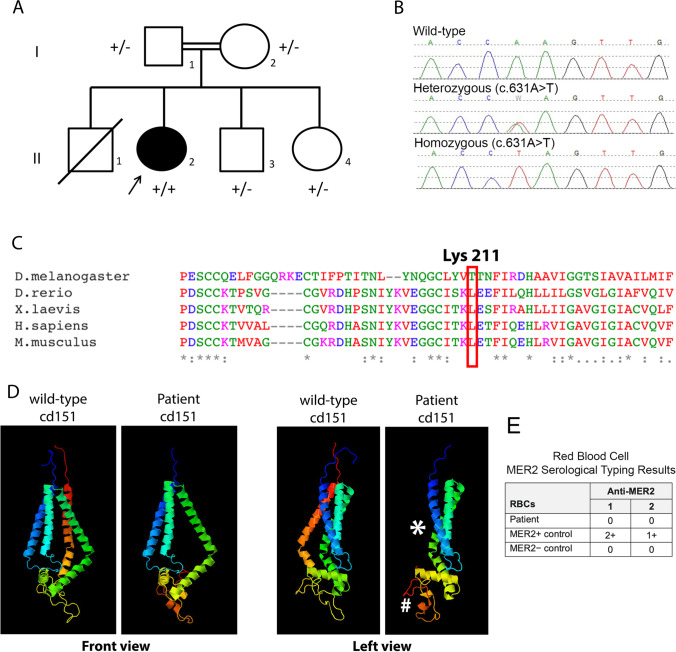
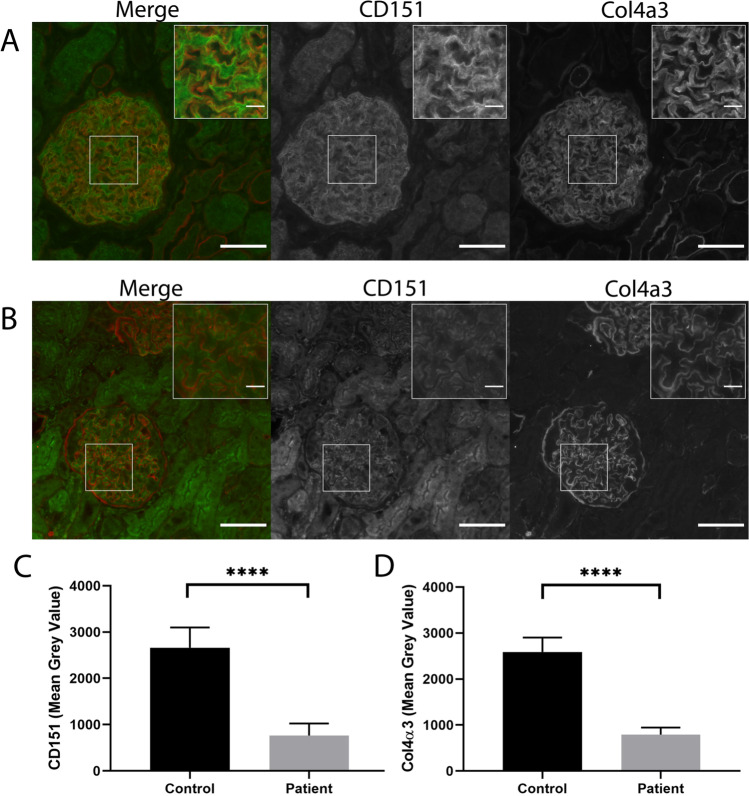
We report a young child with nail dystrophy and persistent urinary tract infections who was incidentally found to have nephrotic-range proteinuria. Through targeted NGS, a novel, homozygous truncating variant was identified in CD151, a gene rarely reported in patients with nephrotic syndrome. Electron microscopy imaging of patient kidney tissue showed thickening of GBM and podocyte effacement. Immunofluorescence of patient kidney tissue demonstrated that CD151 was significantly reduced, and we did not detect immunoreactivity to CD151/MER2 on patient red blood cells. CRISPR-Cas9 depletion of cd151 in zebrafish caused proteinuria, which was rescued by injection of wild-type CD151 mRNA, but not CD151 mRNA containing the variant sequence.
Our results indicate that a novel variant in CD151 is associated with nephrotic-range proteinuria and microscopic haematuria and provides further evidence for a role of CD151 in glomerular disease. Our work highlights a functional testing pipeline for future analysis of patient genetic variants. A higher resolution version of the Graphical abstract is available as Supplementary information.
CD151 是四跨膜蛋白家族的细胞表面分子。其与层粘连蛋白结合的整合素α3β1 的侧向相互作用对于足细胞黏附到肾小球基底膜(GBM)是重要的。在小鼠中敲除 Cd151 会导致肾小球功能障碍,出现蛋白尿和相关的局灶性肾小球硬化、GBM 紊乱和管状囊性扩张。尽管如此,CD151 并没有在肾病范围内蛋白尿的患者中常规筛查。我们旨在更好地了解 CD151 在人类肾脏疾病中的相关性。
使用下一代测序(NGS)检测 CD151 的变异。使用电子显微镜和光镜观察患者肾活检中的滤过屏障,并进行患者红细胞对抗 CD151/MER2 抗体的免疫反应性检测。使用 CRISPR-Cas9 在斑马鱼中进一步验证 CD151 变异作为致病原因。
我们报告了一个患有指甲营养不良和持续性尿路感染的幼儿,偶然发现患有肾病范围内蛋白尿。通过靶向 NGS,在 CD151 基因中发现了一个新的、纯合截断变异,该基因在肾病综合征患者中很少报道。患者肾组织的电子显微镜成像显示 GBM 增厚和足细胞消失。患者肾组织的免疫荧光显示 CD151 明显减少,并且我们没有检测到患者红细胞对 CD151/MER2 的免疫反应性。CRISPR-Cas9 敲除斑马鱼中的 cd151 会导致蛋白尿,而野生型 CD151 mRNA 的注射可挽救该蛋白尿,但含有变异序列的 CD151 mRNA 则不能。
我们的结果表明,CD151 中的一个新变异与肾病范围内蛋白尿和显微镜血尿相关,并为 CD151 在肾小球疾病中的作用提供了进一步证据。我们的工作突出了一种用于未来分析患者遗传变异的功能测试流程。更清晰的图形摘要版本可作为补充信息获取。