Money Kelli M, Baber Ursela, Saart Emma, Samaan Soleil, Sloane Jacob A
Department of Neurology, Beth Israel Deaconess Medical Center, Boston, MA, United States.
Front Neurol. 2022 Feb 23;13:843081. doi: 10.3389/fneur.2022.843081. eCollection 2022.
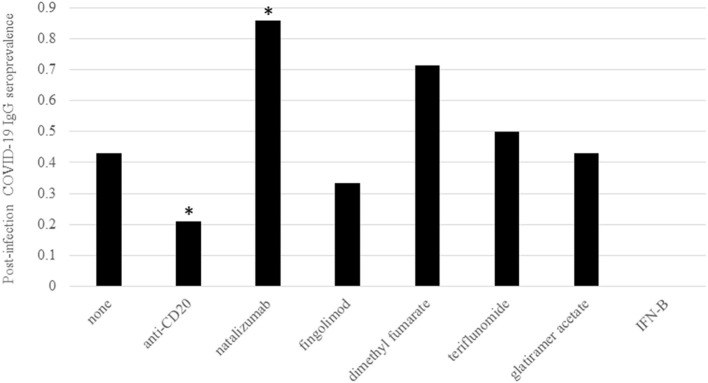
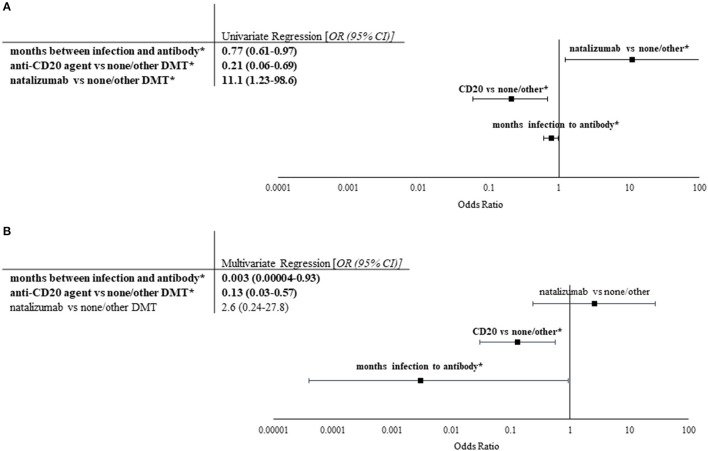
With unclear characteristics of post-infection and post-vaccination immunity, the multiple sclerosis community lacks evidence to guide patients on their continued coronavirus disease 2019 (COVID-19) infection risk. As disease modifying treatments all modulate the immune system, we expect their use to alter acquired immunity to COVID-19, but the specific impact of individual treatments is unclear. To address this, we analyzed the patient and COVID-19 specific characteristics associated with post-infection humoral immunity in 58 patients with central nervous system (CNS) demyelinating disorders in the Boston metropolitan area. Univariate analysis of variance was performed using Mann Whitney U test for continuous variables, and Chi Square or Fisher Exact test for nominal variables. Univariate and stepwise multivariate nominal logistic regression identified clinical characteristics associated with COVID-19 specific nucleocapsid IgG antibody formation post-infection. Our cohort demonstrated a 42% post-infection seropositive rate with a significantly higher rate observed with shorter duration between infection and antibody collection and use of natalizumab over no/other treatment. Use of anti-CD20 treatments compared to no/other treatment was associated with a significantly lower rate of seropositivity. However, only shorter duration between infection and antibody collection as well as use of no/other treatment compared to anti-CD20 treatment were found to be independently associated with increased likelihood of post-infection seropositivity. Additionally, we demonstrate durability of antibody response up to 9 months in a small subset of patients. Thus, our data supports that patients with CNS demyelinating disorders regardless of DMT are able to form a measurable antibody response after COVID-19 infection, and that patients on anti-CD20 treatments form less robust immunity after COVID-19 infection.
由于感染后和接种疫苗后的免疫特征尚不明确,多发性硬化症群体缺乏证据来指导患者了解其持续感染2019冠状病毒病(COVID-19)的风险。由于疾病修正治疗均会调节免疫系统,我们预计其使用会改变对COVID-19的获得性免疫,但个别治疗的具体影响尚不清楚。为了解决这一问题,我们分析了波士顿大都会区58例中枢神经系统(CNS)脱髓鞘疾病患者中与感染后体液免疫相关的患者和COVID-19特定特征。对于连续变量,使用曼-惠特尼U检验进行单因素方差分析;对于名义变量,使用卡方检验或费舍尔精确检验。单因素和逐步多因素名义逻辑回归确定了与感染后COVID-19特异性核衣壳IgG抗体形成相关的临床特征。我们的队列显示感染后血清阳性率为42%,在感染与抗体采集间隔时间较短以及使用那他珠单抗而非不使用/使用其他治疗的情况下,观察到的血清阳性率显著更高。与不使用/使用其他治疗相比,使用抗CD20治疗的血清阳性率显著更低。然而,仅发现感染与抗体采集间隔时间较短以及与抗CD20治疗相比不使用/使用其他治疗与感染后血清阳性可能性增加独立相关。此外,我们在一小部分患者中证明了抗体反应可持续长达9个月。因此,我们的数据支持,无论是否使用疾病修正治疗,中枢神经系统脱髓鞘疾病患者在感染COVID-19后都能够形成可测量的抗体反应,并且接受抗CD20治疗的患者在感染COVID-19后形成的免疫力较弱。