Sarrio David, Rojo-Sebastián Alejandro, Teijo Ana, Pérez-López María, Díaz-Martín Eva, Martínez Lidia, Morales Saleta, García-Sanz Pablo, Palacios José, Moreno-Bueno Gema
Departamento de Bioquímica, Instituto de Investigaciones Biomédicas "Alberto Sols" (CSIC-UAM), Universidad Autónoma de Madrid (UAM), Madrid, Spain.
Centro de Investigación Biomédica en Red de Cáncer (CIBERONC), Madrid, Spain.
Front Cell Dev Biol. 2022 Feb 24;10:813929. doi: 10.3389/fcell.2022.813929. eCollection 2022.
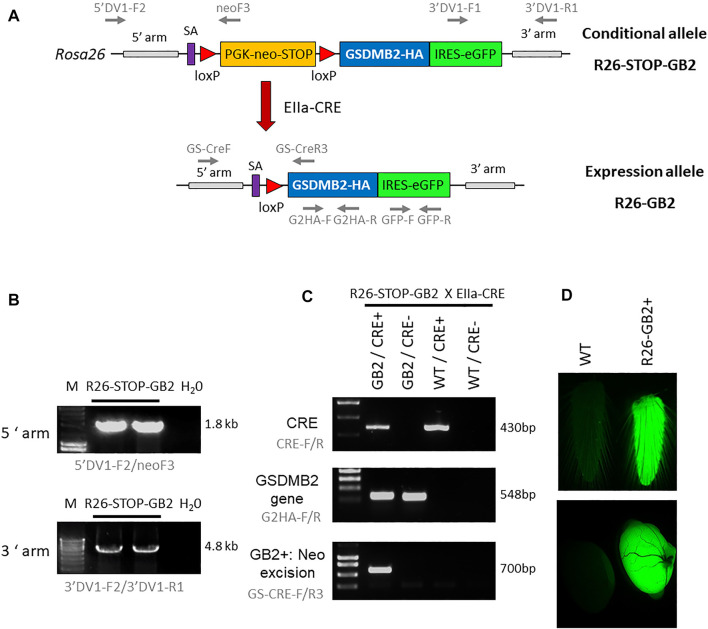
Gasdermins () genes play complex roles in inflammatory diseases and cancer. Gasdermin-B () is frequently upregulated in human cancers, especially in HER2-amplified breast carcinomas, and can promote diverse pro-tumor functions (invasion, metastasis, therapy-resistance). In particular, the shortest translated variant (isoform 2; GSDMB2) increases aggressive behavior in breast cancer cells. Paradoxically, GSDMB can also have tumor suppressor (cell death induction) effects in specific biological contexts. However, whether GSDMB has inherent oncogenic, or tumor suppressor function has not been demonstrated yet in preclinical mouse models, since mice lack orthologue. Therefore, to decipher cancer functions we first generated a novel knock-in mouse model (R26-GB2) ubiquitously expressing human . The comprehensive histopathological analysis of multiple tissues from 75 animals showed that nucleus-cytoplasmic GSDMB2 expression did not clearly affect the overall frequency nor the histology of spontaneous neoplasias (mostly lung carcinomas), but associated with reduced incidence of gastric tumors, compared to wildtype animals. Next, to assess specifically the GSDMB2 roles in breast cancer, we generated two additional double transgenic mouse models, that co-express GSDMB2 with either the HER2/NEU oncogene (R26-GB2/MMTV-NEU mice) or the Polyoma middle-T antigen (R26-GB2/MMTV-PyMT) in breast tumors. Consistent with the pro-tumor effect of GSDMB in HER2+ human breast carcinomas, R26-GB2/MMTV-NEU GSDMB2-positive mice have double breast cancer incidence than wildtype animals. By contrast, in the R26-GB2/MMTV-PyMT model of fast growing and highly metastatic mammary tumors, GSDMB2 expression did not significantly influence cancer development nor metastatic potential. In conclusion, our data prove that GSDMB2 pro-tumor effect is evidenced only in specific biological contexts (in concert with the HER2 oncogene), while GSDMB2 alone does not have overall intrinsic oncogenic potential in genetically modified mice. Our novel models are useful to identify the precise stimuli and molecular mechanisms governing GSDMB functions in neoplasias and can be the basis for the future development of additional tissue-specific and context-dependent cancer models.
Gasdermin()基因在炎症性疾病和癌症中发挥着复杂的作用。Gasdermin-B()在人类癌症中经常上调,尤其是在HER2扩增的乳腺癌中,并可促进多种促肿瘤功能(侵袭、转移、治疗抵抗)。特别是,最短的翻译变体(异构体2;GSDMB2)会增加乳腺癌细胞的侵袭性。矛盾的是,GSDMB在特定生物学背景下也可具有肿瘤抑制(诱导细胞死亡)作用。然而,在临床前小鼠模型中尚未证实GSDMB具有内在的致癌或肿瘤抑制功能,因为小鼠缺乏直系同源物。因此,为了解析其癌症功能,我们首先构建了一种新型的基因敲入小鼠模型(R26-GB2),该模型在全身广泛表达人。对75只动物的多个组织进行的全面组织病理学分析表明,核质GSDMB2表达并未明显影响自发肿瘤(主要是肺癌)的总体发生率和组织学,但与野生型动物相比,胃肿瘤的发生率降低。接下来,为了具体评估GSDMB2在乳腺癌中的作用,我们构建了另外两种双转基因小鼠模型,它们在乳腺肿瘤中共同表达GSDMB2与HER2/NEU癌基因(R26-GB2/MMTV-NEU小鼠)或多瘤病毒中T抗原(R26-GB2/MMTV-PyMT)。与GSDMB在HER2+人乳腺癌中的促肿瘤作用一致,R26-GB2/MMTV-NEU GSDMB2阳性小鼠的乳腺癌发病率是野生型动物的两倍。相比之下,在快速生长和高度转移的乳腺肿瘤的R26-GB2/MMTV-PyMT模型中,GSDMB2表达并未显著影响癌症发展和转移潜能。总之,我们的数据证明,GSDMB2的促肿瘤作用仅在特定生物学背景下(与HER2癌基因协同)得到证实,而在基因改造小鼠中,GSDMB2单独并不具有整体内在致癌潜能。我们的新型模型有助于确定调控GSDMB在肿瘤中功能的精确刺激因素和分子机制,并可为未来开发更多组织特异性和背景依赖性癌症模型奠定基础。