Sako T
J Bacteriol. 1986 Sep;167(3):850-4. doi: 10.1128/jb.167.3.850-854.1986.
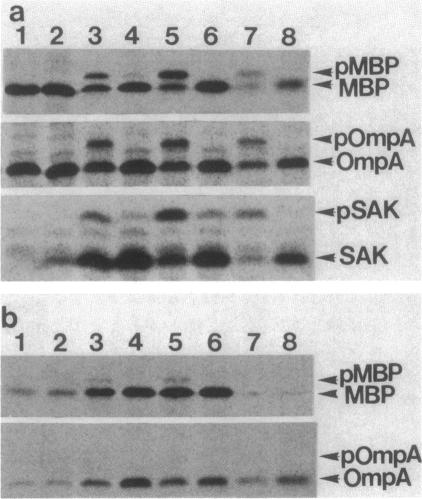
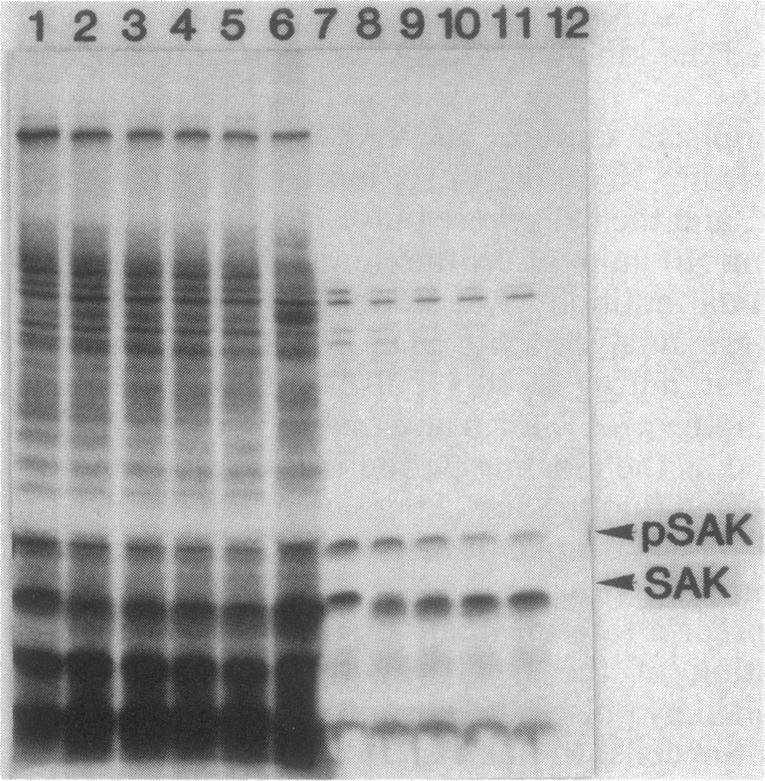
Export through the cytoplasmic membrane and processing of the sak product in Escherichia coli cells were investigated with E. coli strains carrying pTS301, which produce large amounts of staphylokinase at 42 degrees C. High-level synthesis of the sak product caused transient accumulation not only of the staphylokinase precursor (pSAK) but also of the maltose-binding protein and outer membrane protein A precursors. Thus it was concluded that the sak product shares the export pathway with E. coli secreted proteins at least at a certain step. During high-level synthesis of the sak product, a significant amount of the newly synthesized pSAK remained unprocessed after a chase period, possibly causing the observed accumulation of pSAK. Accumulating pSAK did not mature for a long period, whereas the newly synthesized sak product was exclusively detected in the mature form. These results suggest that it is necessary for the sak product to enter the export pathway during or immediately after synthesis to be exported and processed normally.
利用携带pTS301的大肠杆菌菌株,研究了葡萄球菌激酶(sak)产物在大肠杆菌细胞中的胞质膜输出及加工过程,该菌株在42℃时可大量产生葡萄球菌激酶。sak产物的高水平合成不仅导致葡萄球菌激酶前体(pSAK)的瞬时积累,还导致麦芽糖结合蛋白和外膜蛋白A前体的瞬时积累。因此得出结论,sak产物至少在某一步骤与大肠杆菌分泌蛋白共享输出途径。在sak产物的高水平合成过程中,经过追踪期后,大量新合成的pSAK仍未加工,这可能是观察到的pSAK积累的原因。积累的pSAK长时间未成熟,而新合成的sak产物仅以成熟形式被检测到。这些结果表明,sak产物在合成期间或合成后立即进入输出途径对于其正常输出和加工是必要的。