Quach Sara, Thaichon Park, Martin Kelly D, Weaven Scott, Palmatier Robert W
Department of Marketing, Griffith Business School, Griffith University, Gold Coast campus, Southport, Queensland 4222 Australia.
College of Business, Colorado State University, Fort Collins, CO 80523-1201 USA.
J Acad Mark Sci. 2022;50(6):1299-1323. doi: 10.1007/s11747-022-00845-y. Epub 2022 Mar 5.
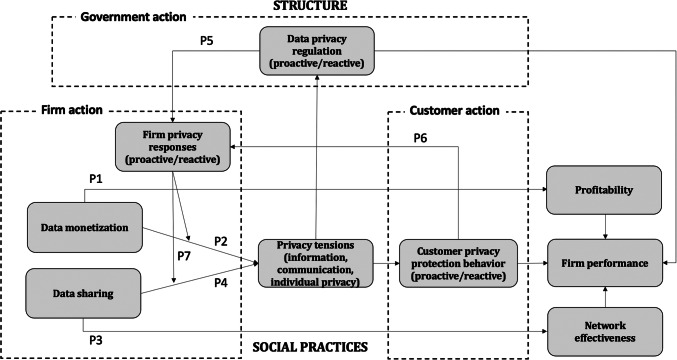
Driven by data proliferation, digital technologies have transformed the marketing landscape. In parallel, significant privacy concerns have shaken consumer-firm relationships, prompting changes in both regulatory interventions and people's own privacy-protective behaviors. With a comprehensive analysis of digital technologies and data strategy informed by structuration theory and privacy literature, the authors consider privacy tensions as the product of firm-consumer interactions, facilitated by digital technologies. This perspective in turn implies distinct consumer, regulatory, and firm responses related to data protection. By consolidating various perspectives, the authors propose three tenets and seven propositions, supported by interview insights from senior managers and consumer informants, that create a foundation for understanding the digital technology implications for firm performance in contexts marked by growing privacy worries and legal ramifications. On the basis of this conceptual framework, they also propose a data strategy typology across two main strategic functions of digital technologies: data monetization and data sharing. The result is four distinct types of firms, which engage in disparate behaviors in the broader ecosystem pertaining to privacy issues. This article also provides directions for research, according to a synthesis of findings from both academic and practical perspectives.
在数据激增的推动下,数字技术改变了营销格局。与此同时,重大的隐私问题动摇了消费者与公司的关系,促使监管干预措施和人们自身的隐私保护行为发生变化。通过运用结构化理论和隐私文献对数字技术和数据战略进行全面分析,作者认为隐私紧张关系是公司与消费者互动的产物,数字技术起到了推动作用。这种观点进而意味着与数据保护相关的消费者、监管机构和公司的不同反应。通过整合各种观点,作者提出了三个原则和七个命题,并得到了高级管理人员和消费者信息提供者的访谈见解的支持,这些原则和命题为理解在隐私担忧和法律后果日益严重的背景下数字技术对公司绩效的影响奠定了基础。基于这一概念框架,他们还针对数字技术的两个主要战略功能——数据货币化和数据共享,提出了一种数据战略类型。结果是形成了四种不同类型的公司,它们在与隐私问题相关的更广泛生态系统中表现出不同的行为。根据学术和实践视角的研究结果综合,本文还提供了研究方向。