Ding Yan, Ouyang Zijun, Zhang Chenyang, Zhu Yuyu, Xu Qiang, Sun Haiyan, Qu Jiao, Sun Yang
State Key Laboratory of Pharmaceutical Biotechnology, Department of Biotechnology and Pharmaceutical Sciences, School of Life Sciences Nanjing University Nanjing China.
Institute of Marine Biomedicine, School of Food and Drug Shenzhen Polytechnic Shenzhen Guangdong China.
MedComm (2020). 2022 Mar 4;3(1):e120. doi: 10.1002/mco2.120. eCollection 2022 Mar.
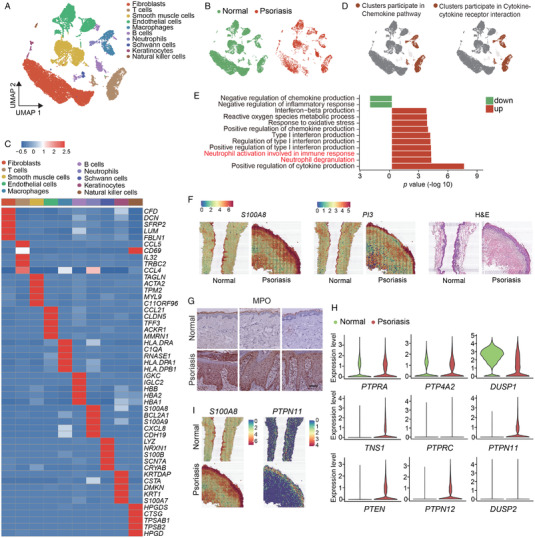
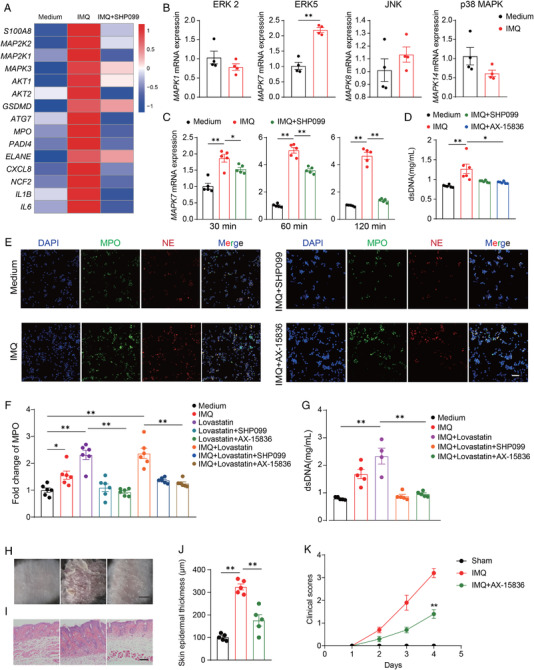
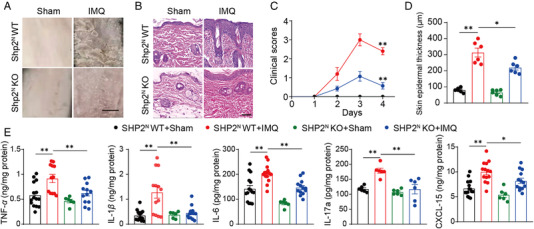
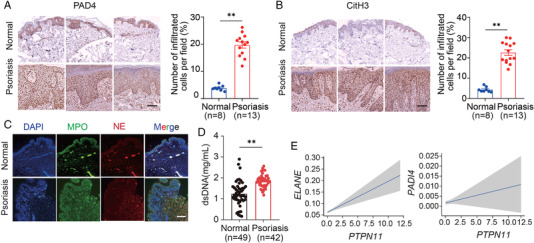
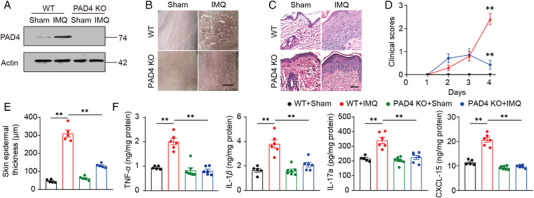
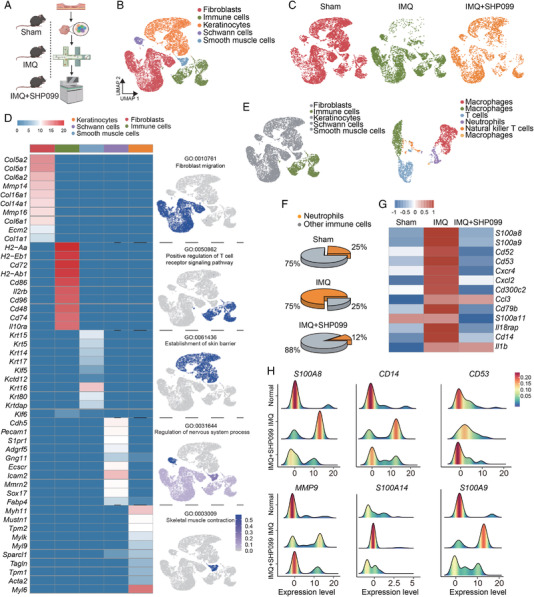
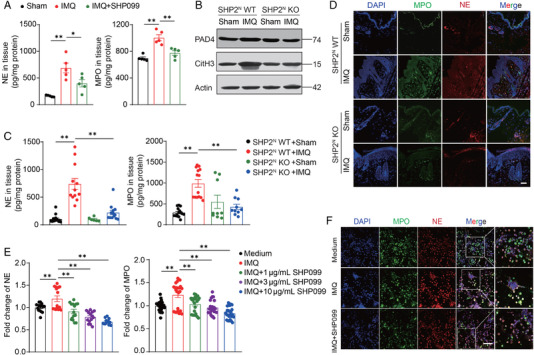
Psoriasis is a chronic inflammatory skin disease, often accompanied by increased infiltration of immune cells, especially neutrophils. However, the detailed mechanism of the neutrophil function in psoriasis progression remains unclear. Here, we found that both Src homology-2 domain-containing protein tyrosine phosphatase-2 (SHP2) and neutrophils were highly correlated to developing psoriasis by single-cell ribonucleic acid (RNA) sequencing and experiment verification. The deficiency of SHP2 in neutrophils significantly alleviated psoriasis-like phenotype in an imiquimod-induced murine model. Interestingly, high levels of neutrophil extracellular traps (NETs) were produced in the inflamed lesions of psoriatic patients. In addition, imiquimod-induced psoriasis-like symptoms were remarkably ameliorated in peptidyl arginine deiminase 4 (PAD4) knockout mice, which cannot form NETs. Mechanistically, RNA-seq analysis revealed that SHP2 promoted the formation of NETs in neutrophils via the ERK5 pathway. Functionally, this mechanism resulted in the infiltration of pro-inflammatory cytokines such as TNF-, IL-1, IL-6, IL-17A, and CXCL-15, which enhances the inflammatory response in skin lesions and reinforces the cross-talk between neutrophils and keratinocytes, ultimately aggravating psoriasis. Our findings uncover a role for SHP2 in NET release and subsequent cell death known as NETosis in the progression of psoriasis and suggest that SHP2 may be a promising therapeutic target for psoriasis.
银屑病是一种慢性炎症性皮肤病,常伴有免疫细胞尤其是中性粒细胞浸润增加。然而,中性粒细胞功能在银屑病进展中的详细机制仍不清楚。在此,我们通过单细胞核糖核酸(RNA)测序和实验验证发现,含Src同源2结构域蛋白酪氨酸磷酸酶-2(SHP2)和中性粒细胞均与银屑病的发生高度相关。中性粒细胞中SHP2的缺乏在咪喹莫特诱导的小鼠模型中显著减轻了银屑病样表型。有趣的是,银屑病患者炎症皮损中产生了高水平的中性粒细胞胞外诱捕网(NETs)。此外,在不能形成NETs的肽基精氨酸脱亚氨酶4(PAD4)基因敲除小鼠中,咪喹莫特诱导的银屑病样症状明显改善。机制上,RNA测序分析显示SHP2通过ERK5途径促进中性粒细胞中NETs的形成。功能上,这一机制导致促炎细胞因子如肿瘤坏死因子-α、白细胞介素-1、白细胞介素-6、白细胞介素-17A和CXC趋化因子配体15的浸润,增强了皮损中的炎症反应并加强了中性粒细胞与角质形成细胞之间的相互作用,最终加重了银屑病。我们的研究结果揭示了SHP2在银屑病进展中NET释放及随后称为NETosis的细胞死亡中的作用,并表明SHP2可能是银屑病一个有前景的治疗靶点。