Li Benjamin, Faúndez Salazar Javier, Rivera Arianne Flores, Babayemi Towo, Colqui Campos Kevin, Del Castillo Pacora Rubén Francisco, Noreña Gómez María Paulina, Gamboa Garay Oscar Andrés, Vacaflor Romero Liceth, Rodríguez Moura Diego, Condori Vasquez Nancy, Martínez Pérez David Antonio
Department of Radiation Oncology, University of California, San Francisco, California.
Rayos Contra Cancer, San Francisco, California.
Adv Radiat Oncol. 2022 Jan 22;7(3):100898. doi: 10.1016/j.adro.2022.100898. eCollection 2022 May-Jun.
Despite the call to increase the number of radiation oncologists in Latin America, the quality, similarity, and number of residency training programs are unknown. We seek to describe the current state of residency programs in radiation oncology in Latin America.
Latin American Residents in Radiation Oncology performed a cross-sectional analysis of universities and training centers for radiation oncologists in Latin America. Latin American Residents in Radiation Oncology members identified and contacted current residents and specialists at each center to obtain information and documents that described their training curricula.
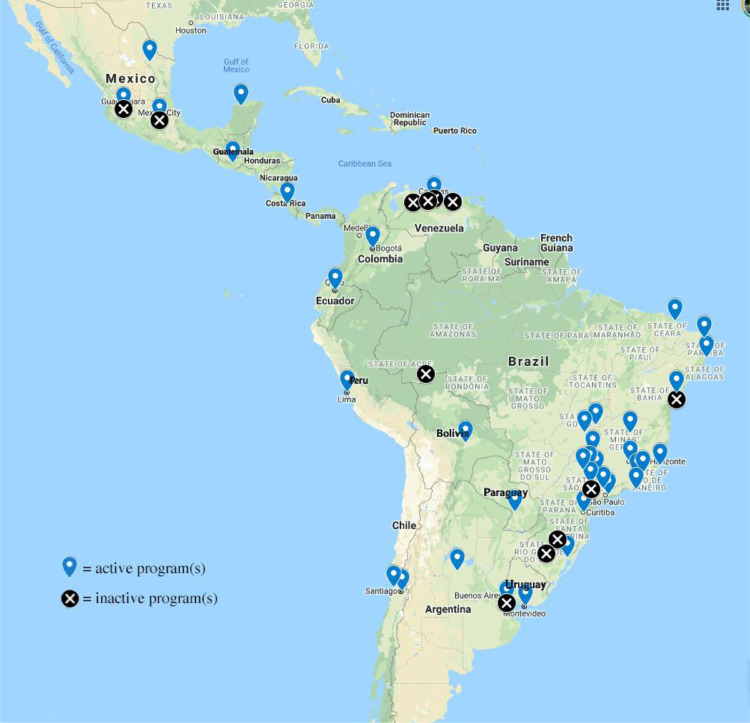
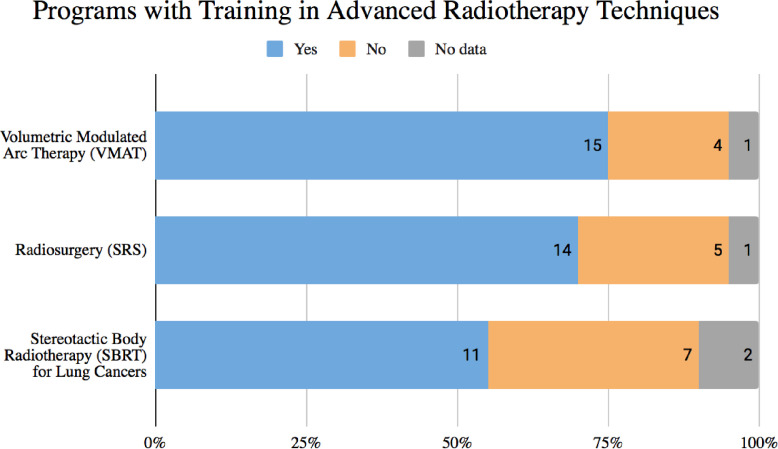
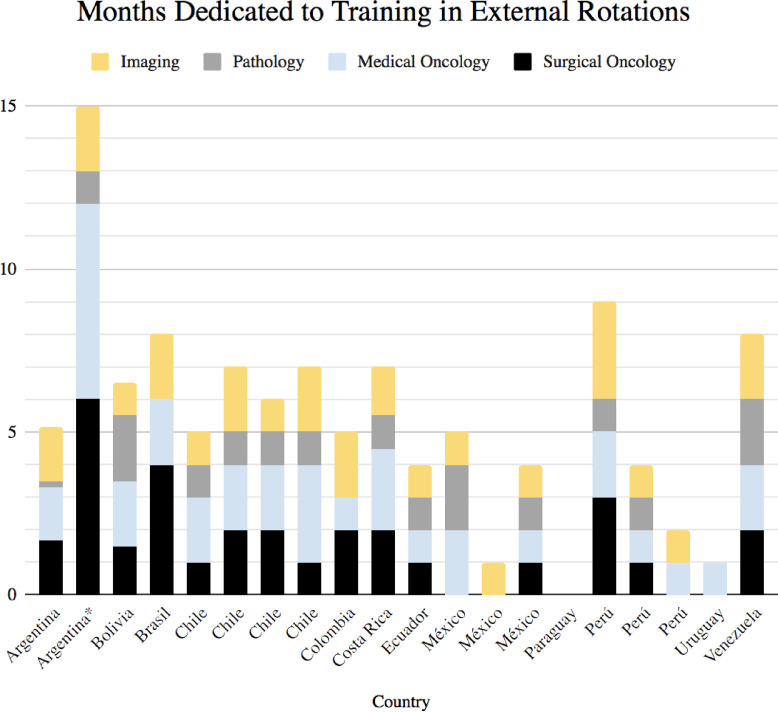
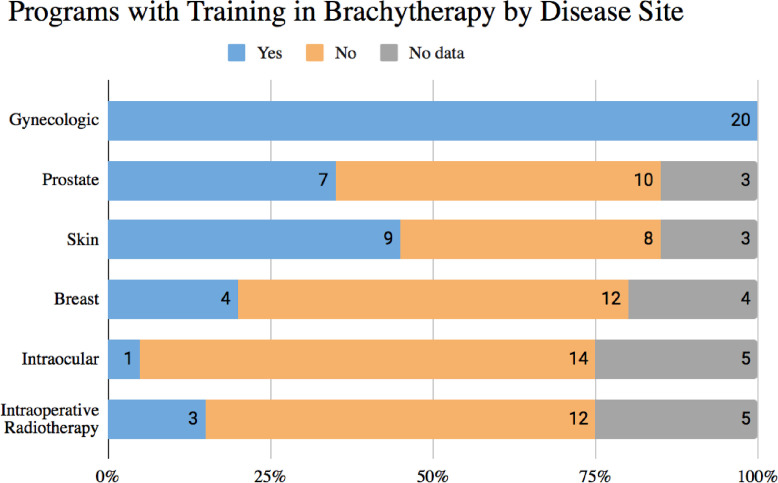
As of 2020, 13 of 23 (56.5%) Latin American countries have radiation oncology training. Seventy-three training centers were identified (59 active and 14 inactive), associated with 28 universities. On average, each active center trains 2.6 new residents per year, and in total, 156 residents are trained annually. The average length of training programs is 3.6 years. Brazil and Mexico comprise 31 (52.5%) and 7 (11.9%) of active programs, respectively, and 64 (41.8%) and 50 (32.7%) residents, respectively. Training is available in 38 cities in 13 countries, and outside Brazil and Mexico, only 13 cities in 11 countries (9 capitals and 4 noncapital cities). Individualized curriculum documents were provided by 20 (83.3%) of 24 non-Brazilian programs, while 1 standardized guideline was provided for Brazilian training programs. These demonstrated variation between subjects taught, their devoted time, outside specialty rotations, and experiences in modern techniques. Seventy-five percent include volumetric modulated arc therapy, 70% stereotactic radiosurgery, and 55% stereotactic body radiation therapy training. One-hundred percent include gynecologic brachytherapy education and <50% brachytherapy education in other disease sites.
Training is highly centralized in capital cities. The number of trainees is insufficient to close the current human resource divide but is limited by available job openings. Over 50% of training programs now include technological training in stereotactic radiosurgery, stereotactic body radiation therapy, or volumetric modulated arc therapy; however, substantial variation still exists. The development of radiation oncology specialists must be improved and modernized to address the escalating demand for cancer care.
尽管呼吁增加拉丁美洲放射肿瘤学家的数量,但住院医师培训项目的质量、相似性和数量尚不清楚。我们旨在描述拉丁美洲放射肿瘤学住院医师培训项目的现状。
拉丁美洲放射肿瘤学住院医师对拉丁美洲的放射肿瘤学大学和培训中心进行了横断面分析。拉丁美洲放射肿瘤学住院医师协会成员识别并联系了每个中心的现任住院医师和专家,以获取描述其培训课程的信息和文件。
截至2020年,23个拉丁美洲国家中有13个(56.5%)设有放射肿瘤学培训项目。共识别出73个培训中心(59个活跃中心和14个非活跃中心),与28所大学相关。平均而言,每个活跃中心每年培训2.6名新住院医师,每年总共培训156名住院医师。培训项目的平均时长为3.6年。巴西和墨西哥分别占活跃项目的31个(52.5%)和7个(11.9%),以及住院医师的64名(41.8%)和50名(32.7%)。13个国家的38个城市提供培训,在巴西和墨西哥以外,只有11个国家的13个城市(9个首都城市和4个非首都城市)提供培训。24个非巴西项目中有20个(83.3%)提供了个性化的课程文件,而巴西的培训项目提供了1份标准化指南。这些文件显示了所教授科目、所分配时间、专科外轮转以及现代技术经验方面的差异。75%的项目包括容积调强弧形放疗培训,70%包括立体定向放射外科培训,55%包括立体定向体部放疗培训。100%的项目包括妇科近距离放疗教育,而其他疾病部位的近距离放疗教育不足50%。
培训高度集中在首都城市。学员数量不足以弥合当前的人力资源差距,但受到现有职位空缺的限制。现在超过50%的培训项目包括立体定向放射外科、立体定向体部放疗或容积调强弧形放疗的技术培训;然而,仍然存在很大差异。必须改进和更新放射肿瘤学专家的培养,以满足对癌症护理不断增长的需求。