Dai Tie-Ying, Lan Jin-Jian, Gao Rui-Lan, Zhao Yan-Na, Yu Xiao-Ling, Liang Simon-Xun, Liu Wen-Bin, Sun Xin
Institute of Hematology Research, The First Affiliated Hospital of Zhejiang Chinese Medical University, Hangzhou, China.
Department of Oncology, Zhejiang Provincial People's Hospital, Hangzhou, China.
Ann Transl Med. 2022 Jan;10(2):38. doi: 10.21037/atm-21-4800.
Our research team has identified a biological active component, panaxadiol saponins component (PDS-C) isolated from total saponins of panax ginseng as a potential targeted drug for treating hemocytopenia. PDS-C possesses dual activities, namely that of promoting hematopoiesis and regulating immune function. Our study is to observe effects of PDS-C on promoting hematopoiesis in normal and aplastic anemia (AA) mice, furthermore, to explore its possible mechanism.
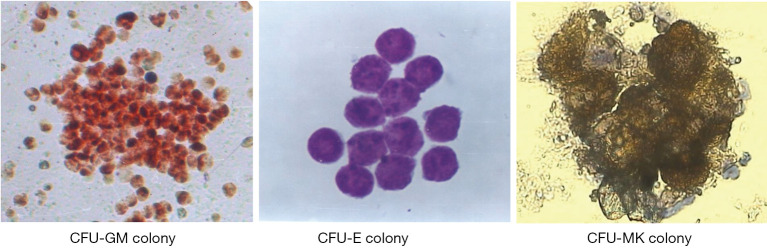
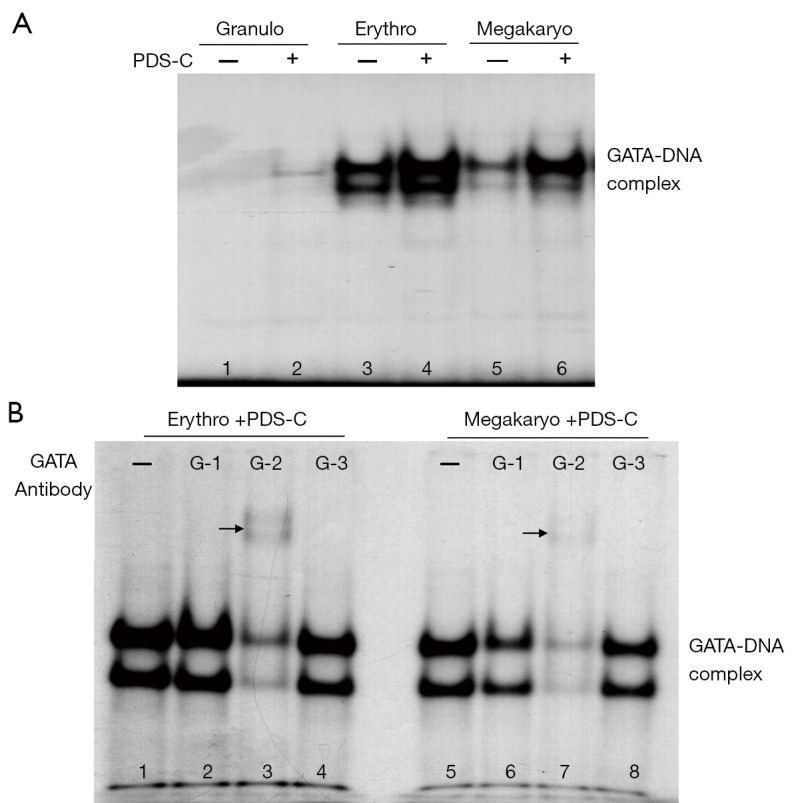
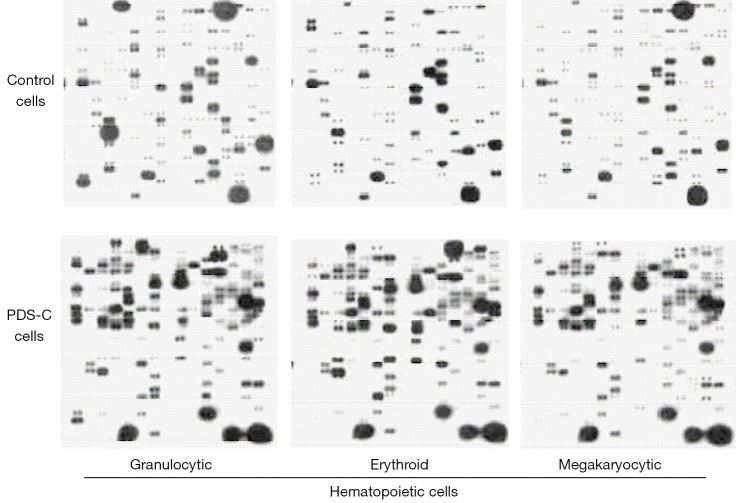
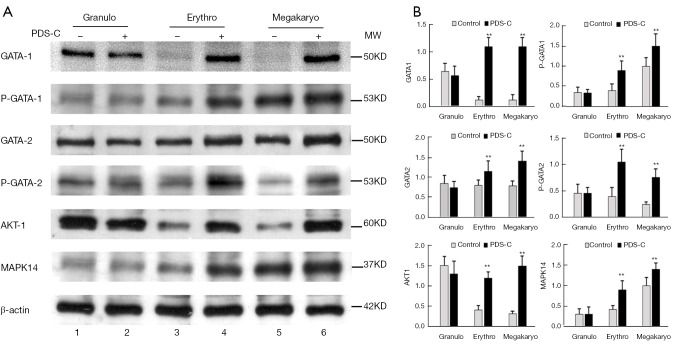
Bone marrow nucleated cells were cultured for colony forming assay of CFU-GM, CFU-E and CFU-MK in the presence of PDS-C at different concentration. The proliferation and differentiation-related genes expression profile was analyzed with DNA membrane microarray. The mRNA expression levels and protein phosphorylated state of GATA-1, GATA-2 transcription factors and AKT-1, MAPK14 protein kinases were detected by RT-qPCR and Western blot, the DNA binding activity and components of GATA-DNA complex were analyzed by EMSA and antibody gel supershift assay.
In response to PDS-C at 10, 25 and 50 mg/L, the bone marrow colony numbers of CFU-GM, CFU-E and CFU-MK increased significantly by 25.7%±3.1% to 42.4%±4.5% respectively in normal mice, and 29.7%±3.7% to 53.2%±7.1% in AA mice. The gene microarray profile initiated by PDS-C provided the up-regulated genes by more than 3 times, which can be classified into 11 categories according to their functions, including GATA-1, GATA-2, and AKT-1, MAPK14. The mRNA expression levels of GATA-1, GATA-2 were consistent with their gene microarray profile in PDS-C treated erythroid and megakaryocytic hematopoietic cells. Meanwhile, PDS-C could not only up-regulate expression levels of GATA-1, GATA-2 proteins, but also enhance phosphorylated activity state. Furthermore, PDS-C obviously enhanced binding activity of GATA protein with DNA in erythroid and megakaryocytic cells, and the main composition of GATA-DNA complex was GATA-2 and GATA-1.
PDS-C displays the role to promote proliferation and induce differentiation for hematopoietic cells. Its action mechanism may involve in GATA-1, GATA-2 transcription factors, including up-regulating mRNA and protein expression, enhancing DNA binding activity, phosphorylated functional activity and up-regulating AKT-1, MAPK14 protein kinases as the upstream signaling molecule for activation GATA-1, GATA-2 respectively in hematopoietic cells.
我们的研究团队已鉴定出一种生物活性成分,即从人参总皂苷中分离得到的人参二醇皂苷成分(PDS-C),它是一种治疗血细胞减少症的潜在靶向药物。PDS-C具有双重活性,即促进造血和调节免疫功能。我们的研究旨在观察PDS-C对正常小鼠和再生障碍性贫血(AA)小鼠造血的促进作用,并进一步探讨其可能的机制。
在不同浓度的PDS-C存在下培养骨髓有核细胞,用于CFU-GM、CFU-E和CFU-MK的集落形成测定。用DNA膜微阵列分析增殖和分化相关基因的表达谱。通过RT-qPCR和Western blot检测GATA-1、GATA-2转录因子以及AKT-1、MAPK14蛋白激酶的mRNA表达水平和蛋白磷酸化状态,通过EMSA和抗体凝胶超迁移试验分析GATA-DNA复合物的DNA结合活性和成分。
在10、25和50 mg/L的PDS-C作用下,正常小鼠中CFU-GM、CFU-E和CFU-MK的骨髓集落数分别显著增加25.7%±3.1%至42.4%±4.5%,AA小鼠中增加29.7%±3.7%至53.2%±7.1%。PDS-C引发的基因微阵列谱显示上调基因超过3倍,根据其功能可分为11类,包括GATA-1、GATA-2以及AKT-1、MAPK14。在PDS-C处理的红系和巨核系造血细胞中,GATA-1、GATA-2的mRNA表达水平与其基因微阵列谱一致。同时,PDS-C不仅能上调GATA-1、GATA-2蛋白的表达水平,还能增强磷酸化活性状态。此外,PDS-C明显增强了红系和巨核系细胞中GATA蛋白与DNA的结合活性,GATA-DNA复合物的主要成分是GATA-2和GATA-1。
PDS-C对造血细胞具有促进增殖和诱导分化的作用。其作用机制可能涉及GATA-1、GATA-2转录因子,包括上调mRNA和蛋白表达、增强DNA结合活性、磷酸化功能活性以及上调AKT-1、MAPK14蛋白激酶,它们分别作为造血细胞中激活GATA-1、GATA-2的上游信号分子。