Zhao Rui, Zheng Haining, Wang Wei, Du Yigang, Tong Yisha, Wen Chaoyang
Department of Ultrasound, Peking University International Hospital, Beijing, China.
Department of Ultrasound, The Fourth Medical Center of PLA General Hospital, Beijing, China.
Front Cardiovasc Med. 2022 Feb 24;9:829825. doi: 10.3389/fcvm.2022.829825. eCollection 2022.
To investigate the value of Vector Flow Imaging (V Flow) in the assessment of post-stenotic turbulence in the canine arterial stenosis model.
Canine femoral artery stenosis models were established using ameroid constrictors in 12 beagle dogs. 50% and then 70% femoral artery stenoses were confirmed by selective femoral artery angiography. V Flow was used to measure femoral artery flow turbulence index (Tur) preoperatively as a baseline. After establishing of a 50% and then 70% stenoses, the Tur indices were recorded in the femoral artery at 1, 3, 5, 7, 9, 11, 13, 15, 17, and 19 mm distal to the stenosis.
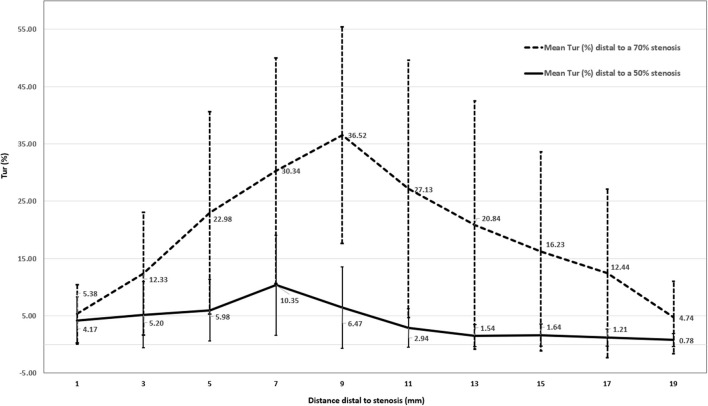
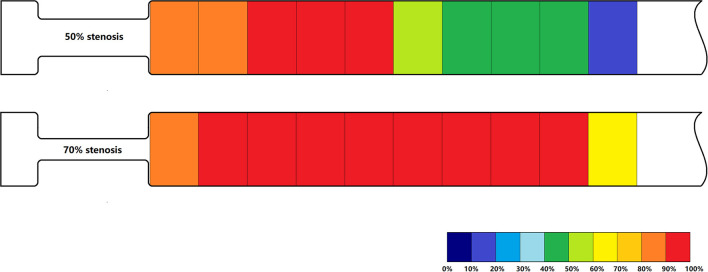
Baseline Tur indices of normal canine femoral arteries were <1% in 11 of 12 cases (91.7%). Distal to a 50% stenosis, the Tur index (>1%) was recorded in 83.3-100% cases between 1 and 9 mm, 41.7-58.3% between 11 and 17 mm, and 16.7% at 19 mm. For a 70% stenosis, the Tur index (>1%) occurred in 81.8-100% cases between 1 and 17 mm distal to the stenosis, and 63.6% at 19 mm. The Tur index peaked around 7 mm or 2.3 times of the initial vessel diameter (3 mm) downstream for a 50% stenosis and 11 mm or 3.7 times of vessel diameter downstream for a 70% stenosis.
V Flow with Tur index measurement adds quantitative information of post-stenotic turbulence when assessing an arterial stenosis with ultrasound. Tur index of 1% seems a useful threshold for assessment of flow turbulence in this small sample study. Further studies with larger sample size are needed to evaluate the value of V Flow in clinical applications.
探讨矢量血流成像(V Flow)在评估犬动脉狭窄模型中狭窄后湍流情况的价值。
使用阿梅氏缩窄器在12只比格犬中建立犬股动脉狭窄模型。通过选择性股动脉血管造影确认股动脉狭窄程度分别为50%和70%。术前使用V Flow测量股动脉血流湍流指数(Tur)作为基线值。在建立50%和70%狭窄后,记录狭窄远端1、3、5、7、9、11、13、15、17和19毫米处股动脉的Tur指数。
12例正常犬股动脉的基线Tur指数中,11例(91.7%)<1%。在50%狭窄远端,1至9毫米处83.3% - 100%的病例记录到Tur指数(>1%),11至17毫米处为41.7% - 58.3%,19毫米处为16.7%。对于70%狭窄,狭窄远端1至17毫米处81.8% - 100%的病例出现Tur指数(>1%),19毫米处为63.6%。对于50%狭窄,Tur指数在狭窄下游约7毫米或初始血管直径(3毫米)的2.3倍处达到峰值;对于70%狭窄,Tur指数在狭窄下游11毫米或血管直径的3.7倍处达到峰值。
在超声评估动脉狭窄时,V Flow结合Tur指数测量可增加狭窄后湍流的定量信息。在本小样本研究中,1%的Tur指数似乎是评估血流湍流的有用阈值。需要进一步进行更大样本量的研究来评估V Flow在临床应用中的价值。