Department of Obstetrics and Gynecology, Division of Gynecologic Oncology, The Ohio State University Wexner Medical Center, Arthur G James Cancer Center, Columbus, OH.
Department of Statistics, The Ohio State University, Columbus, OH.
Am J Obstet Gynecol. 2022 Aug;227(2):244.e1-244.e17. doi: 10.1016/j.ajog.2022.03.004. Epub 2022 Mar 10.
Disparities in adjuvant treatment between Black and White women with endometrial cancer exist and contribute to worse outcomes among Black women. However, factors leading to disparate treatment receipt are understudied.
We examined whether patient refusal of adjuvant treatment (chemotherapy or radiation) differed between Black and White women and whether treatment refusal mediated racial disparities in survival among women with endometrial cancer.
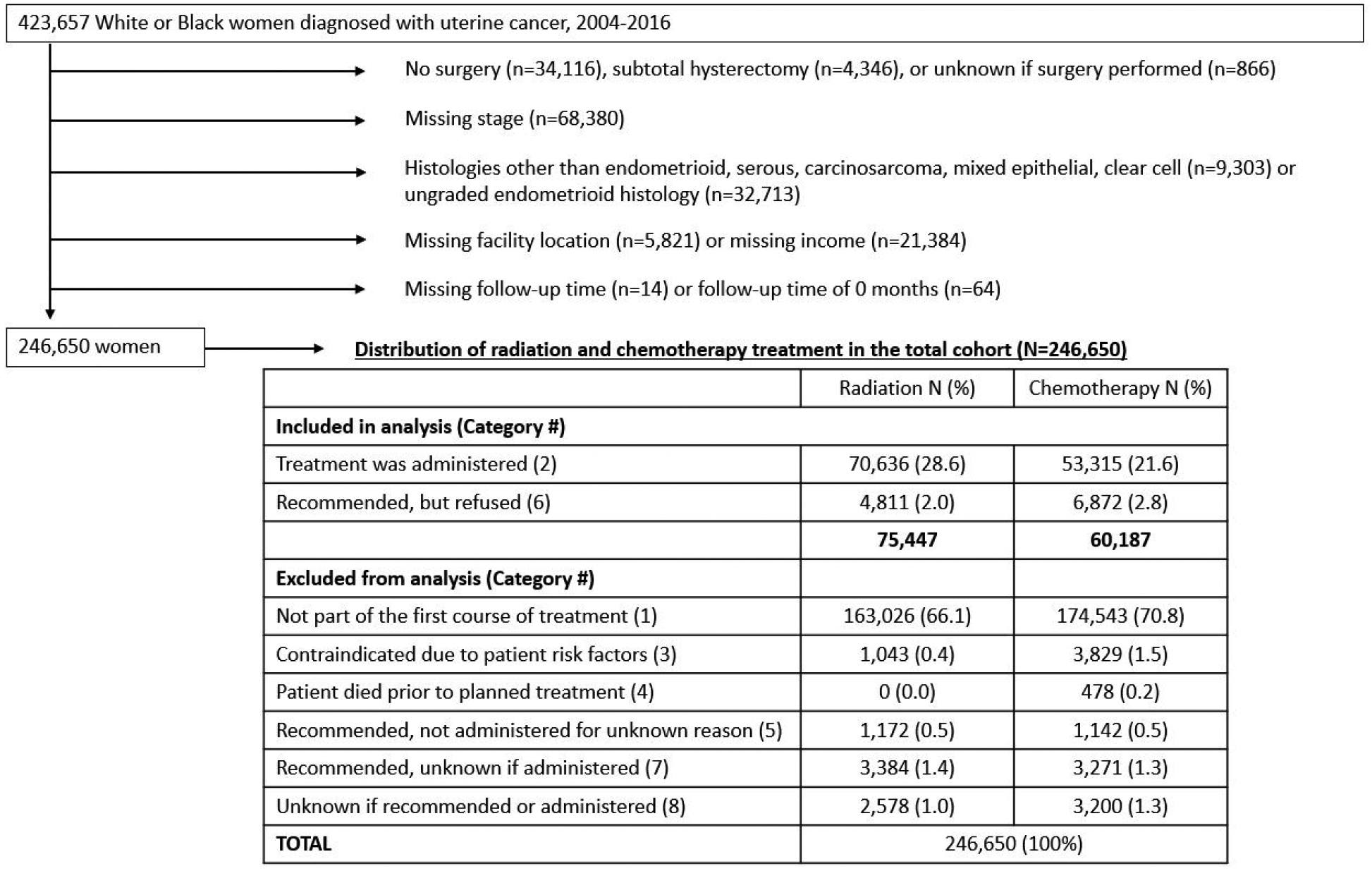
We used the National Cancer Database, a hospital-based cancer registry, to identify non-Hispanic Black and non-Hispanic White women diagnosed with endometrial cancer from 2004 to 2016 who either received or refused recommended radiation or chemotherapy. We used logistic regression to estimate multivariable-adjusted odds ratios and 95% confidence intervals for associations between race and treatment refusal. We also examined predictors of treatment refusal in race-specific models. Accelerated failure time models were used to estimate absolute differences in overall survival by race. We used causal mediation analysis to estimate the proportion of racial differences in overall survival attributable to racial differences in adjuvant treatment refusal. We considered the overall study population and strata defined by histology, and adjusted for sociodemographic, tumor, and facility characteristics.
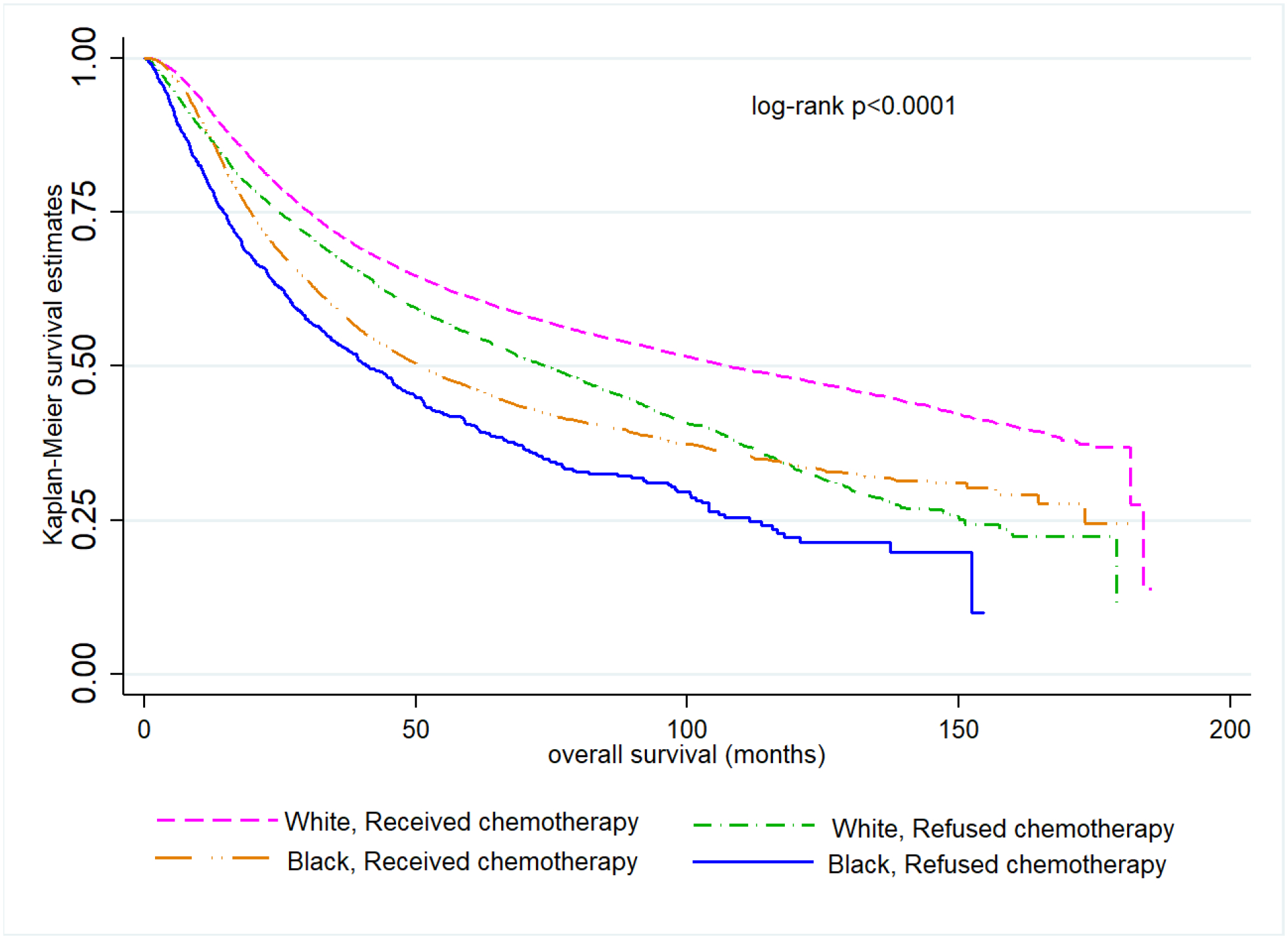
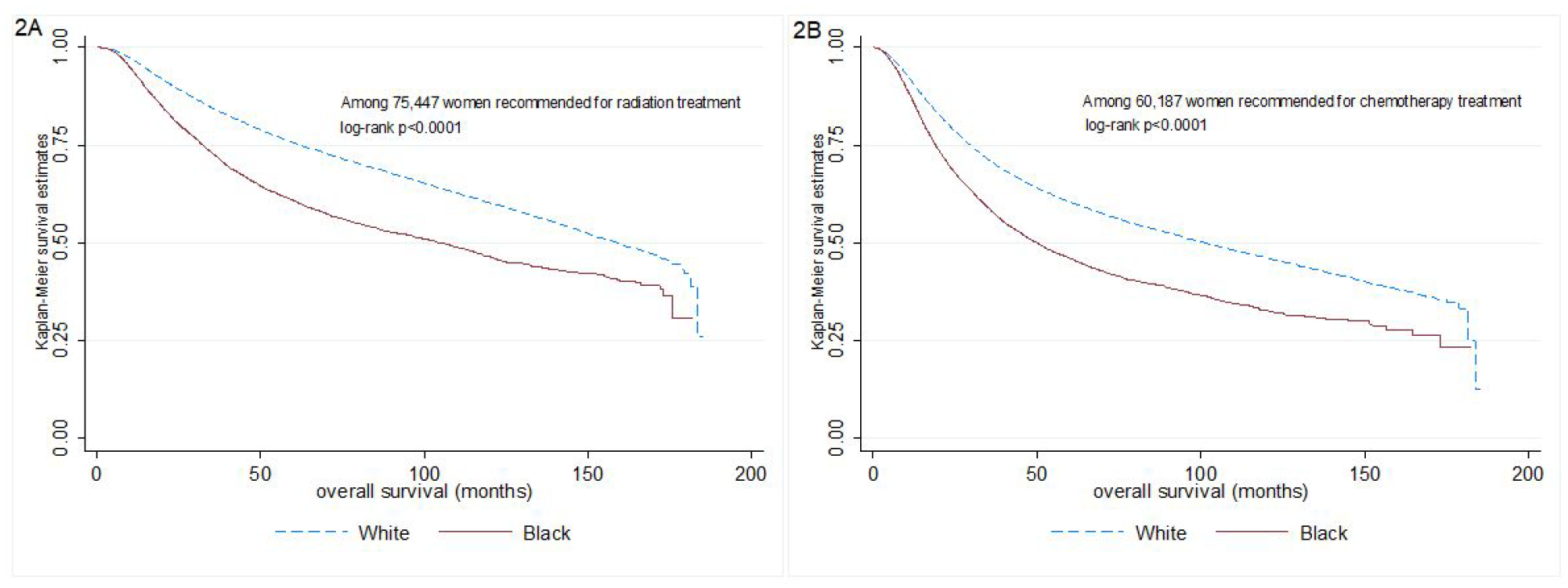
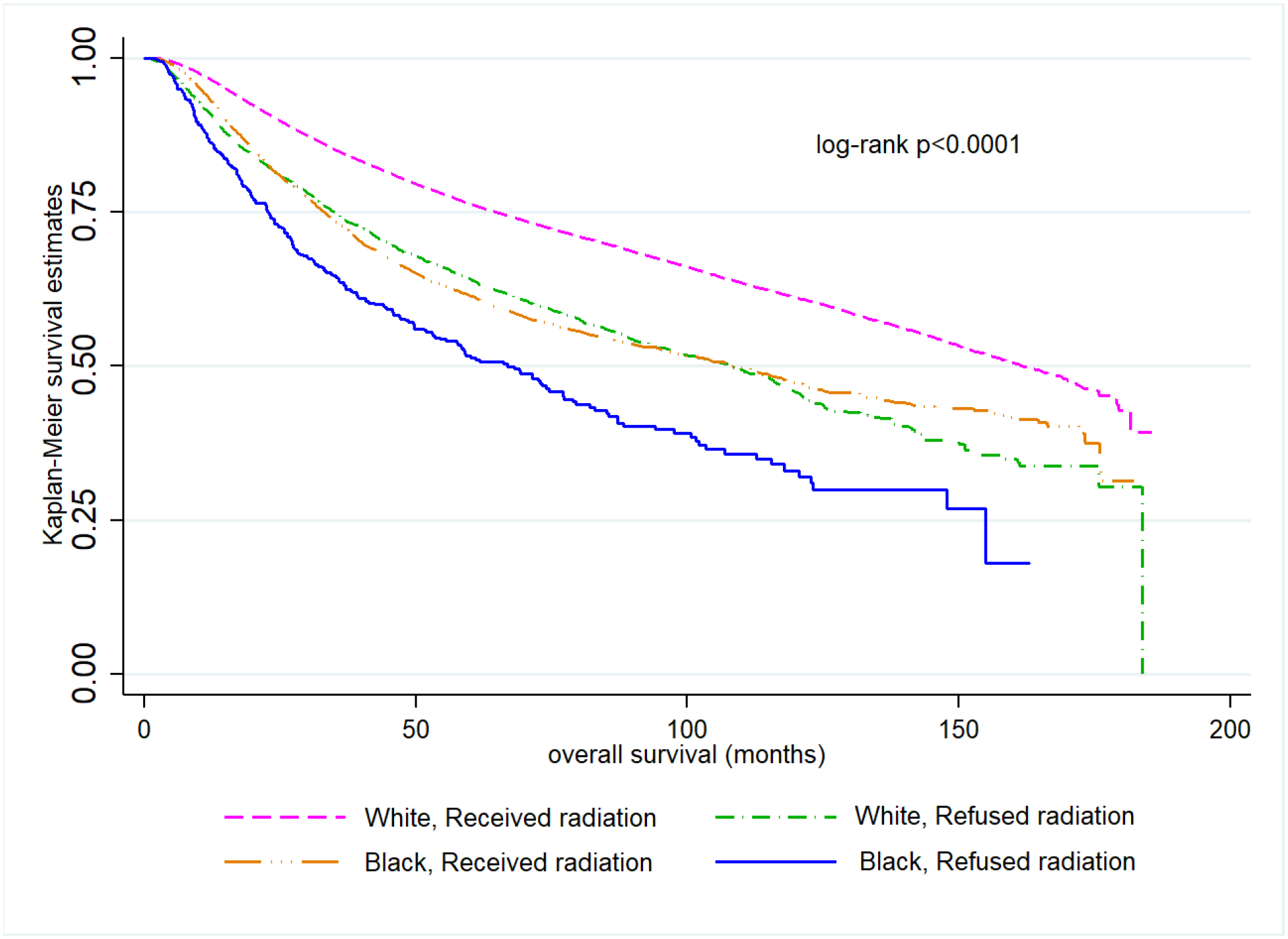
Our analysis included 75,447 endometrial cancer patients recommended to receive radiation and 60,187 endometrial cancer patients recommended to receive chemotherapy, among which 6.4% and 11.4% refused treatment, respectively. Among Black women recommended for radiation or chemotherapy, 6.4% and 9.6% refused, respectively. Among White women recommended for radiation or chemotherapy, 6.4% and 11.8% refused, respectively. After adjusting for sociodemographic variables, facility characteristics, and tumor characteristics, Black women were more likely to refuse chemotherapy than White women (adjusted odds ratio, 1.26; 95% confidence interval, 1.15-1.37), but no difference in radiation refusal was observed (adjusted odds ratio, 1.00; 95% confidence interval, 0.91-1.11). Some predictors of radiation refusal varied by race, namely income, education, histology, stage, and chemotherapy receipt (P interactions<.05), whereas predictors of chemotherapy refusal were generally similar between Black and White women. Among women recommended for radiation, Black women survived an average of 4.3 years shorter than White women, which did not seem attributable to differences in radiation refusal. Among women recommended for chemotherapy, Black women survived an average of 3.2 years shorter than White women of which 1.9 months (4.9%) could potentially be attributed to differences in chemotherapy refusal.
We observed differences in chemotherapy refusal by race, and those differences may be responsible for up to about 2 months of the overall 3.2-year survival disparity between White and Black women. Radiation refusal did not explain any of the 4.3-year disparity among women recommended for radiation. Treatment refusal accounts for, at most, a small fraction of the total racial disparity in endometrial cancer survival. Although a better understanding of the reasons for patient treatment refusal and subsequent intervention may help improve outcomes for some women, other causes of disparate outcomes, particularly those reflecting the social determinants of health, must be investigated.
黑人和白人女性在子宫内膜癌的辅助治疗方面存在差异,这导致黑人女性的预后更差。然而,导致治疗差异的因素尚未得到充分研究。
我们研究了黑人女性和白人女性是否拒绝接受辅助治疗(化疗或放疗),以及治疗拒绝是否在子宫内膜癌患者的生存中导致了种族差异。
我们使用国家癌症数据库(National Cancer Database),这是一个基于医院的癌症登记处,来确定 2004 年至 2016 年间被诊断患有子宫内膜癌的非西班牙裔黑人和非西班牙裔白人女性,她们要么接受了推荐的放疗或化疗,要么拒绝了。我们使用逻辑回归来估计种族与治疗拒绝之间的多变量调整比值比和 95%置信区间。我们还在种族特异性模型中研究了治疗拒绝的预测因素。加速失效时间模型用于估计按种族划分的总生存率的绝对差异。我们使用因果中介分析来估计种族差异在总生存率中的归因于辅助治疗拒绝的比例。我们考虑了总体研究人群和按组织学定义的分层,并调整了社会人口统计学、肿瘤和医疗机构特征。
我们的分析包括 75447 名被推荐接受放疗的子宫内膜癌患者和 60187 名被推荐接受化疗的子宫内膜癌患者,其中分别有 6.4%和 11.4%拒绝治疗。在被推荐接受放疗或化疗的黑人女性中,分别有 6.4%和 9.6%拒绝治疗。在被推荐接受放疗或化疗的白人女性中,分别有 6.4%和 11.8%拒绝治疗。在调整了社会人口统计学变量、医疗机构特征和肿瘤特征后,黑人女性比白人女性更有可能拒绝化疗(调整后的比值比,1.26;95%置信区间,1.15-1.37),但放疗拒绝率没有差异(调整后的比值比,1.00;95%置信区间,0.91-1.11)。放疗拒绝的一些预测因素因种族而异,即收入、教育、组织学、分期和化疗接受情况(P 交互<.05),而化疗拒绝的预测因素在黑人和白人女性之间通常相似。在被推荐接受放疗的女性中,黑人女性的存活时间比白人女性平均短 4.3 年,这似乎与放疗拒绝无关。在被推荐接受化疗的女性中,黑人女性的存活时间比白人女性平均短 3.2 年,其中 1.9 个月(4.9%)可能归因于化疗拒绝的差异。
我们观察到种族之间在化疗拒绝方面存在差异,这些差异可能导致白人女性和黑人女性之间的总生存差异长达 3.2 年。放疗拒绝并不能解释在被推荐接受放疗的女性中 4.3 年的差异。治疗拒绝最多只能解释子宫内膜癌生存种族差异的一小部分。尽管更好地了解患者治疗拒绝的原因及其后续干预可能有助于改善一些女性的预后,但必须调查导致不同结果的其他原因,特别是那些反映健康社会决定因素的原因。