Argunhan Fulye, Brain Susan D
Section of Vascular Biology & Inflammation, School of Cardiovascular Medicine & Research, BHF Centre of Excellence, King's College London, London, United Kingdom.
Front Physiol. 2022 Feb 25;13:833645. doi: 10.3389/fphys.2022.833645. eCollection 2022.
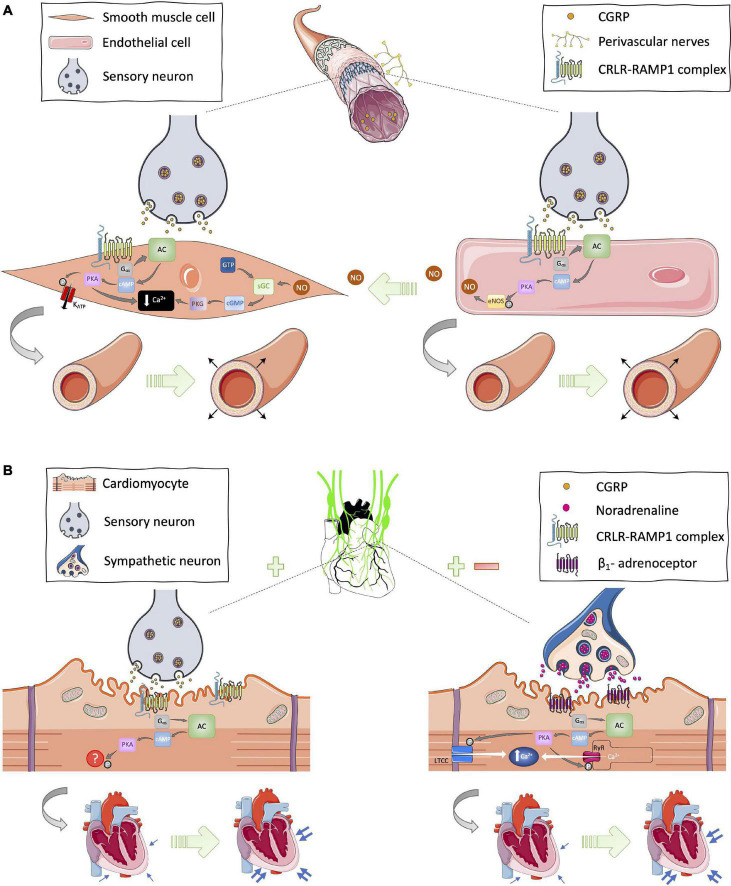
The treatment of hypertension and heart failure remains a major challenge to healthcare providers. Despite therapeutic advances, heart failure affects more than 26 million people worldwide and is increasing in prevalence due to an ageing population. Similarly, despite an improvement in blood pressure management, largely due to pharmacological interventions, hypertension remains a silent killer. This is in part due to its ability to contribute to heart failure. Development of novel therapies will likely be at the forefront of future cardiovascular studies to address these unmet needs. Calcitonin gene-related peptide (CGRP) is a 37 amino acid potent vasodilator with positive-ionotropic and -chronotropic effects. It has been reported to have beneficial effects in hypertensive and heart failure patients. Interestingly, changes in plasma CGRP concentration in patients after myocardial infarction, heart failure, and in some forms of hypertension, also support a role for CGRP on hemodynamic functions. Rodent studies have played an important role thus far in delineating mechanisms involved in CGRP-induced cardioprotection. However, due to the short plasma half-life of CGRP, these well documented beneficial effects have often proven to be acute and transient. Recent development of longer lasting CGRP agonists may therefore offer a practical solution to investigating CGRP further in cardiovascular disease . Furthermore, pre-clinical murine studies have hinted at the prospect of cardioprotective mechanisms of CGRP which is independent of its hypotensive effect. Here, we discuss past and present evidence of vascular-dependent and -independent processes by which CGRP could protect the vasculature and myocardium against cardiovascular dysfunction.
高血压和心力衰竭的治疗仍然是医疗服务提供者面临的重大挑战。尽管治疗取得了进展,但心力衰竭在全球影响着超过2600万人,并且由于人口老龄化,其患病率正在上升。同样,尽管在血压管理方面有所改善,这在很大程度上归功于药物干预,但高血压仍然是一个无声的杀手。这部分是由于它会导致心力衰竭。开发新疗法可能会成为未来心血管研究的前沿,以满足这些未满足的需求。降钙素基因相关肽(CGRP)是一种由37个氨基酸组成的强效血管扩张剂,具有正性肌力和正性变时作用。据报道,它对高血压和心力衰竭患者有有益作用。有趣的是,心肌梗死、心力衰竭患者以及某些形式的高血压患者血浆CGRP浓度的变化,也支持CGRP在血流动力学功能方面的作用。迄今为止,啮齿动物研究在阐明CGRP诱导心脏保护的机制方面发挥了重要作用。然而由于CGRP的血浆半衰期较短,这些已充分证明的有益作用往往被证明是急性和短暂的。因此,最近开发的长效CGRP激动剂可能为在心血管疾病中进一步研究CGRP提供一个切实可行的解决方案。此外,临床前小鼠研究已经暗示了CGRP心脏保护机制的前景,该机制独立于其降压作用。在此,我们讨论过去和现在的证据,这些证据表明CGRP可通过血管依赖性和非依赖性过程保护血管和心肌免受心血管功能障碍的影响。