Choi In-Su, Cardoso Domingos, de Queiroz Luciano P, de Lima Haroldo C, Lee Chaehee, Ruhlman Tracey A, Jansen Robert K, Wojciechowski Martin F
School of Life Sciences, Arizona State University, Tempe, AZ, United States.
National Institute of Science and Technology in Interdisciplinary and Transdisciplinary Studies in Ecology and Evolution (INCT IN-TREE), Instituto de Biologia, Universidade Federal da Bahia, Salvador, Brazil.
Front Plant Sci. 2022 Feb 23;13:823190. doi: 10.3389/fpls.2022.823190. eCollection 2022.
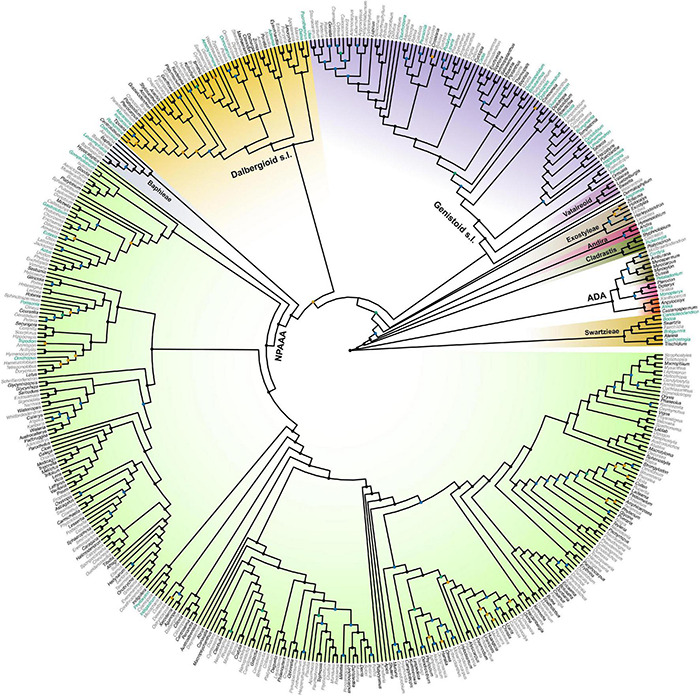
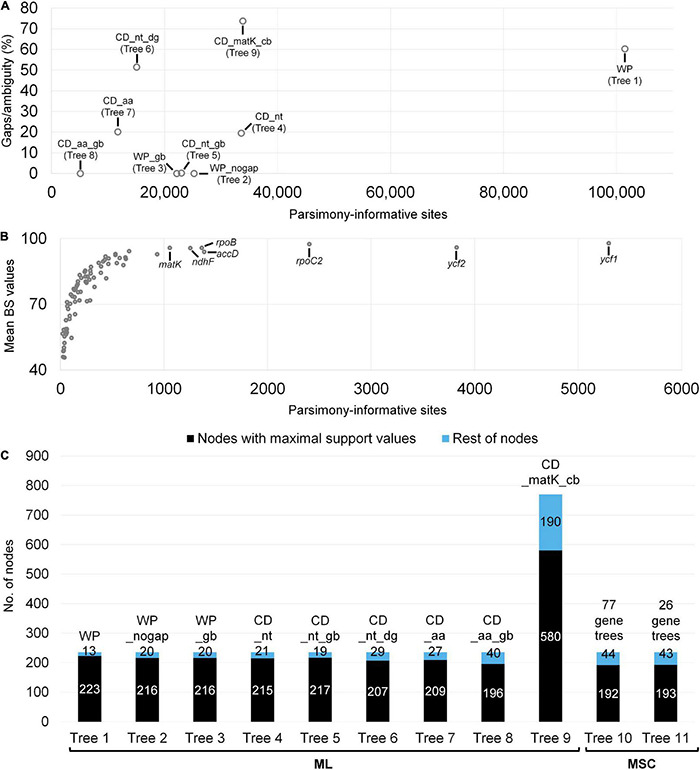
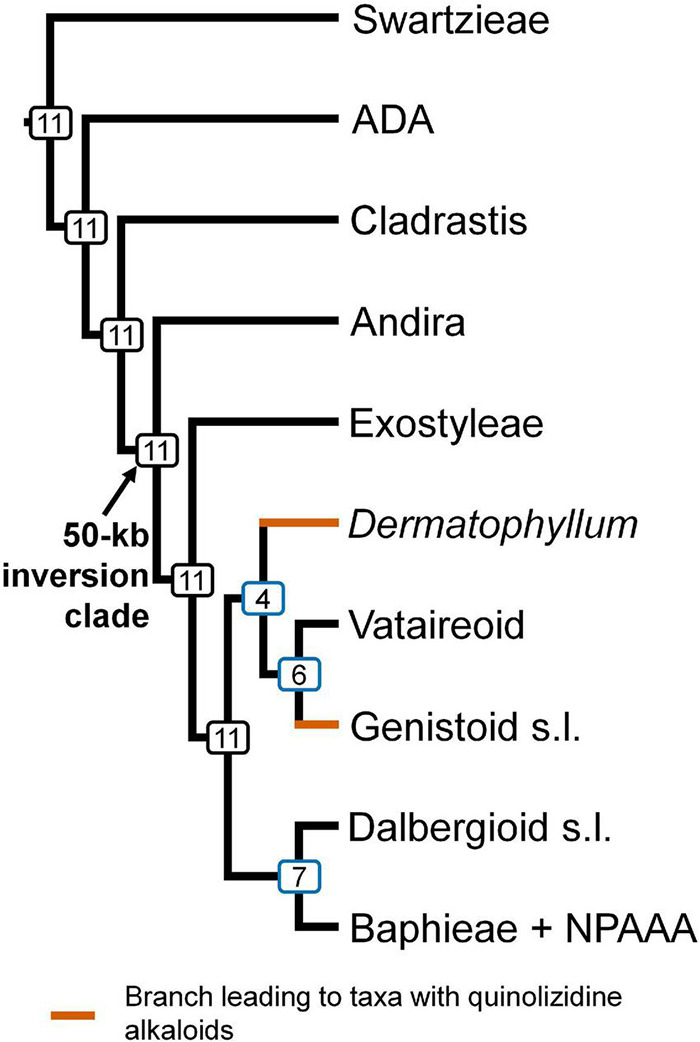
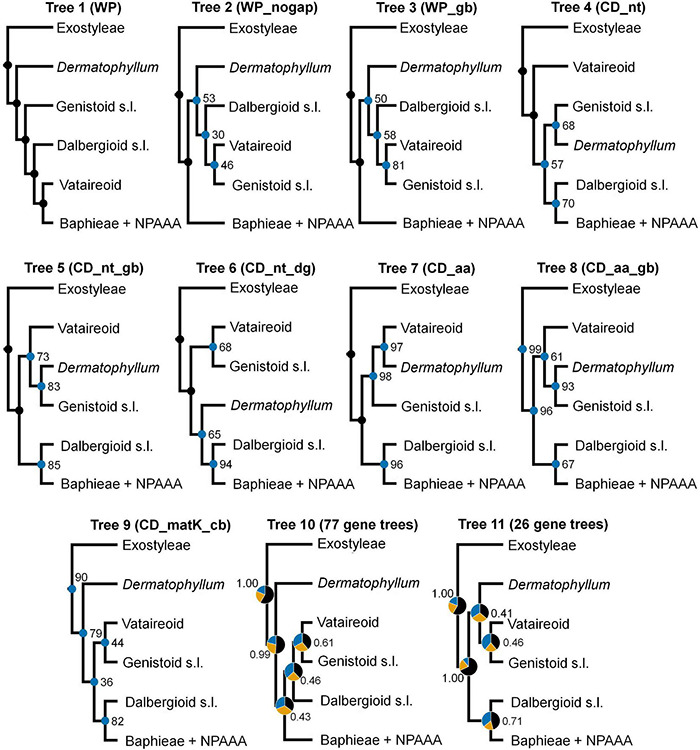
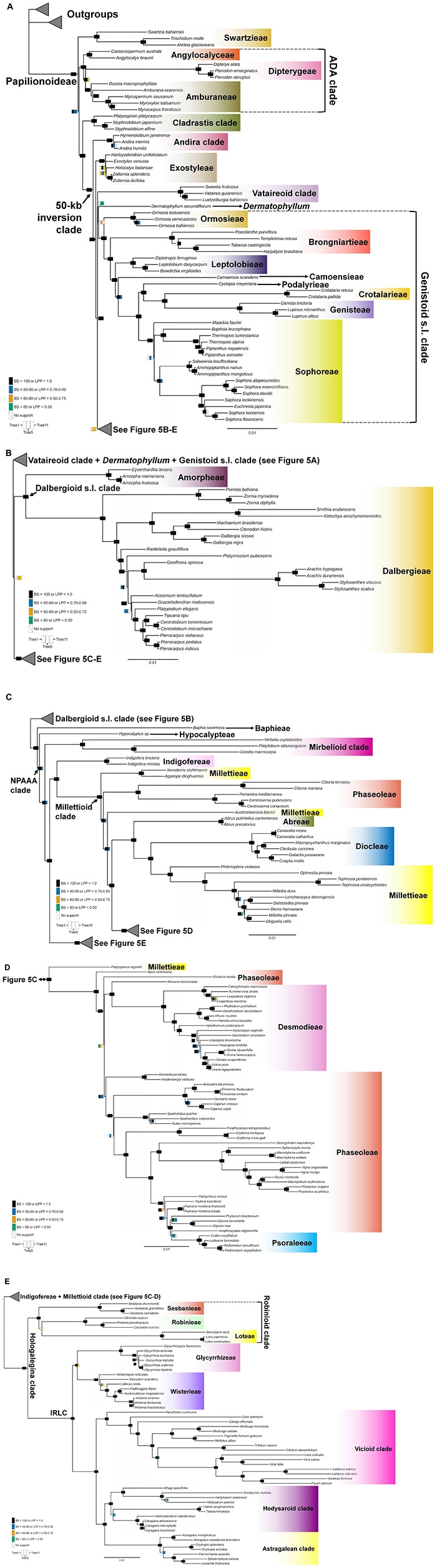
Comprising 501 genera and around 14,000 species, Papilionoideae is not only the largest subfamily of Fabaceae (Leguminosae; legumes), but also one of the most extraordinarily diverse clades among angiosperms. Papilionoids are a major source of food and forage, are ecologically successful in all major biomes, and display dramatic variation in both floral architecture and plastid genome (plastome) structure. Plastid DNA-based phylogenetic analyses have greatly improved our understanding of relationships among the major groups of Papilionoideae, yet the backbone of the subfamily phylogeny remains unresolved. In this study, we sequenced and assembled 39 new plastomes that are covering key genera representing the morphological diversity in the subfamily. From 244 total taxa, we produced eight datasets for maximum likelihood (ML) analyses based on entire plastomes and/or concatenated sequences of 77 protein-coding sequences (CDS) and two datasets for multispecies coalescent (MSC) analyses based on individual gene trees. We additionally produced a combined nucleotide dataset comprising CDS plus gene sequences only, in which most papilionoid genera were sampled. A ML tree based on the entire plastome maximally supported all of the deep and most recent divergences of papilionoids (223 out of 236 nodes). The Swartzieae, ADA (Angylocalyceae, Dipterygeae, and Amburaneae), Cladrastis, Andira, and Exostyleae clades formed a grade to the remainder of the Papilionoideae, concordant with nine ML and two MSC trees. Phylogenetic relationships among the remaining five papilionoid lineages (Vataireoid, , Genistoid s.l., Dalbergioid s.l., and Baphieae + Non-Protein Amino Acid Accumulating or NPAAA clade) remained uncertain, because of insufficient support and/or conflicting relationships among trees. Our study fully resolved most of the deep nodes of Papilionoideae, however, some relationships require further exploration. More genome-scale data and rigorous analyses are needed to disentangle phylogenetic relationships among the five remaining lineages.
蝶形花亚科包含501个属和约14000个物种,不仅是豆科(豆目;豆类)中最大的亚科,也是被子植物中极为多样的分支之一。蝶形花科植物是食物和饲料的主要来源,在所有主要生物群落中都很成功,并且在花部结构和质体基因组(质体基因组)结构上都表现出巨大的差异。基于质体DNA的系统发育分析极大地增进了我们对蝶形花亚科主要类群之间关系的理解,但该亚科系统发育的主干仍未解决。在本研究中,我们测序并组装了39个新的质体基因组,这些基因组涵盖了代表该亚科形态多样性的关键属。从总共244个分类单元中,我们基于整个质体基因组和/或77个蛋白质编码序列(CDS)的串联序列生成了8个数据集用于最大似然(ML)分析,并基于个体基因树生成了2个数据集用于多物种溯祖(MSC)分析。我们还生成了一个仅包含CDS加基因序列的组合核苷酸数据集,其中对大多数蝶形花科属进行了采样。基于整个质体基因组的ML树最大程度地支持了蝶形花科所有深层和最新的分歧(236个节点中的223个)。Swartzieae、ADA(Angylocalyceae、Dipterygeae和Amburaneae)、Cladrastis、Andira和Exostyleae分支与蝶形花亚科的其余部分形成了一个等级,这与9个ML树和2个MSC树一致。其余五个蝶形花科谱系(Vataireoid、Genistoid s.l.、Dalbergioid s.l.以及Baphieae + 非蛋白质氨基酸积累或NPAAA分支)之间的系统发育关系仍不确定,因为树之间的支持不足和/或关系冲突。我们的研究完全解决了蝶形花亚科的大多数深层节点,然而,一些关系还需要进一步探索。需要更多的基因组规模数据和严格的分析来理清其余五个谱系之间的系统发育关系。