Ahn Gyeongik, Jung In Jung, Cha Joon-Yung, Jeong Song Yi, Shin Gyeong-Im, Ji Myung Geun, Kim Min Gab, Lee Sang Yeol, Kim Woe-Yeon
Division of Applied Life Science (BK21 Four), Institute of Agricultural and Life Science, Research Institute of Life Science, Gyeongsang National University, Jinju, South Korea.
National Institute of Wildlife Disease Control and Prevention (NIWDC), Ministry of Environment, Gwangju, South Korea.
Front Plant Sci. 2022 Feb 23;13:846294. doi: 10.3389/fpls.2022.846294. eCollection 2022.
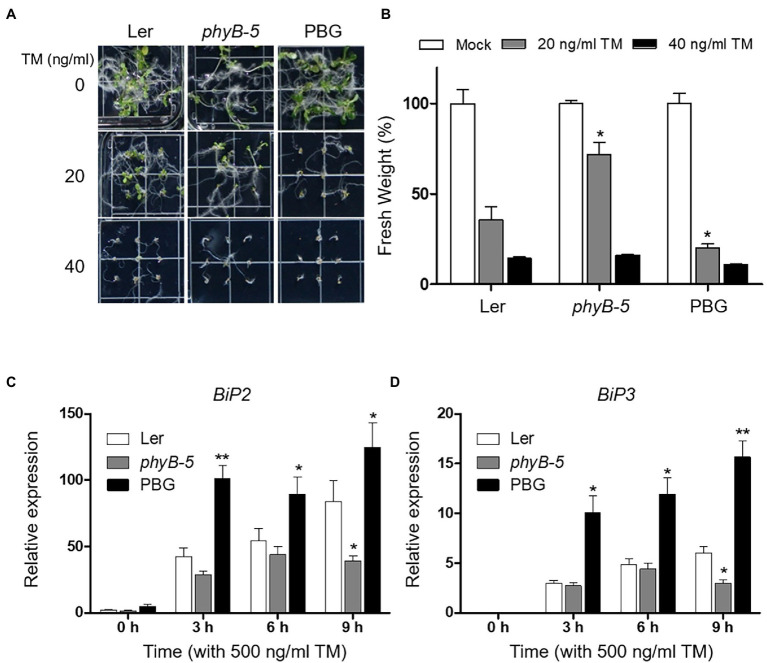
Light plays a crucial role in plant growth and development, and light signaling is integrated with various stress responses to adapt to different environmental changes. During this process, excessive protein synthesis overwhelms the protein-folding ability of the endoplasmic reticulum (ER), causing ER stress. Although crosstalk between light signaling and ER stress response has been reported in plants, the molecular mechanisms underlying this crosstalk are poorly understood. Here, we demonstrate that the photoreceptor phytochrome B (phyB) induces the expression of ER luminal protein chaperones as well as that of unfolded protein response (UPR) genes. The mutant was less sensitive to tunicamycin (TM)-induced ER stress than were the wild-type plants, whereas -overexpressing plants displayed a more sensitive phenotype under white light conditions. ER stress response genes ( and ), UPR-related bZIP transcription factors (, , and ), and programmed cell death (PCD)-associated genes (, , and ) were upregulated in -overexpressing plants, but not in , under ER stress conditions. The ER stress-sensitive phenotype of under red light conditions was eliminated with a reduction in photo-equilibrium by far-red light and darkness. The N-terminal domain of phyB is essential for signal transduction of the ER stress response in the nucleus, which is similar to light signaling. Taken together, our results suggest that phyB integrates light signaling with the UPR to relieve ER stress and maintain proper plant growth.
光在植物生长发育中起着至关重要的作用,光信号与各种胁迫反应相互整合以适应不同的环境变化。在此过程中,过量的蛋白质合成超过了内质网(ER)的蛋白质折叠能力,从而导致内质网应激。尽管植物中光信号与内质网应激反应之间的相互作用已有报道,但这种相互作用的分子机制仍知之甚少。在这里,我们证明光受体phytochrome B(phyB)诱导内质网腔蛋白伴侣以及未折叠蛋白反应(UPR)基因的表达。phyB突变体对衣霉素(TM)诱导的内质网应激的敏感性低于野生型植物,而phyB过表达植物在白光条件下表现出更敏感的表型。在内质网应激条件下,内质网应激反应基因(BiP和PDI)、UPR相关的bZIP转录因子(bZIP17、bZIP28和bZIP60)以及程序性细胞死亡(PCD)相关基因(AtCaspase3、AtCaspase6和AtCaspase7)在phyB过表达植物中上调,但在phyB突变体中未上调。通过远红光和黑暗降低光平衡,消除了phyB突变体在红光条件下的内质网应激敏感表型。phyB的N端结构域对于细胞核中内质网应激反应的信号转导至关重要,这与光信号转导类似。综上所述,我们的结果表明phyB将光信号与UPR整合以减轻内质网应激并维持植物的正常生长。